
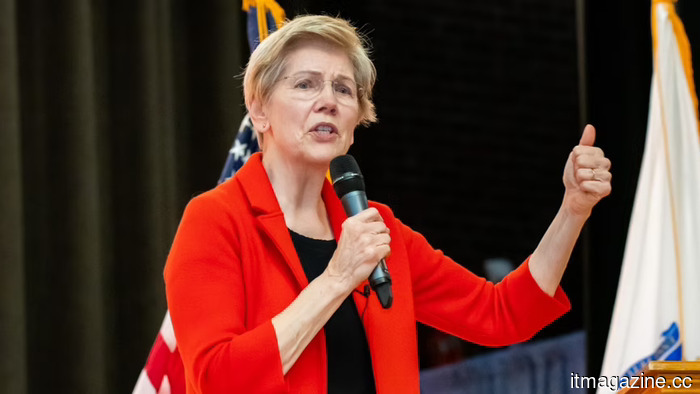
Warren claims that AI companies are utilizing trade agreements to avoid regulation.
Senator Elizabeth Warren has accused major AI companies of attempting to establish their own regulatory limitations within a trade agreement, utilizing U.S. trade policy to cement restrictions on oversight that Congress has not yet approved. This allegation, reported by Reuters on July 23, continues a battle that the Massachusetts Democrat has been engaged in for over a year.
Warren argues that Big Tech is subtly transforming contested domestic issues into trade concessions, reflecting the rationale behind the trade investigation into European Union tech regulations that lawmakers urged the administration to initiate. She highlights a particular clause rather than a headline, pointing out that several recent U.S. bilateral agreements, analyzed by the Center for Strategic and International Studies under what it refers to as a "containment doctrine," include nearly identical "non-discrimination" language. This language prohibits partners from enacting measures that "discriminate against U.S. digital services."
This phrasing is broad enough to encompass the regulations that the industry has been trying to dilute for two years: the EU's Digital Markets Act and Digital Services Act, as well as the various state AI laws that Washington has attempted to preempt. A rule that exists within a state legislature can still be contested as a trade barrier internationally.
Warren has presented variations of this argument directly to the administration. In a letter dated May 2025 addressed to Treasury Secretary Scott Bessent, Commerce Secretary Howard Lutnick, and Trade Representative Jamieson Greer, she stated that "Big Tech firms have long sought to use trade deals to undermine pro-consumer, pro-competition policies." This letter identified Apple, Amazon, Meta, and Google as contributors to the industry groups advocating for the U.S. Trade Representative to regard foreign digital regulations as obstacles.
A follow-up in March 2026, triggered by the proliferation of sexual deepfakes generated by Elon Musk’s Grok, questioned whether U.S. negotiators had pressured other nations to completely disregard content moderation laws. In that correspondence, she referenced the administration’s approach to the EU’s Digital Services Act, which U.S. officials have characterized as "overseas extortion," in conjunction with stalled discussions regarding the UK’s Online Safety Act and France’s SREN law, aimed at imposing stricter penalties for sexual deepfakes.
Warren contended that the recurring nature of content and competition regulations at the negotiation table, rather than in open rulemaking where they could be openly debated and voted on, was problematic. The industry's response has not been a direct refutation but rather a reinterpretation. The sector has consistently argued that regulations like the DMA are essentially protectionism disguised as consumer protection, inherently discriminatory and thus justifiable for a trade complaint—an argument the same companies utilized while they financed the campaign against domestic AI regulations.
The administration has supported this perspective with leverage, once threatening 100% tariffs in response to digital services taxes. The CSIS analysis indicates that this strategy has varied in effectiveness: smaller economies like Guatemala and Cambodia have entered agreements containing the restrictive clauses, while larger markets have resisted.
On the domestic front, Washington has been considering a federal standard that would supersede state AI laws, and the industry has spent months preparing to oppose those state regulations. Thus, a trade clause that impacts the same laws from abroad would provide an additional avenue for their efforts.
What Warren faces an obstacle in is making the text public. Trade negotiations typically operate with limited transparency, and she has co-sponsored legislation aimed at ensuring that deal texts are published prior to Congress granting fast-track authority, though she has yet to be successful. Without access to the text, she argues, neither lawmakers nor the public can adequately assess what has been committed.
It remains uncertain whether the accusation from July will have a different impact. Reuters reported on the allegation; however, the companies mentioned in her earlier letters have not publicly addressed it, and the U.S. Trade Representative has not responded to the specific claim. For now, it reflects one senator’s interpretation of a clause that most voters will never encounter, which is close to the essence of her argument.
Other articles
 The Pixel Watch 5 may receive an increase in memory but not much else in terms of upgrades.
A listing on the Google Play Console indicates that the Pixel Watch 5 will maintain the same Qualcomm CPU and GPU components, while boosting the memory from 2GB to 3GB.
The Pixel Watch 5 may receive an increase in memory but not much else in terms of upgrades.
A listing on the Google Play Console indicates that the Pixel Watch 5 will maintain the same Qualcomm CPU and GPU components, while boosting the memory from 2GB to 3GB.
 Dbrand's Grip cases offer excellent protection for the Galaxy Z Flip 8 and Fold 8 while maintaining a stylish appearance.
Readers of Digital Trends can take advantage of a 15% discount on dbrand’s customizable Grip cases for Samsung’s newest foldable devices by using an exclusive code until July 26.
Dbrand's Grip cases offer excellent protection for the Galaxy Z Flip 8 and Fold 8 while maintaining a stylish appearance.
Readers of Digital Trends can take advantage of a 15% discount on dbrand’s customizable Grip cases for Samsung’s newest foldable devices by using an exclusive code until July 26.
 Dbrand's Grip cases claim to offer excellent protection for the Galaxy Z Flip 8 and Fold 8 while maintaining an appealing appearance.
Readers of Digital Trends can receive a 15% discount on dbrand's customizable Grip cases for Samsung's newest foldables by using a special code valid until July 26.
Dbrand's Grip cases claim to offer excellent protection for the Galaxy Z Flip 8 and Fold 8 while maintaining an appealing appearance.
Readers of Digital Trends can receive a 15% discount on dbrand's customizable Grip cases for Samsung's newest foldables by using a special code valid until July 26.
 Valve has recently implemented a significant quality-of-life improvement for Steam wishlists and gifting.
Steam's most recent update revamps gifting and wishlists, introducing features like guest checkout and custom categories. Here’s a summary of the changes made.
Valve has recently implemented a significant quality-of-life improvement for Steam wishlists and gifting.
Steam's most recent update revamps gifting and wishlists, introducing features like guest checkout and custom categories. Here’s a summary of the changes made.
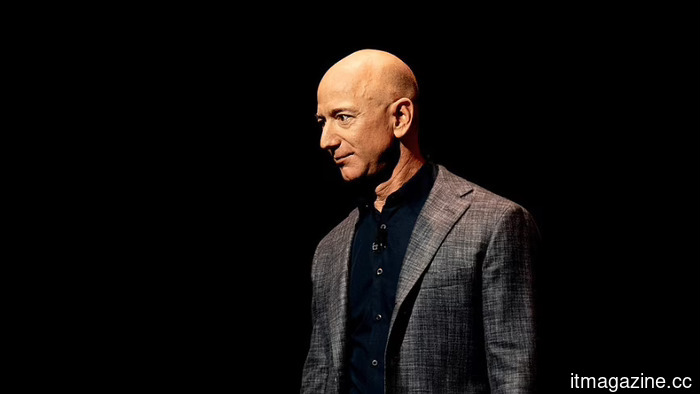 Jeff Bezos is advocating for a redesign of Prime Video with an emphasis on artificial intelligence, and studios might ultimately bear the costs.
Jeff Bezos is advocating for a redesign of Prime Video focused on AI, known as Lighthouse, which prioritizes recommendations over the advertisement slots that studios purchase.
Jeff Bezos is advocating for a redesign of Prime Video with an emphasis on artificial intelligence, and studios might ultimately bear the costs.
Jeff Bezos is advocating for a redesign of Prime Video focused on AI, known as Lighthouse, which prioritizes recommendations over the advertisement slots that studios purchase.
 Google has been fined €890 million, marking its first penalty under the Digital Markets Act.
The EU imposed a fine of €890 million on Google for search self-preferencing and restrictions in the Play Store, marking its initial penalty under the Digital Markets Act.
Google has been fined €890 million, marking its first penalty under the Digital Markets Act.
The EU imposed a fine of €890 million on Google for search self-preferencing and restrictions in the Play Store, marking its initial penalty under the Digital Markets Act.
Warren claims that AI companies are utilizing trade agreements to avoid regulation.
Senator Elizabeth Warren claims that AI companies are turning disputed regulatory issues into trade agreements that avoid public examination.