
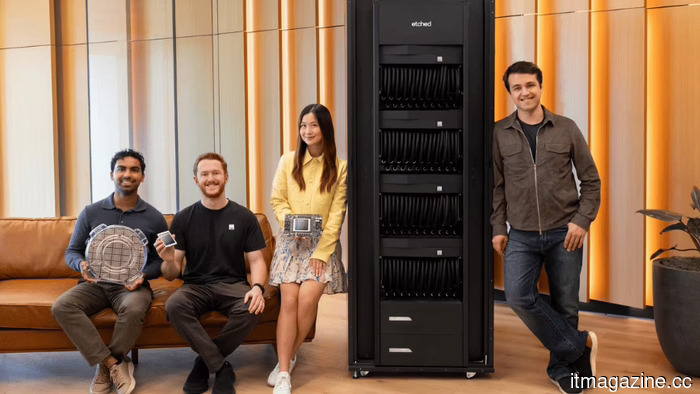
Etched secures $300M with a valuation of $10.3B, with SK Hynix participating.
Etched presents a straightforward proposition. While Nvidia manufactures chips that handle a variety of tasks, Etched specializes in inference chips and asserts that its performance is significantly superior. This past Thursday, the startup secured a substantial financial boost, raising $300 million in a Series C funding round that values the company at $10.3 billion.
Sequoia Capital took the lead in this funding round, with participation from investors such as Andreessen Horowitz, Jane Street, Diffusion, and notably, the memory production giant SK Hynix. The company claims this represents the highest valuation for a Series C round led by Sequoia to date. With this latest round, Etched has amassed over $1 billion in total funding.
What is particularly noteworthy is the rapid increase in valuation. In December, Etched was valued at $5 billion, and just seven months later, it has doubled in worth. The startup only came out of stealth mode in June, when it showcased a functional chip and announced $1 billion in confirmed orders.
Focusing on a singular task, Etched was founded on a contrarian concept. In 2022, creating a chip specifically optimized for AI models based on the transformer architecture seemed, as noted by TechCrunch’s Julie Bort, unconventional, if not outright crazy. Nonetheless, the three founders—CEO Gavin Uberti, President Rob Wachen, and Chief Technology Officer Chris Zhu—left Harvard to pursue this vision.
Overcoming prevailing skepticism, critics initially believed that Etched's systems could only support a limited number of specific models. However, Wachen contends that this viewpoint is incorrect. Their clusters are architecture-agnostic, capable of running extensive mixture-of-experts models like DeepSeek and Qwen, as well as non-transformer designs such as Mamba, which utilizes a completely different methodology.
The broader industry perspective has shifted to embrace Etched's core premise. Reports suggest that Google is integrating Gemini’s architecture into its own Frozen v2 chip. Etched’s approach no longer appears as far-fetched.
Focusing on power and memory, Etched sells complete rack-scale systems instead of individual chips. The company claims its advantage lies in two key innovations targeting different inference bottlenecks.
The first pertains to power. As AI chips increase their computational load, they tend to overheat and consequently reduce their speed. Etched operates its mathematical blocks at less than half the standard voltage, which reduces heat production. This allows for a higher transistor density and increased performance, a method they refer to as low-voltage inference.
The second innovation addresses memory. Providing a response requires substantial and speedy memory access. To address this need, Etched created a shared memory pool across an entire cluster of chips, interconnected with a proprietary high-speed link. The involvement of SK Hynix, a leading AI memory manufacturer, is no coincidence.
The next phase poses significant challenges. Etched must transition from prototype models to mass production. They have established an 80,000 square-foot facility near their San Jose headquarters and also operate a factory in Taiwan. Their workforce of 400 includes engineers drawn from Nvidia, Broadcom, Google’s TPU division, and SK Hynix.
According to Reuters, demand is exceeding supply as clients progress from testing to deployment. Uberti has been candid about the company’s next steps, stating, “Now is the time to be aggressive. Our chips work, people want them, and it’s time to ship.”
The question remains whether they can scale production to the level of Nvidia. With substantial funding and heightened expectations, the competition to make inference cheaper now includes a new, well-capitalized player, backed by a major memory manufacturer.
Other articles
 Kalanick secures $1.7 billion for Atoms, with an investment from Uber as well.
Travis Kalanick's industrial-AI venture, Atoms, has secured $1.7 billion in funding, spearheaded by a16z, with Uber, the company that removed him from his position in 2017, also contributing to the investment.
Kalanick secures $1.7 billion for Atoms, with an investment from Uber as well.
Travis Kalanick's industrial-AI venture, Atoms, has secured $1.7 billion in funding, spearheaded by a16z, with Uber, the company that removed him from his position in 2017, also contributing to the investment.
 Amazon is revamping Prime Video with increased AI features, but will it address the issues that annoy viewers?
Amazon is experimenting with a redesign of Prime Video that utilizes AI, which may lead to a shift in paid studio placements to be based on algorithm-driven rankings. This has raised concerns about whether the recommendations for viewers will genuinely enhance their experience.
Amazon is revamping Prime Video with increased AI features, but will it address the issues that annoy viewers?
Amazon is experimenting with a redesign of Prime Video that utilizes AI, which may lead to a shift in paid studio placements to be based on algorithm-driven rankings. This has raised concerns about whether the recommendations for viewers will genuinely enhance their experience.
 Four ex-DOGE employees secured $160 million at a valuation of $1.4 billion for an AI-focused military cybersecurity startup.
Cathedral, established by four former DOGE employees, secured $160 million in funding from a16z and Sequoia at a valuation of $1.4 billion. The company develops AI-based offensive and defensive cybersecurity tools for the U.S. military.
Four ex-DOGE employees secured $160 million at a valuation of $1.4 billion for an AI-focused military cybersecurity startup.
Cathedral, established by four former DOGE employees, secured $160 million in funding from a16z and Sequoia at a valuation of $1.4 billion. The company develops AI-based offensive and defensive cybersecurity tools for the U.S. military.
 Reddit might restrict Google’s access to its content due to traffic generated by AI.
Reddit's shares declined by 9% following a report that suggests it might restrict Google's access to its content for AI purposes, as AI Overviews diminish the referral traffic that publishers depend on.
Reddit might restrict Google’s access to its content due to traffic generated by AI.
Reddit's shares declined by 9% following a report that suggests it might restrict Google's access to its content for AI purposes, as AI Overviews diminish the referral traffic that publishers depend on.
 Your preferred Android applications may soon perform more effectively on foldable devices.
Google has launched new tools for Android developers, providing adaptive layout guidance and Wear OS 7 widgets to enhance app compatibility with foldable devices and wearables.
Your preferred Android applications may soon perform more effectively on foldable devices.
Google has launched new tools for Android developers, providing adaptive layout guidance and Wear OS 7 widgets to enhance app compatibility with foldable devices and wearables.
 Ultrahuman's most significant update yet replaces charts with real advice.
Ultrahuman's Emerald update revamps the app and introduces UltraSphere, a decision-making engine that transforms the data from your ring into straightforward advice, all without needing an internet connection.
Ultrahuman's most significant update yet replaces charts with real advice.
Ultrahuman's Emerald update revamps the app and introduces UltraSphere, a decision-making engine that transforms the data from your ring into straightforward advice, all without needing an internet connection.
Etched secures $300M with a valuation of $10.3B, with SK Hynix participating.
Nvidia competitor Etched has secured $300 million at a valuation of $10.3 billion, which signifies a doubling of its value in just seven months, and has attracted memory giant SK Hynix as an investor.