
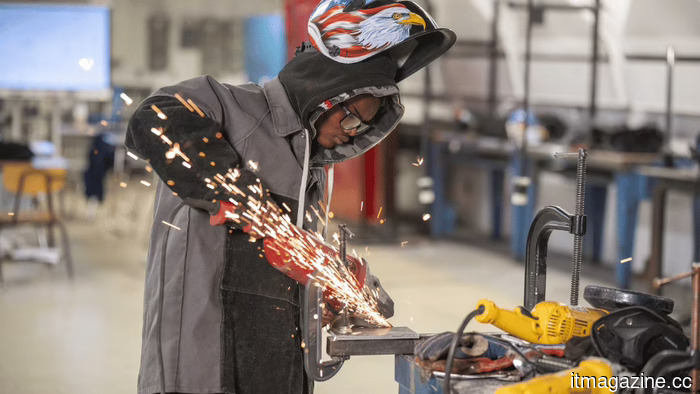
Google and Ford are investing in trading as artificial intelligence takes over office roles.
The four companies announced the Alliance for America’s Skilled Trades on Tuesday, citing a labor shortage as their primary concern. The underlying message is quite evident.
The statistics behind it
Employers are struggling to find sufficient electricians, technicians, and builders. The alliance estimates there will be 2.1 million unfilled skilled-trade positions by 2030, spanning manufacturing, infrastructure, and energy sectors. It predicts a need for an additional 130,000 electrical workers by 2030 and over 350,000 auto technicians by 2029.
The founders assert that they have already supported skilled workforce programs in 30 states, and this new group aims to consolidate those efforts.
What it aims to achieve
According to the companies, the plan consists of three main components: creating awareness campaigns to build a talent pipeline and establish clearer entry pathways; expanding apprenticeships and pre-apprenticeships, supported by a data report in collaboration with Burning Glass and Jobs for the Future; and enhancing partnerships with unions, colleges, and non-profits.
In an article for Fortune, the four founders positioned the initiative as a means of constructing America's future rather than merely filling vacancies. Ford, for instance, requires technicians, as does an increasing number of other companies.
The irony at play
The companies involved tell an intriguing story. Google’s AI technologies are assisting firms in reducing their white-collar workforce, a change that has faced resistance from its employees. JPMorgan’s CEO notes that AI has already resulted in a 30 to 40% job reduction in certain sectors. Additionally, Verizon is eliminating 3,000 retail jobs.
However, Google also stands as one of the largest developers of data centers and thus requires tradespeople for their construction. Ruth Porat, Alphabet and Google’s president and chief investment officer, emphasized that building the necessary physical infrastructure "requires significantly increasing the pipeline of skilled tradespeople."
In contrast, skilled trades appear to be secure. No machine can wire a house, scale a pylon, or repair a transmission line. While a degree paired with AI is valuable, there will always be a need for individuals to physically construct the world.
The complication
Delving into the details reveals growing tension. The AI boom is not only vying for attention with the trades; it is also competing for the workers themselves. Each data center, substation, and power line that the industry is eager to build requires the very electricians and technicians who are already in short supply.
Moreover, the alliance is voluntary and lacks a specified funding amount, and awareness campaigns have had varying degrees of success. Nonetheless, the shortage is tangible, and funding for apprenticeships is substantial. Interestingly, it is the same companies whose technologies are transforming the workplace that are now investing in jobs that technology cannot replace.
Other articles
 Big Tech's expenditure on AI is beginning to align with its cash flow.
The total capital expenditure on AI by the largest cloud companies is expected to surpass the cash generated by their main operations, with free cash flow being impacted first.
Big Tech's expenditure on AI is beginning to align with its cash flow.
The total capital expenditure on AI by the largest cloud companies is expected to surpass the cash generated by their main operations, with free cash flow being impacted first.
 Apple is said to be collaborating with Klarna to allow customers to pay for new devices in installments.
Apple is said to be launching a new financing initiative named Apple Upgrade in collaboration with Klarna later this month.
Apple is said to be collaborating with Klarna to allow customers to pay for new devices in installments.
Apple is said to be launching a new financing initiative named Apple Upgrade in collaboration with Klarna later this month.
 Apple has resolved an issue with the Hide My Email feature that revealed users' actual email addresses.
A vulnerability in Hide My Email revealed actual addresses through returned spam messages for more than a year before Apple fixed it, just days after it became public knowledge.
Apple has resolved an issue with the Hide My Email feature that revealed users' actual email addresses.
A vulnerability in Hide My Email revealed actual addresses through returned spam messages for more than a year before Apple fixed it, just days after it became public knowledge.
 Samsung's offer of doubling free storage for preorders has ended in Austria, and the new promotion isn't as appealing.
Samsung's traditional pre-order benefit of offering double storage at no extra cost has been removed for Austria, now substituted with discounted upgrades for the Galaxy Z Fold 8 and Z Flip 8.
Samsung's offer of doubling free storage for preorders has ended in Austria, and the new promotion isn't as appealing.
Samsung's traditional pre-order benefit of offering double storage at no extra cost has been removed for Austria, now substituted with discounted upgrades for the Galaxy Z Fold 8 and Z Flip 8.
 ONS: AI adoption in the UK has tripled since 2023, yet the integration has barely advanced.
The adoption of AI in UK businesses increased from 12% to 35% since 2023, yet the typical user utilizes only 1.6 tools. According to Scott Pope from Nexthink, the issue lies within the organizational culture.
ONS: AI adoption in the UK has tripled since 2023, yet the integration has barely advanced.
The adoption of AI in UK businesses increased from 12% to 35% since 2023, yet the typical user utilizes only 1.6 tools. According to Scott Pope from Nexthink, the issue lies within the organizational culture.
 The University of Tennessee is filing a lawsuit against Anthropic regarding patents related to neural networks.
The University of Tennessee has filed a lawsuit against Anthropic in Delaware concerning two neural network patents, marking what is believed to be the first patent lawsuit involving the company.
The University of Tennessee is filing a lawsuit against Anthropic regarding patents related to neural networks.
The University of Tennessee has filed a lawsuit against Anthropic in Delaware concerning two neural network patents, marking what is believed to be the first patent lawsuit involving the company.
Google and Ford are investing in trading as artificial intelligence takes over office roles.
Google, Ford, Carhartt, and BlackRock have formed a partnership aimed at filling 2.1 million skilled-trade positions by 2030, focusing on jobs that cannot be automated by AI.