
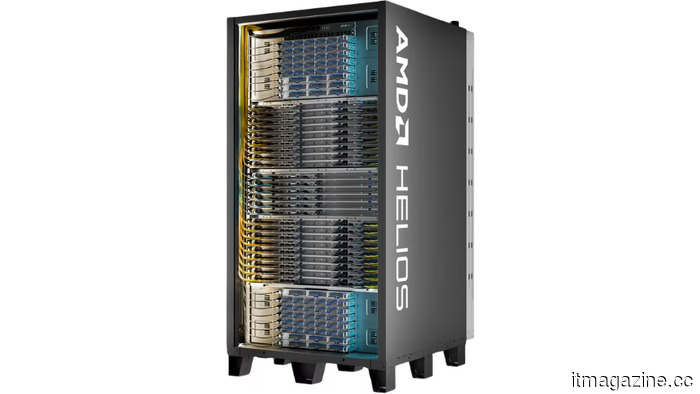
AMD's Helios combines 72 GPUs and 31 terabytes of HBM4 within a single rack. This is AMD's response to Nvidia's NVL72.
**TL;DR**: AMD Helios features 72 MI455X GPUs, 31TB of HBM4, and achieves 2.9 exaflops of inference within a single rack. It is based on open standards. Engineering samples are expected in H2 2026, with mass production starting in Q2 2027.
AMD’s Helios is a rack that houses 72 Instinct MI455X GPUs, 31 terabytes of HBM4 memory, and delivers 2.9 exaflops of FP4 inference computing power. This marks AMD’s inaugural rack-scale AI system, positioned directly against Nvidia’s Vera Rubin NVL72. The setup includes 18 compute trays, each hosting four MI455X accelerators built on the new CDNA 5 architecture, along with one sixth-generation EPYC “Venice” CPU. Engineering samples are set to be released in the latter half of 2026, with mass production commencing in Q2 2027.
The architecture prioritizes open standards. Helios employs UALink for scale-up interconnects among GPUs within the rack, adheres to Ultra Ethernet Consortium standards for networking among racks, and utilizes the OCP Open Rack Wide form factor. In contrast, Nvidia’s NVL72 relies on proprietary NVLink technology. AMD anticipates that data center operators looking to avoid vendor lock-in will value this flexibility. Networking is managed by AMD Pensando AI NICs, which feature programmable hardware and UEC-ready RDMA.
The specifications aim to compete not just on processing power but also on memory capacity. Each MI455X GPU is equipped with HBM4 offering 19.6 TB/s of bandwidth, resulting in a full rack capable of providing 260 TB/s of scale-up bandwidth and 43 TB/s of scale-out bandwidth. This memory capacity is crucial for training frontier models and facilitating long-context inferences, where the challenge has increasingly shifted from sheer computational power to the volume of data the system can manage and transfer. The growing demand for memory driven by AI has significantly increased HBM prices, and the presence of 31TB of HBM4 in a single rack reflects a substantial material cost that only companies with vast resources or sovereign computing budgets can accommodate.
The latest updates from the EU tech landscape, an insightful story from our founder Boris, and some dubious AI-generated art. It’s free and delivered weekly to your inbox. Sign up now! Supermicro showcased Helios hardware at Computex in June. Additionally, AMD announced significant investments in UK AI infrastructure during London Tech Week, with Helios being the hardware underpinning those commitments. The ROCm software suite is compatible with PyTorch, TensorFlow, and JAX, meaning developers theoretically won’t need to rewrite code when transitioning from Nvidia’s CUDA ecosystem. The pivotal question is whether AMD can bridge the software gap that has historically placed it behind Nvidia in AI computing. The hardware specifications are competitive, but the success of the ecosystem remains to be seen.
Other articles
 AI in Hollywood: The Dispute Between Netflix, Nolan, and Payment Responsibilities
Netflix utilized AI in 300 productions, an AI actress secured a leading role, and Nolan referred to it as a Trojan horse. Exploring the battle regarding AI in Hollywood.
AI in Hollywood: The Dispute Between Netflix, Nolan, and Payment Responsibilities
Netflix utilized AI in 300 productions, an AI actress secured a leading role, and Nolan referred to it as a Trojan horse. Exploring the battle regarding AI in Hollywood.
 AI in Hollywood: The Dispute over Payments Involving Netflix, Nolan, and Others
Netflix has utilized AI across 300 titles, an AI-generated actress has secured a leading role, and Nolan referred to it as a Trojan horse. Here’s a look at the battle over AI in Hollywood.
AI in Hollywood: The Dispute over Payments Involving Netflix, Nolan, and Others
Netflix has utilized AI across 300 titles, an AI-generated actress has secured a leading role, and Nolan referred to it as a Trojan horse. Here’s a look at the battle over AI in Hollywood.
 Z.AI constructed a large AI data center utilizing chips produced in China.
The Chinese lab Z.AI has successfully established a 1GW data center that operates exclusively on domestically produced chips to train its GLM models, without using any Nvidia components. This development indicates significant implications for the AI landscape.
Z.AI constructed a large AI data center utilizing chips produced in China.
The Chinese lab Z.AI has successfully established a 1GW data center that operates exclusively on domestically produced chips to train its GLM models, without using any Nvidia components. This development indicates significant implications for the AI landscape.
 Z.AI constructed a large AI data center utilizing chips manufactured in China.
The Chinese laboratory Z.AI has finished constructing a 1GW data center that exclusively utilizes chips produced in China to train its GLM models, entirely without Nvidia components. This development indicates certain implications for the AI sector.
Z.AI constructed a large AI data center utilizing chips manufactured in China.
The Chinese laboratory Z.AI has finished constructing a 1GW data center that exclusively utilizes chips produced in China to train its GLM models, entirely without Nvidia components. This development indicates certain implications for the AI sector.
 A new AI model aims to make self-driving cars think carefully before making a sudden turn.
A team from Seoul National University developed an AI that evaluates the safety decisions of self-driving cars in real-time, and it recently received a noteworthy highlight paper recognition at CVPR.
A new AI model aims to make self-driving cars think carefully before making a sudden turn.
A team from Seoul National University developed an AI that evaluates the safety decisions of self-driving cars in real-time, and it recently received a noteworthy highlight paper recognition at CVPR.
 The old internet created a museum for fading technological sounds, and somehow it continues to exist.
This charmingly nostalgic online museum archives dial-up modems, floppy disks, Windows startup sounds, and other audio that gradually vanished as our devices became sleeker, quicker, and far less vocal.
The old internet created a museum for fading technological sounds, and somehow it continues to exist.
This charmingly nostalgic online museum archives dial-up modems, floppy disks, Windows startup sounds, and other audio that gradually vanished as our devices became sleeker, quicker, and far less vocal.
AMD's Helios combines 72 GPUs and 31 terabytes of HBM4 within a single rack. This is AMD's response to Nvidia's NVL72.
The AMD Helios features 72 MI455X GPUs, 31TB of HBM4, and delivers 2.9 exaflops of inference processing within a single rack. Engineering samples are expected to ship in the second half of 2026, with mass production set for the second quarter of 2027.