

Z.AI constructed a large AI data center utilizing chips produced in China.
For a year, a significant question has lingered regarding China's rapidly advancing AI models: what infrastructure are they utilizing? Z.AI has partially answered this by establishing a large data center that exclusively utilizes Chinese-made chips.
The company, previously known as Zhipu, has begun partial operations at this site, according to a report from Bloomberg, citing sources with knowledge of the situation. The center is designed as a 1-gigawatt hub for training Z.AI's GLM models. Z.AI did not provide a comment when approached.
What has been constructed
The scale of this facility is noteworthy. A gigawatt is approximately equivalent to the electricity consumption of 750,000 homes at any given time, placing this site among the largest server hubs constructed by any Chinese AI organization.
The quantity of chips is also impressive. Z.AI currently operates multiple computing clusters, each containing over 10,000 chips, as per the source. Importantly, none of these chips are from Nvidia.
Bloomberg did not disclose the specific types of chips involved. Huawei, China's leading AI accelerator designer, competes with local companies like Cambricon and Alibaba in an effort to catch up with Nvidia.
Why this is significant
U.S. export restrictions have prevented Chinese labs from acquiring Nvidia's most advanced chips. The key question was whether domestically produced components could handle the demands for training cutting-edge models, rather than just operating them.
A 1GW cluster built entirely with homegrown silicon provides a concrete answer to that issue. It indicates that Chinese labs are capable of continuing their expansion even while being barred from the chips that the broader industry considers standard.
The timing adds to its significance. This announcement comes shortly after Moonshot's Kimi K3, based in Beijing, matched the capabilities of top U.S. models, but then faced limitations in computing power and halted new registrations. Z.AI is in competition with the same rivals, placing its bet on owning the infrastructure.
The broader development
Z.AI is not undertaking this project in isolation. China plans to invest approximately 2 trillion yuan (around $295 billion) over five years to develop data centers nationwide. Cloud giants like Alibaba and China Telecom are currently the leading builders.
Additionally, Z.AI has the financial resources to compete effectively. Following a Hong Kong listing and a subsequent share sale, Z.AI is on track to achieve $1 billion in annual recurring revenue, making it the first Chinese AI company to reach that milestone. Its stock surged nearly 20% on the announcement day.
The company aims to position itself as a supplier of enterprise AI, drawing comparisons to Anthropic.
The caveats
However, there are some caveats to consider. The information about the chips comes from an unidentified source, and Z.AI has yet to verify it. Constructing the cluster does not equate to confirming that it can train a cutting-edge model with the same efficiency as those built using Nvidia's technology.
Domestic chips may still fall short in terms of raw performance, and integrating thousands of them into a cohesive system poses challenges. The true test will come with the next GLM model and its comparison to products from U.S. labs.
Nevertheless, the trajectory is clearly evident. The initiative to establish a Chinese alternative to Nvidia has transitioned from conceptual plans to a functional, gigawatt-scale data center. This shift alone alters the discussion surrounding the limitations imposed by export controls.
Other articles
 Google Frozen chip: Gemini embedded in the silicon.
A report indicates that the Google Frozen chip will integrate Gemini directly into silicon, potentially achieving up to 10 times efficiency by 2028. This development could have significant implications for AI.
Google Frozen chip: Gemini embedded in the silicon.
A report indicates that the Google Frozen chip will integrate Gemini directly into silicon, potentially achieving up to 10 times efficiency by 2028. This development could have significant implications for AI.
 A new AI model aims for self-driving cars to think carefully before making a sudden swerve.
A team from Seoul National University developed an AI that evaluates the safety decisions of self-driving cars in real time, and it has recently received a prestigious highlight paper recognition at CVPR.
A new AI model aims for self-driving cars to think carefully before making a sudden swerve.
A team from Seoul National University developed an AI that evaluates the safety decisions of self-driving cars in real time, and it has recently received a prestigious highlight paper recognition at CVPR.
 The old internet created a museum for fading technological sounds, and somehow it continues to exist.
This charmingly nostalgic online museum archives dial-up modems, floppy disks, Windows startup sounds, and other audio that gradually vanished as our devices became sleeker, quicker, and far less vocal.
The old internet created a museum for fading technological sounds, and somehow it continues to exist.
This charmingly nostalgic online museum archives dial-up modems, floppy disks, Windows startup sounds, and other audio that gradually vanished as our devices became sleeker, quicker, and far less vocal.
 This Mac application can transform any window into a CRT-inspired surreal experience or evoke the nostalgia of a Game Boy.
Glaze 1.9 employs real-time GPU shaders to enhance every Mac window, video, and game, offering more than 50 different appearances for a one-time cost of $9.99.
This Mac application can transform any window into a CRT-inspired surreal experience or evoke the nostalgia of a Game Boy.
Glaze 1.9 employs real-time GPU shaders to enhance every Mac window, video, and game, offering more than 50 different appearances for a one-time cost of $9.99.
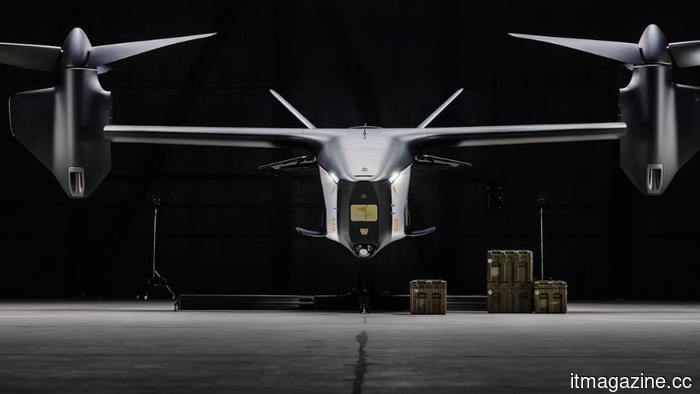 Anduril and Archer revealed an autonomous attack rotorcraft developed from air taxi technology. The initial flight is scheduled for 2027.
Anduril and Archer unveiled Thunder at Farnborough, a Group 5 autonomous attack VTOL constructed on a dual-use platform. It features hybrid-electric propulsion and tiltrotors.
Anduril and Archer revealed an autonomous attack rotorcraft developed from air taxi technology. The initial flight is scheduled for 2027.
Anduril and Archer unveiled Thunder at Farnborough, a Group 5 autonomous attack VTOL constructed on a dual-use platform. It features hybrid-electric propulsion and tiltrotors.
 Microsoft aims to prevent screenshot leaks, addressing the issue one Edge tab at a time.
Microsoft is addressing a security vulnerability that enabled sensitive PDFs to be intercepted within web browsers. However, this protection is initially available only for Edge users with an enterprise account.
Microsoft aims to prevent screenshot leaks, addressing the issue one Edge tab at a time.
Microsoft is addressing a security vulnerability that enabled sensitive PDFs to be intercepted within web browsers. However, this protection is initially available only for Edge users with an enterprise account.
Z.AI constructed a large AI data center utilizing chips produced in China.
The Chinese lab Z.AI has successfully established a 1GW data center that operates exclusively on domestically produced chips to train its GLM models, without using any Nvidia components. This development indicates significant implications for the AI landscape.