

AI in Hollywood: The Dispute Between Netflix, Nolan, and Payment Responsibilities
The dispute over AI in Hollywood used to focus on the future, but this month it shifted to the present. Within a few days, a studio, a director, and a union each established their positions, which do not align. Collectively, these actions reveal an industry that has already embraced the technology, now merely debating the terms of its use.
The director's caution
Christopher Nolan is not one to engage in exaggeration. His latest adaptation of “The Odyssey” is leading the box office and is also the first feature completely filmed on Imax. Thus, when he speaks about technology, Hollywood pays attention. When interviewer Hugo Travers asked if AI could be a contemporary Trojan horse, Nolan chuckled, stating, “I think AI is a Trojan horse that everybody knows the Greeks are inside,” according to TechCrunch. He described it as “a transparent horse, it’s made of glass.”
Nolan noted the public sentiment, remarking, “I’ve never seen a technology advancing so rapidly so completely rejected by the public.” He highlighted the youth who easily dismiss AI as subpar, calling it a healthy skepticism. As the president of the Directors Guild of America—which secured AI protections in its recent contract—he has reason to appreciate this sentiment.
The studio's revelation
Nolan's caution coincided with a more straightforward revelation. In its second-quarter earnings report, Netflix disclosed a surprising statistic: generative AI influenced approximately 300 of its films and shows this year. The company portrayed these tools as beneficial to creators, accelerating effects and pre-production tasks. According to Variety, this number encompasses titles across its 2026 lineup, not limited to a few experiments.
For many viewers, the mere figure was startling. The subtlety of its impact is significant; AI didn’t emerge with a single hit but infiltrated numerous productions while the credits remained unchanged. Netflix has been strengthening this capability, having acquired an AI film startup earlier in the year.
The non-existent actress
Then there was the introduction of the performer. In early July, the UK studio Particle6 announced its plan to feature an AI-generated “actress,” Tilly Norwood, as the star of a film titled “Misaligned,” where she fittingly plays an AI.
SAG-AFTRA, the American performers' union, dismissed this development. In a statement, it asserted that Norwood “is not an actor.” She was produced by a software trained on numerous performers “without permission or compensation.” The union's stance emphasized that creativity should focus on human involvement.
The theme of consent recurs repeatedly. SAG-AFTRA has also advised its members to opt out of Meta’s Muse imaging tool, which could convert public photographs into AI-generated images. This mirrors the music industry’s struggle with AI models that learn from artists who never consented to such use.
The payment debate
Beneath the cultural conflict lies a financial question: if a studio employs a synthetic performer instead of a human, should they compensate for that choice?
SAG-AFTRA believes they should. The union has proposed a “Tilly Tax,” requiring studios to pay a royalty into a union fund whenever they opt for an AI actor instead of a real one. Studios are opposed, arguing that an entirely fictional character is different from a digital replica of an actual person.
The implications are greatest in animation. A study by CVL Economics estimated that generative AI could eliminate or absorb around 118,500 jobs in US film, television, and animation by 2026—more than a fifth of the workforce. Jeffrey Katzenberg, co-founder of DreamWorks, has been even more drastic in his prediction, stating that AI could eliminate 90% of animation artist jobs.
The unions are firmly positioning themselves. The Animation Guild has secured contract language compelling studios to negotiate over AI’s effects, while SAG-AFTRA’s 2026 agreement includes numerous AI stipulations. The broader apprehension about AI and job security is particularly pronounced in animation, where the craft and the paycheck are intertwined.
The true conflict
Connecting the events from the week reveals a pattern: the technology is already integrated into the industry. The debate has shifted from whether to use AI to who approves its use and who benefits from it.
This is why Nolan’s analogy is fitting—A Trojan horse is only effective if brought inside willingly, and Hollywood has already done so with 300 Netflix projects and an AI character in the spotlight.
The subsequent developments will be determined by contractual negotiations, not screenplays. Can human performers maintain their involvement and share in the profits? This is the pressing question the industry can no longer ignore. As Nolan cautioned, the situation requires a critical perspective. Everyone can see what lies within.
Other articles
 Security of AI agents: four July attacks linked by a common vulnerability.
Over the course of ten days, four research teams exploited AI agents in four different methods, ranging from Claude for Chrome to memory poisoning. Here's an explanation of the security vulnerabilities in AI agents.
Security of AI agents: four July attacks linked by a common vulnerability.
Over the course of ten days, four research teams exploited AI agents in four different methods, ranging from Claude for Chrome to memory poisoning. Here's an explanation of the security vulnerabilities in AI agents.
 Google Frozen chip: Gemini integrated into the silicon.
A report indicates that the Google Frozen chip will integrate Gemini directly into silicon, achieving up to 10 times the efficiency by 2028. This has implications for AI.
Google Frozen chip: Gemini integrated into the silicon.
A report indicates that the Google Frozen chip will integrate Gemini directly into silicon, achieving up to 10 times the efficiency by 2028. This has implications for AI.
 Z.AI constructed a large AI data center utilizing chips manufactured in China.
The Chinese company Z.AI has finished constructing a 1GW data center that operates exclusively on domestically produced chips to train its GLM models, entirely devoid of Nvidia components. This development indicates potential implications for the field of AI.
Z.AI constructed a large AI data center utilizing chips manufactured in China.
The Chinese company Z.AI has finished constructing a 1GW data center that operates exclusively on domestically produced chips to train its GLM models, entirely devoid of Nvidia components. This development indicates potential implications for the field of AI.
 A temporary restraining order has halted the merger between Paramount and Warner Bros. just one day prior to its completion.
A judge in California has issued a temporary restraining order on the Paramount-WBD agreement following state attorneys general presenting "compelling evidence" of market concentration. A ticking fee of $650 million per quarter is approaching.
A temporary restraining order has halted the merger between Paramount and Warner Bros. just one day prior to its completion.
A judge in California has issued a temporary restraining order on the Paramount-WBD agreement following state attorneys general presenting "compelling evidence" of market concentration. A ticking fee of $650 million per quarter is approaching.
 Z.AI constructed a large AI data center utilizing chips manufactured in China.
The Chinese laboratory Z.AI has finished constructing a 1GW data center that exclusively utilizes chips produced in China to train its GLM models, entirely without Nvidia components. This development indicates certain implications for the AI sector.
Z.AI constructed a large AI data center utilizing chips manufactured in China.
The Chinese laboratory Z.AI has finished constructing a 1GW data center that exclusively utilizes chips produced in China to train its GLM models, entirely without Nvidia components. This development indicates certain implications for the AI sector.
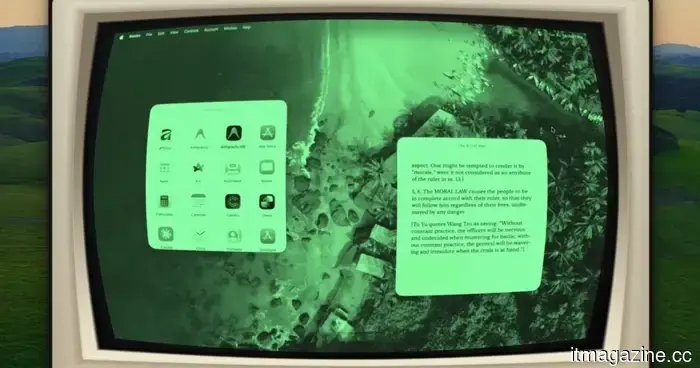 This Mac application can transform any window into a CRT fever dream or a reminiscent Game Boy experience.
Glaze 1.9 employs real-time GPU shaders to enhance every Mac window, video, and game, offering more than 50 styles for a one-time cost of $9.99.
This Mac application can transform any window into a CRT fever dream or a reminiscent Game Boy experience.
Glaze 1.9 employs real-time GPU shaders to enhance every Mac window, video, and game, offering more than 50 styles for a one-time cost of $9.99.
AI in Hollywood: The Dispute Between Netflix, Nolan, and Payment Responsibilities
Netflix utilized AI in 300 productions, an AI actress secured a leading role, and Nolan referred to it as a Trojan horse. Exploring the battle regarding AI in Hollywood.