
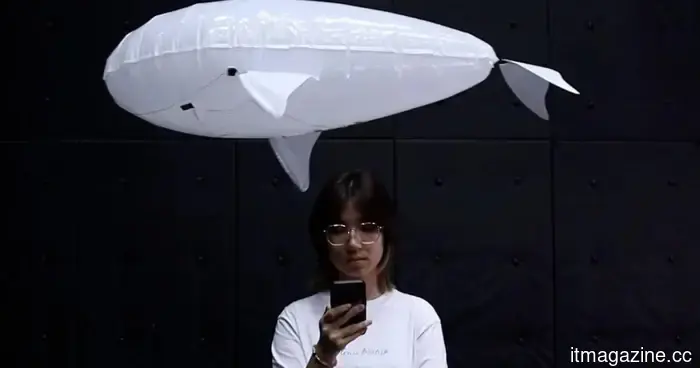
This hovering AI robot appears as if it has come straight out of a Studio Ghibli movie, and that’s precisely the intention.
Today’s home robots typically share common characteristics: they tend to be noisy, rigid, and clearly mechanical. Whether it's a vacuum cleaner colliding with furniture or a drone hovering overhead, they are designed primarily to execute tasks rather than create a comfortable environment for people. However, researchers in Japan propose a different approach, inspired by animated beings instead of industrial machines.
A team led by Mingyang Xu from Keio University, in collaboration with several institutions including the MIT Media Lab, has introduced a prototype of a floating companion robot that moves silently through the air rather than rolling on the ground. Far from resembling another piece of technology, this robot resembles a small floating creature, inspired by figures like Tinker Bell, Pokémon’s Mew, and the Soot Sprites from Studio Ghibli.
The researchers recently showcased this concept in a video demonstrating how these lighter-than-air robots could potentially integrate into daily life.
A more gentle approach for robots cohabiting with humans
In contrast to traditional drones, this prototype does not depend on fast-moving propellers that generate constant noise. Instead, it features a lightweight design with small fins that gently navigate it through the air, creating the illusion of a floating white whale gliding from one room to another.
The design prioritizes not just looks. Its lightweight and soft-bodied structure, devoid of exposed moving parts or pinch points, allows it to safely interact with people without presenting the same hazards as conventional flying robots. This opens up opportunities for robots that can operate in close proximity to humans without needing safety barriers.
During the demonstration, the floating companion engages in surprisingly mundane activities. It functions like an alarm clock to wake users, provides reminders, offers companionship while studying, dances with its owner, and serves as a source of light-hearted entertainment. Rather than replacing smartphones or smart speakers, it acts as a friendly entity that naturally shares space with its owner.
The importance of making robots feel inviting
This project also addresses one of the long-standing design challenges in robotics: the uncanny valley. Researchers have discovered that robots designed to appear almost human can often unsettle people due to their appearance being caught between the familiar and the artificial, resulting in the uncanny valley effect—where something seems nearly human, yet falls short.
Instead of focusing on creating realistic facial expressions, the research team asserts that emotions can be conveyed through movement. Gentle floating motions, soft body language, and playful interactions may be more effective than artificial smiles or blinking digital eyes.
Cuddle-Fish is a groundbreaking soft-bodied, lighter-than-air robot developed by Mingyang Xu at Keio University in Japan. Mingyang Xu/Keio University
This perspective could gain increasing significance as AI companions become more prevalent. Companies like OpenAI, Meta, and Apple are heavily investing in AI assistants anticipated to extend beyond smartphones to dedicated hardware. Concurrently, robotics firms are striving to create home companions that people genuinely enjoy living with, rather than just machines that handle chores.
Although this floating robot is not yet ready for commercial launch, it offers an intriguing preview of what the future generation of AI companions might resemble. Should the researchers' hypothesis prove correct, the most effective home robots of the future might not look like humanoid assistants at all; instead, they could quietly float into a room, reminiscent of something from an animated fantasy.

Other articles
 Fraudsters are currently replicating reputable news websites to con you out of your money.
Cybercriminals are replicating reputable news websites with AI-generated material to advance fraudulent investment schemes, complicating the task of telling real journalism apart from scams.
Fraudsters are currently replicating reputable news websites to con you out of your money.
Cybercriminals are replicating reputable news websites with AI-generated material to advance fraudulent investment schemes, complicating the task of telling real journalism apart from scams.
 Samsung advances the timeline for its first Yongin chip facility to 2029.
Samsung is accelerating the opening of its first fab in the Yongin cluster to 2029, which is one to two years ahead of schedule, due to the growing demand for AI chips influencing Korea's construction timeline.
Samsung advances the timeline for its first Yongin chip facility to 2029.
Samsung is accelerating the opening of its first fab in the Yongin cluster to 2029, which is one to two years ahead of schedule, due to the growing demand for AI chips influencing Korea's construction timeline.
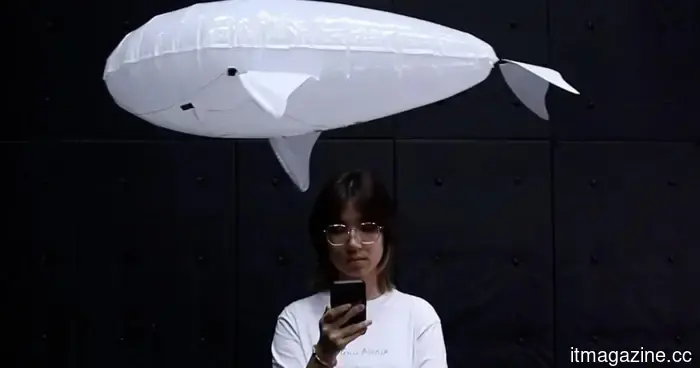 This hovering AI robot appears to have emerged from a Studio Ghibli movie, and that’s precisely the intention.
Researchers have introduced a floating AI robot influenced by Studio Ghibli that moves quietly through the air, presenting a safer and more welcoming concept for future AI companions.
This hovering AI robot appears to have emerged from a Studio Ghibli movie, and that’s precisely the intention.
Researchers have introduced a floating AI robot influenced by Studio Ghibli that moves quietly through the air, presenting a safer and more welcoming concept for future AI companions.
 Christopher Nolan's perspective on smartphones is unexpectedly pragmatic.
Christopher Nolan states that steering clear of smartphones helps safeguard the quiet moments in which his best ideas arise, even though living without one has become more and more impractical.
Christopher Nolan's perspective on smartphones is unexpectedly pragmatic.
Christopher Nolan states that steering clear of smartphones helps safeguard the quiet moments in which his best ideas arise, even though living without one has become more and more impractical.
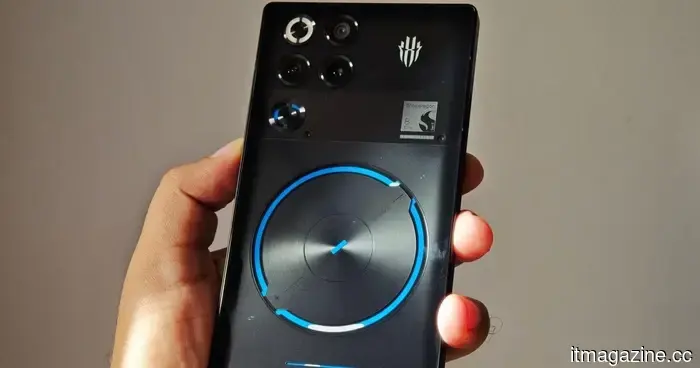 I used to own a liquid-cooled gaming phone, and it hardly ever disappointed me in my daily routine.
The Red Magic 11S Pro is capable of handling resource-intensive PC games, but its battery life, display quality, charging speed, and overall daily dependability are equally important beyond gaming.
I used to own a liquid-cooled gaming phone, and it hardly ever disappointed me in my daily routine.
The Red Magic 11S Pro is capable of handling resource-intensive PC games, but its battery life, display quality, charging speed, and overall daily dependability are equally important beyond gaming.
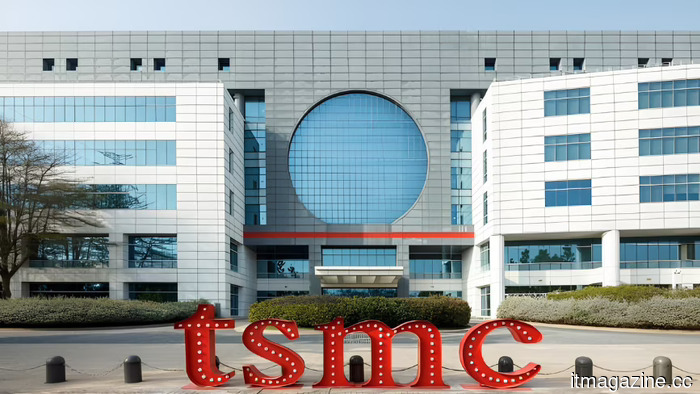 TSMC has commenced construction on more advanced packaging factories in Chiayi.
Taiwan has begun construction on Phase II of the Chiayi Science Park, where TSMC will introduce advanced packaging fabs to a location that is currently operational with two facilities in mass production.
TSMC has commenced construction on more advanced packaging factories in Chiayi.
Taiwan has begun construction on Phase II of the Chiayi Science Park, where TSMC will introduce advanced packaging fabs to a location that is currently operational with two facilities in mass production.
This hovering AI robot appears as if it has come straight out of a Studio Ghibli movie, and that’s precisely the intention.
Researchers have introduced a floating AI robot influenced by Studio Ghibli, which moves quietly through the air, presenting a safer and more friendly vision for future AI companions.