

Ed Markey's legislation on AI accountability challenges Big Tech.
The dispute over the dangers of AI has unfolded on a state-by-state basis, but one US senator aims to address it at the federal level all at once. Ed Markey has numerous concerns about artificial intelligence: data-hungry data centers, workplace monitoring, biased algorithms, and chatbots that exploit children. On Friday, the Massachusetts Democrat sought to transform these concerns into legislation.
In an exclusive interview with the Guardian, Markey introduced a set of bills he refers to as an “AI accountability agenda,” which focuses on “reclaiming power from big tech.” The 79-year-old senator has already drafted nearly a dozen AI-related bills and is now attempting to unify them.
Prove your data center won’t cause harm
The focal point is a bill expected in the coming weeks that would require any company planning or operating a data center to obtain certification from the Federal Communications Commission (FCC) before construction starts. This certification would need to verify that the site “will not harm the public interest.”
Under the proposal, the FCC would assess a potential data center's impact on air and water quality, noise, energy expenses, grid reliability, local wildlife, and the economy. It would also consult with the Environmental Protection Agency and zoning boards. “We need to ensure these data centers don’t become sources of pollution,” Markey stated.
The individuals behind the bills
Markey’s proposal highlights individuals he claims are already experiencing harm. This includes a rural Georgia resident unable to use her tap water since a data center was built nearby, parents whose 14-year-old son died by suicide allegedly due to a chatbot’s manipulations, a woman who litigated against an algorithm that she claims denied her housing, and a veteran nurse pressured to prioritize an AI’s assessment over her own judgment.
Every case corresponds to a bill. Markey is advocating for independent bias audits before high-stakes algorithms are implemented, prohibiting employers from predominantly relying on automated systems for hiring, firing, and promotions, preventing chatbot companies from allowing children to become emotionally reliant on them, and ensuring hospitals maintain a human override for AI decisions.
A federal solution to a fragmented approach
Markey argues that safety should not vary based on one’s location. “Every American deserves these protections,” he asserted, cautioning that a state-by-state approach “would leave many individuals unprotected.”
This is where Europe comes into play. The EU already operates a proactive, precautionary framework akin to what Markey is pursuing, via its AI Act, GDPR, and online safety regulations. Meanwhile, Washington has made little progress at the federal level since the emergence of ChatGPT in 2022, even as companies in Silicon Valley have begun calling for regulations.
Challenging prospects
The political landscape is harsh. Most of Markey’s bills currently face stagnation, and he finds himself one senator in a Congress that tends to prioritize speed over regulation. However, he remains hopeful. “Ultimately, there will be national solutions that will be enacted,” he expressed.
There are some potential gains. In March, the Senate passed legislation tightening online safety protocols for children, which prohibits targeted advertising to minors and restricts their data collection. Other legislators are advocating for Big Tech to cover the energy expenses of AI, as data centers drive up electricity costs and, in one instance, polluted a city’s water supply.
Markey ties the entire struggle to his father, who lost a finger to a factory machine before contemporary safety laws were established. His point is that technology continuously outpaces the regulations designed to control it. He contends that AI is merely the latest iteration of this ongoing issue.
Other articles
 This image could be your initial genuine glimpse of the Galaxy Z Fold 8.
A photo shared on Reddit allegedly depicts Samsung's Galaxy Z Fold 8, Fold 8 Ultra, and Flip 8 in real life, weeks before the Unpacked event scheduled for July 22.
This image could be your initial genuine glimpse of the Galaxy Z Fold 8.
A photo shared on Reddit allegedly depicts Samsung's Galaxy Z Fold 8, Fold 8 Ultra, and Flip 8 in real life, weeks before the Unpacked event scheduled for July 22.
 Tingyu Su emphasizes the importance of considering the founding designer as a strategic hire right from the beginning of the company's development for AI startups.
Tingyu Su, the founding designer of the healthcare AI startup Youlify, points out that as AI simplifies software development, the role of the founding designer becomes essential. This individual plays a vital strategic role by linking product development, branding, and customer experience right from the start.
Tingyu Su emphasizes the importance of considering the founding designer as a strategic hire right from the beginning of the company's development for AI startups.
Tingyu Su, the founding designer of the healthcare AI startup Youlify, points out that as AI simplifies software development, the role of the founding designer becomes essential. This individual plays a vital strategic role by linking product development, branding, and customer experience right from the start.
 What features define the optimal stablecoin payment solution?
A comprehensive guide to assessing stablecoin payment solutions for businesses, focusing on aspects such as acceptance, settlement, compliance, payouts, and API integration for e-commerce, SaaS, marketplaces, and international operations.
What features define the optimal stablecoin payment solution?
A comprehensive guide to assessing stablecoin payment solutions for businesses, focusing on aspects such as acceptance, settlement, compliance, payouts, and API integration for e-commerce, SaaS, marketplaces, and international operations.
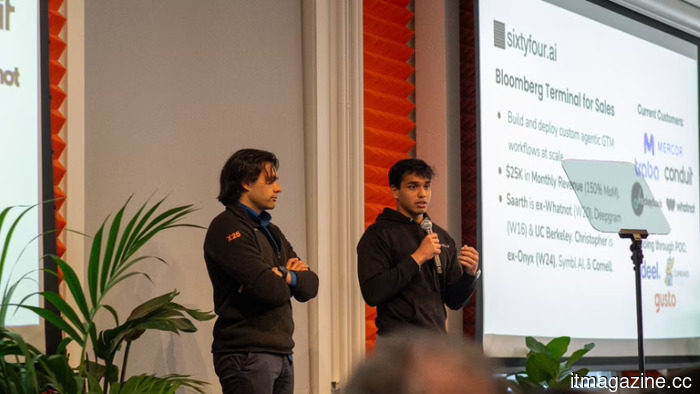 The Eval Stack: Demonstrating the agents' correctness rather than just asserting it.
Saarth Shah, the CEO of Sixtyfour, describes how his company developed AI research agents focused on strict evaluation systems instead of solely relying on the fluency of language models. They established a verification infrastructure that demonstrates accuracy through graded benchmarks and referenced sources.
The Eval Stack: Demonstrating the agents' correctness rather than just asserting it.
Saarth Shah, the CEO of Sixtyfour, describes how his company developed AI research agents focused on strict evaluation systems instead of solely relying on the fluency of language models. They established a verification infrastructure that demonstrates accuracy through graded benchmarks and referenced sources.
 The UK's £2 billion AI 'Combat Laboratory' designed for the British Army
Britain's new £2 billion AI 'Combat Laboratory' is set to train 60,000 soldiers annually. A US company is at the forefront of the initiative, while Germany's Rheinmetall holds nearly half of the involvement.
The UK's £2 billion AI 'Combat Laboratory' designed for the British Army
Britain's new £2 billion AI 'Combat Laboratory' is set to train 60,000 soldiers annually. A US company is at the forefront of the initiative, while Germany's Rheinmetall holds nearly half of the involvement.
 Samsung is introducing a new type of OBLYX OLED panels, which are expected to be available in gaming laptops shortly.
Samsung Display has launched OBLYX, marking its inaugural OLED gaming laptop brand, as it aims to take advantage of the swiftly increasing demand for high-end gaming displays, especially in China.
Samsung is introducing a new type of OBLYX OLED panels, which are expected to be available in gaming laptops shortly.
Samsung Display has launched OBLYX, marking its inaugural OLED gaming laptop brand, as it aims to take advantage of the swiftly increasing demand for high-end gaming displays, especially in China.
Ed Markey's legislation on AI accountability challenges Big Tech.
Senator Ed Markey has introduced an 'AI accountability agenda' consisting of proposed legislation aimed at data centers, biased algorithms, chatbots, and surveillance in the workplace.