
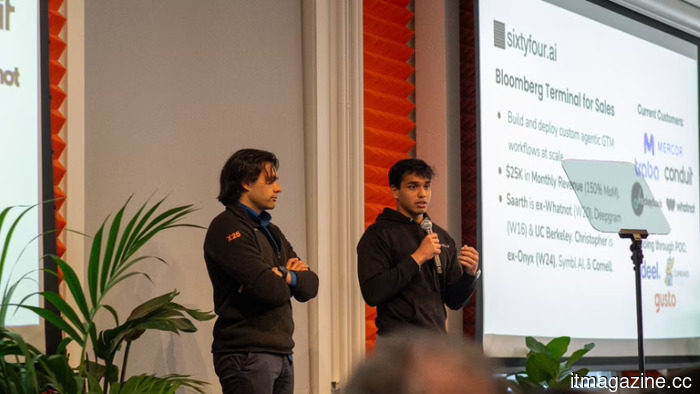
The Eval Stack: Demonstrating the agents' correctness rather than just asserting it.
Most AI research tools utilize a language model to search the web and accept the results without question. In contrast, Saarth Shah developed Sixtyfour based on a different principle: evaluate everything and only deliver what enhances the score.
Shah maintains a scoreboard where every iteration of Sixtyfour’s research agents is assessed against questions curated by a team of experts who validate them with real-world scenarios across various sectors. The resulting grade solely determines what is released. The rigor of this scoreboard is why a payments company trusts Shah's software, rather than a human analyst, to ascertain the authenticity of a stranger.
While many AI research tools rely on a common shortcut—using a language model to access the open web for information—the output may be articulate, but Shah was more focused on its accuracy and how one could verify it.
Initially, the industry attributed issues to "hallucination," where models fabricate facts and sources. Although this concern is genuine and is gradually improving, with frontier models hallucinating less than they did a year ago and advancements made through integration with live web search, Shah’s primary concern is the model's access capacity.
A language model with a search interface can only access what a user with an internet browser can see. Crucial facts typically lie beneath the surface, found in licensed and proprietary records, unindexed documents, and the complex networks designed to obscure fraudulent activities. Standard web searches cannot uncover this information.
“The models keep improving, yet they can still only access what a person with a browser can access,” Shah said. “The answers that are crucial in this field are several levels deeper, and someone needs to obtain them.”
Currently, approximately 96 percent of enterprises utilize AI agents, and the distinction between a system that provides answers and one that delivers correct answers has emerged as the primary challenge in production AI. Even the most advanced models still face difficulties with realistic, long-term professional tasks, where a single misstep can compromise the outcome. Shah recognized this distinction years before benchmarks validated it: capability and reliability are not the same, and the latter must be deliberately engineered.
What he created is a unique system. Sixtyfour's agents function between two insufficient options, the outdated static databases and the improvisational general models. Each investigation combines live web research, public records, legal documents, open-source intelligence, and licensed data, resulting in a report where every assertion refers back to its source. No claim is made without traceable documentation, which is the kind of citation a court would require.
In practice, a single query expands into multiple inquiries. When asked to verify a seller, Sixtyfour’s agents retrieve corporate filings, cross-check addresses and executives, review sanctions and litigation records, and probe the live web for the actual presence of the business. If a lead emerges, the agent pursues it, accumulating context to resolve the inquiry instead of settling for the first feasible answer. The output is a dossier where each statement links back to the relevant document, allowing a reviewer to verify the reasoning of the machine rather than simply trusting its conclusions.
Shah is particularly proud of the aspect that most companies overlook. For every domain his agents function in, he established evaluation systems that assess their output against known answers, enabling the company to demonstrate its accuracy instead of merely promoting it in sales materials. They also refrain from releasing any product updates unless they show clear enhancements according to the evaluation systems. Daily, they elevate their benchmarks, utilizing real-world examples, to constantly push the limits.
“Every answer must demonstrate its basis,” Shah stated. “If we cannot cite the record or filing, we do not deliver the answer. The citation is the product, not just an embellishment.”
Developing these evaluations constituted a significant portion of the effort necessary to establish themselves as the best globally, with the most challenging part being the pursuit of truth. Existing data vendors often cannot serve as reliable sources; their information is frequently outdated or insufficient. Therefore, to grade an agent on genuinely challenging cases, Sixtyfour occasionally verifies answers through extensive investigation with human researchers, subsequently creating tests that the agents need to pass. The goal is to match and eventually surpass the best investigators, establishing an evaluation set that sets a standard unattainable by a single reviewer alone.
The approach is rigorous. Every new tool the team integrates is evaluated against the set before release, and if a promising addition negatively impacts the score, it is removed. A competitor may replicate an architectural diagram in a day, but they cannot replicate years of graded performances from production systems or the intricacies that compel the AI agents to improve.
This is why Sixtyfour is at the forefront of the reconnaissance benchmark, surpassing systems from much larger labs.
Competitors tend to prioritize different objectives. For example, Parallel, a web research firm, focuses on generating lengthy, detailed responses. Exa creates embedding-based semantic searches centered around exploration rather than verification. Sixtyfour, however, targets something narrower and more challenging: confirming whether a specific claim
Other articles
 1X's NEO robot is equipped with hands capable of sensing when a glass is slipping.
The NEO home robot from 1X features new tendon-driven hands that offer 25 degrees of freedom and tactile skin. It can easily detect a slipping glass, but performing actual tasks remains challenging.
1X's NEO robot is equipped with hands capable of sensing when a glass is slipping.
The NEO home robot from 1X features new tendon-driven hands that offer 25 degrees of freedom and tactile skin. It can easily detect a slipping glass, but performing actual tasks remains challenging.
 Disney+ is considering a free tier as a strategy to counter YouTube's increasing influence in the TV market.
Disney is in the initial stages of talks regarding the possibility of offering some Disney+ content for free, as YouTube's increasing share of television viewership is pressuring paid streaming services to adjust.
Disney+ is considering a free tier as a strategy to counter YouTube's increasing influence in the TV market.
Disney is in the initial stages of talks regarding the possibility of offering some Disney+ content for free, as YouTube's increasing share of television viewership is pressuring paid streaming services to adjust.
 Tingyu Su emphasizes the importance of considering the founding designer as a strategic hire right from the beginning of the company's development for AI startups.
Tingyu Su, the founding designer of the healthcare AI startup Youlify, points out that as AI simplifies software development, the role of the founding designer becomes essential. This individual plays a vital strategic role by linking product development, branding, and customer experience right from the start.
Tingyu Su emphasizes the importance of considering the founding designer as a strategic hire right from the beginning of the company's development for AI startups.
Tingyu Su, the founding designer of the healthcare AI startup Youlify, points out that as AI simplifies software development, the role of the founding designer becomes essential. This individual plays a vital strategic role by linking product development, branding, and customer experience right from the start.
 What constitutes the ideal stablecoin payment solution?
A guide to assessing stablecoin payment solutions for businesses, focusing on acceptance, settlement, compliance, payouts, and API integration for ecommerce, SaaS, marketplaces, and international operations.
What constitutes the ideal stablecoin payment solution?
A guide to assessing stablecoin payment solutions for businesses, focusing on acceptance, settlement, compliance, payouts, and API integration for ecommerce, SaaS, marketplaces, and international operations.
 Instagram is allowing users to create AI-generated images of themselves. Here's how you can prevent it.
Instagram's new Muse AI allows individuals to utilize your photos to create AI-generated images and videos, and you are automatically opted in. Here’s how to locate the setting and disable it to prevent others from using your likeness without your permission.
Instagram is allowing users to create AI-generated images of themselves. Here's how you can prevent it.
Instagram's new Muse AI allows individuals to utilize your photos to create AI-generated images and videos, and you are automatically opted in. Here’s how to locate the setting and disable it to prevent others from using your likeness without your permission.
 This image could be your first genuine glimpse of the Galaxy Z Fold 8.
A photo being shared on Reddit purportedly displays Samsung's Galaxy Z Fold 8, Fold 8 Ultra, and Flip 8 in real life, weeks before the Unpacked event scheduled for July 22.
This image could be your first genuine glimpse of the Galaxy Z Fold 8.
A photo being shared on Reddit purportedly displays Samsung's Galaxy Z Fold 8, Fold 8 Ultra, and Flip 8 in real life, weeks before the Unpacked event scheduled for July 22.
The Eval Stack: Demonstrating the agents' correctness rather than just asserting it.
Saarth Shah, the CEO of Sixtyfour, describes how his company developed AI research agents focused on strict evaluation systems instead of solely relying on the fluency of language models. They established a verification infrastructure that demonstrates accuracy through graded benchmarks and referenced sources.