
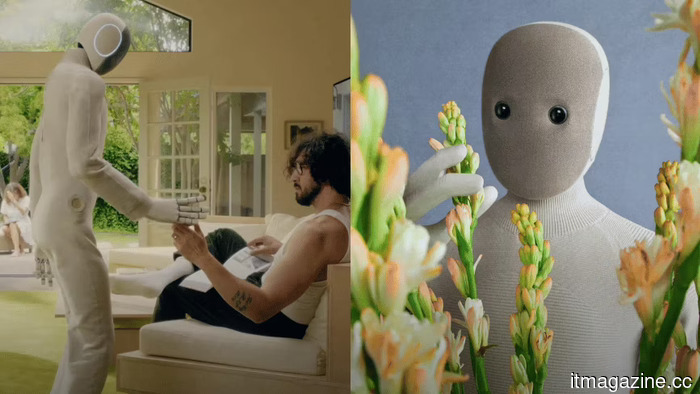
1X's NEO robot is equipped with hands capable of sensing when a glass is slipping.
Humanoid robots mastered walking several years ago, but they still struggle with their hands. 1X has equipped its NEO home robot with new hands, making that feature the most intriguing aspect of the unit. A robot can confidently walk across a stage while still being ineffective in a kitchen. Tasks like lifting a wet glass require precision, quick adjustments, and the control to avoid applying too much pressure.
Wired, which had an early opportunity to assess the robot, described the fingers as “freaky fast.” While speed is an asset, what truly matters is the ability of the hand to sense what it is gripping.
Each hand boasts 25 degrees of freedom, according to 1X: 22 for the fingers and palm, plus three in the wrist. The joints are backdrivable, allowing them to yield under pressure rather than remaining stiff, so a bump doesn’t have to evolve into a struggle.
A crucial feature is the skin. As noted by Digital Trends, NEO’s tactile sensors are capable of detecting both pressure and lateral movement along the fingers. This enables the hand to sense when a glass begins to slip and adjust its grip before it can fall.
The challenge with hands
While factory robots have utilized grippers for years, these typically operate with items placed in the same location consistently. In contrast, a home environment presents varied objects that can have different shapes, weights, and may be wet or partially obscured, requiring the machine to adapt.
1X rates the hands with an IP68 standard and claims they are made from food-safe materials, which is sensible for a device intended to work near sinks and dining plates. The fingers can bend beyond the range of a human hand and conform to unusual shapes. The specifications indicate that the hardware is prepared for household tasks.
The limitation that’s often overlooked
Having capable hands does not automatically translate to effectively performing household chores. NEO still needs to identify an object, select the appropriate grip, and execute the task repeatedly in a disorderly environment, all without prior setup. One well-executed demonstration cannot confirm its overall ability.
There’s a significant caveat: for tasks that NEO is unfamiliar with, 1X provides an "Expert Mode," allowing a human operator to guide it remotely. This clever method enables remote operation of a fleet but also implies that an unknown individual could navigate a camera-equipped device throughout your home. Its autonomy remains a work in progress.
A competitive, and subtly European, landscape
Although 1X is now based in Palo Alto, it originally began in Norway as Halodi Robotics. As such, it is part of a broader European focus on humanoid robots, joining other regional competitors. This sector is vibrant, with some rivals suggesting that home robots should forgo legs and fingers entirely, while others believe the humanoid trend is overstated. The quest for a functional robotic hand underpins the entire discourse.
NEO is sufficiently developed to allow for pre-orders with a $200 deposit. The hands stand out as the most compelling aspect of the offering. The next demonstration to watch should move beyond finger drumming to showcase NEO completing a routine task independently from start to finish.
Other articles
 The UK has established a £2 billion AI 'Combat Laboratory' for the British Army.
Britain's new £2 billion AI 'Combat Laboratory' is set to train 60,000 soldiers annually. A US company is at the forefront of this initiative, while Germany's Rheinmetall holds nearly 50% of the project.
The UK has established a £2 billion AI 'Combat Laboratory' for the British Army.
Britain's new £2 billion AI 'Combat Laboratory' is set to train 60,000 soldiers annually. A US company is at the forefront of this initiative, while Germany's Rheinmetall holds nearly 50% of the project.
 What features define the optimal stablecoin payment solution?
A comprehensive guide to assessing stablecoin payment solutions for businesses, focusing on aspects such as acceptance, settlement, compliance, payouts, and API integration for e-commerce, SaaS, marketplaces, and international operations.
What features define the optimal stablecoin payment solution?
A comprehensive guide to assessing stablecoin payment solutions for businesses, focusing on aspects such as acceptance, settlement, compliance, payouts, and API integration for e-commerce, SaaS, marketplaces, and international operations.
 The UK's £2 billion AI 'Combat Laboratory' designed for the British Army
Britain's new £2 billion AI 'Combat Laboratory' is set to train 60,000 soldiers annually. A US company is at the forefront of the initiative, while Germany's Rheinmetall holds nearly half of the involvement.
The UK's £2 billion AI 'Combat Laboratory' designed for the British Army
Britain's new £2 billion AI 'Combat Laboratory' is set to train 60,000 soldiers annually. A US company is at the forefront of the initiative, while Germany's Rheinmetall holds nearly half of the involvement.
 Tingyu Su emphasizes the importance of considering the founding designer as a strategic hire right from the beginning of the company's development for AI startups.
Tingyu Su, the founding designer of the healthcare AI startup Youlify, points out that as AI simplifies software development, the role of the founding designer becomes essential. This individual plays a vital strategic role by linking product development, branding, and customer experience right from the start.
Tingyu Su emphasizes the importance of considering the founding designer as a strategic hire right from the beginning of the company's development for AI startups.
Tingyu Su, the founding designer of the healthcare AI startup Youlify, points out that as AI simplifies software development, the role of the founding designer becomes essential. This individual plays a vital strategic role by linking product development, branding, and customer experience right from the start.
 Spotify has introduced new controls for Release Radar, allowing you to discover new music in your preferred way.
Spotify is introducing new session controls to Release Radar worldwide, allowing you to sort your weekly new music playlist by genre, emerging artists, or editor's selections before starting playback.
Spotify has introduced new controls for Release Radar, allowing you to discover new music in your preferred way.
Spotify is introducing new session controls to Release Radar worldwide, allowing you to sort your weekly new music playlist by genre, emerging artists, or editor's selections before starting playback.
 What constitutes the ideal stablecoin payment solution?
A guide to assessing stablecoin payment solutions for businesses, focusing on acceptance, settlement, compliance, payouts, and API integration for ecommerce, SaaS, marketplaces, and international operations.
What constitutes the ideal stablecoin payment solution?
A guide to assessing stablecoin payment solutions for businesses, focusing on acceptance, settlement, compliance, payouts, and API integration for ecommerce, SaaS, marketplaces, and international operations.
1X's NEO robot is equipped with hands capable of sensing when a glass is slipping.
The NEO home robot from 1X features new tendon-driven hands that offer 25 degrees of freedom and tactile skin. It can easily detect a slipping glass, but performing actual tasks remains challenging.