
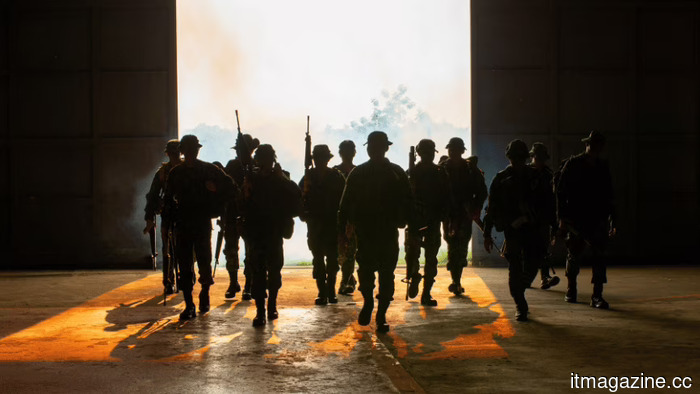
The UK has established a £2 billion AI 'Combat Laboratory' for the British Army.
Britain is investing £2 billion to train its military through a simulation. The task has been awarded to an American defense company, with a German firm taking part as well. The UK has finalized a £2 billion ($2.7 billion) contract for soldier training utilizing artificial intelligence. This agreement, revealed by the Ministry of Defence on Friday, spans 15 years and is led by the American contractor Raytheon UK.
At the core of this initiative is what the ministry refers to as a Combat Laboratory. This digital platform leverages AI, analytics, and virtual environments to replicate the complexities of modern warfare, enabling commanders and troops to practice anywhere and at any time.
Up to 60,000 soldiers annually will utilize this system in trainings that range from small teams of 100 to larger formations of 50,000. The system integrates simulation, live drills, and data to help the army identify patterns, assess performance, and make quicker decisions. Officials indicate that it directly utilizes insights gained from the conflict in Ukraine.
As for who is constructing the system, the contract has been awarded to Omnia Training, a consortium of five UK firms: Raytheon UK, Capita, Cervus, Rheinmetall UK, and Skyral. Raytheon initiated this consortium over three years ago, and it is supported by a supply chain of 44 British businesses.
One notable player is Rheinmetall, the German company that has become the most active arms manufacturer in Europe, involved in a contract that the government refers to as sovereign. Rheinmetall's UK division will provide training infrastructure, system setup, and logistics, expanding its presence in the Isle of Wight and Southampton. Reports from Bloomberg state that Rheinmetall’s share is valued at just under €1 billion ($1.14 billion), nearly half of the total contract.
The emphasis of the project is on job creation and military readiness. The contract is projected to support about 400 jobs in the UK, including 270 skilled positions and 100 apprenticeships in collaboration with Wiltshire College and the University of Staffordshire, predominantly in Wiltshire, with veteran roles based in Warminster, a military town.
The government aims for the British Army to be ten times more lethal by 2035, a goal it frequently reiterates, supported by a £298 billion investment plan over four years. Defence Secretary Dan Jarvis stated that the new system would provide soldiers “the quality training they need to keep us safe.”
Regarding sovereignty, two consortium members, Skyral and Cervus, developed their software in the UK, backed by over £2 million in government innovation funding. The ministry emphasizes that the intellectual property remains under UK control, which is significant as European governments express hesitance about relying on foreign technology that they cannot deactivate.
Britain is making efforts to establish its own sovereign AI capabilities for this reason. Still, the largest portion of this “sovereign” training contract goes to a German prime contractor, under American leadership, highlighting the complexities within European defense mechanisms, even as the continent re-arms.
This agreement comes at a crucial time for AI in military applications. NATO is developing an AI "kill web" on its eastern borders, Germany has engaged Helsing for combat software, and Europe recently introduced a new defense unicorn, Kraken. American autonomous vehicles have already been in action for several months in Ukraine.
Training represents a quieter but possibly more significant aspect of this shift. Before any new weapon is deployed, this is when an army determines its strategic thinking. Implementation is set to start this summer.
Other articles
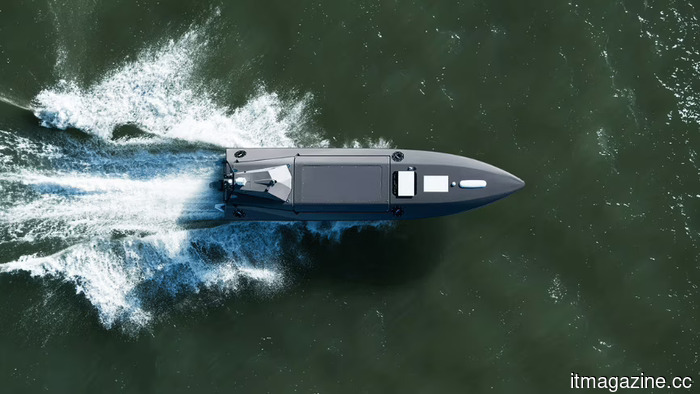 Kraken secures $175 million to achieve unicorn status in maritime defense.
The British company Kraken secured $175 million (€152.9 million), with DTCP leading the round, achieving a valuation of $1 billion to develop uncrewed war boats for NATO, the United States, and the United Kingdom.
Kraken secures $175 million to achieve unicorn status in maritime defense.
The British company Kraken secured $175 million (€152.9 million), with DTCP leading the round, achieving a valuation of $1 billion to develop uncrewed war boats for NATO, the United States, and the United Kingdom.
 Mercor targets a $20 billion valuation and acquires Deeptune.
Mercor is in discussions to increase its valuation to $20 billion and has acquired Deeptune, an AI training startup that was supported by its own CEO. The details are found in the footnotes.
Mercor targets a $20 billion valuation and acquires Deeptune.
Mercor is in discussions to increase its valuation to $20 billion and has acquired Deeptune, an AI training startup that was supported by its own CEO. The details are found in the footnotes.
 Mercor aims for a $20 billion valuation and acquires Deeptune.
Mercor is negotiating to increase its valuation to $20 billion and has acquired Deeptune, an AI-training startup supported by its own CEO. The details are in the footnotes.
Mercor aims for a $20 billion valuation and acquires Deeptune.
Mercor is negotiating to increase its valuation to $20 billion and has acquired Deeptune, an AI-training startup supported by its own CEO. The details are in the footnotes.
 1X's NEO robot is equipped with hands capable of sensing when a glass is slipping.
The NEO home robot from 1X features new tendon-driven hands that offer 25 degrees of freedom and tactile skin. It can easily detect a slipping glass, but performing actual tasks remains challenging.
1X's NEO robot is equipped with hands capable of sensing when a glass is slipping.
The NEO home robot from 1X features new tendon-driven hands that offer 25 degrees of freedom and tactile skin. It can easily detect a slipping glass, but performing actual tasks remains challenging.
 Anthropic discovered a concealed 'workspace' within Claude.
Anthropic's latest Jacobian lens interprets the unvoiced thoughts within Claude's concealed 'workspace', intercepting the model's plans for blackmail before it can generate any text.
Anthropic discovered a concealed 'workspace' within Claude.
Anthropic's latest Jacobian lens interprets the unvoiced thoughts within Claude's concealed 'workspace', intercepting the model's plans for blackmail before it can generate any text.
 Anthropic reaches a valuation of $1.2 trillion, surpassing OpenAI.
Shares of Anthropic suggest a valuation of $1.2 trillion in secondary markets, surpassing OpenAI's $908 billion. The drawback is that very few are willing to sell.
Anthropic reaches a valuation of $1.2 trillion, surpassing OpenAI.
Shares of Anthropic suggest a valuation of $1.2 trillion in secondary markets, surpassing OpenAI's $908 billion. The drawback is that very few are willing to sell.
The UK has established a £2 billion AI 'Combat Laboratory' for the British Army.
Britain's new £2 billion AI 'Combat Laboratory' is set to train 60,000 soldiers annually. A US company is at the forefront of this initiative, while Germany's Rheinmetall holds nearly 50% of the project.