
EU's inaugural Level 4 self-driving highway trial: Aidoptation
Aidoptation has received permission to test a fully autonomous vehicle at highway speeds on public roads in Belgium, marking the first Level 4 permit of this nature within the European Union. The company shared that this approval encompasses 100 km of the E313 and E314 motorways in Limburg.
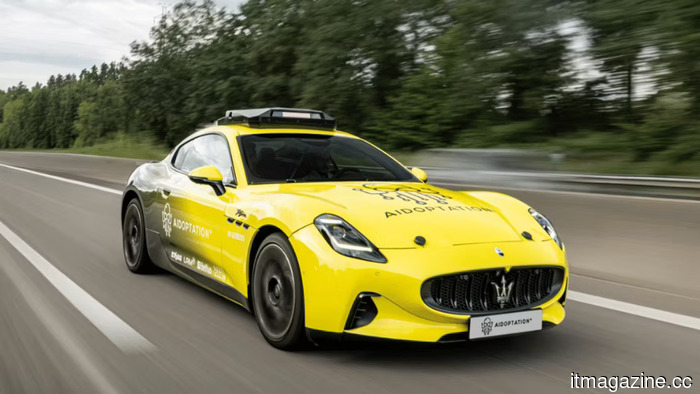
Level 4 signifies that the vehicle manages all driving tasks without requiring a human to monitor the road, distinguishing it from the driver-assistance technologies previously tested in Europe. For instance, Tesla's Full Self-Driving (FSD) feature operates at Level 2, which keeps the human driver legally responsible. Aidoptation's test vehicle is a Maserati GranTurismo Folgore, an electric coupe equipped with lidar, radar, cameras, and robotic hardware.
Focused on the high-speed and dangerous aspects of driving, Aidoptation is shifting the attention from slow city robotaxis to motorways, where accidents, though less frequent, are often more lethal. At a speed of 120 km/h, a car covers over 50 meters in the 1.5 seconds it typically takes for an average driver to respond.
The company emerged from the Indy Autonomous Challenge, a series of driverless racing events. Its engineers established an autonomous speed record of 318 km/h in a driverless Maserati MC20 at the Kennedy Space Center. Their product, EdgeDrive, is specifically designed to handle critical situations that arise at high speeds, such as unexpected obstacles, sharp evasions, and slippery surfaces.
The unique aspect of EdgeDrive is that it does not employ AI for its driving decisions. Instead, it operates on what Aidoptation defines as first-principles deterministic models. According to the company, every decision made by the car can be traced and audited, which they believe provides reassurance to regulators and insurers in a manner that a neural network cannot.
This perspective is notable, as the majority of the robotaxi industry heavily relies on machine learning and has encountered challenges when vehicles perform inexplicable actions. A system with clear, traceable logic is more appealing to safety regulators.
Testing will be conducted under controlled circumstances, with a human safety driver present at all times, ready to intervene if necessary. This will be executed according to a phased plan established with the Federal Public Service Mobility and the Flemish roads agency. The project is insured by the Belgian company Ethias, which also supports Aidoptation.
Flanders views this achievement as a significant milestone, with local ministers presenting the permit as evidence of the region's potential to lead in the field of autonomous driving rather than merely following behind. Aidoptation was founded in 2025 and receives backing from LRM, SFPIM, Ethias Ventures, and Belfius Bank.
The significance of this development lies in Europe's lag behind the US and China regarding public-road autonomy, hindered by caution and bureaucratic processes. Obtaining the first Level 4 highway permit, even one that includes a safety driver, is a notable milestone. The forthcoming tests will determine whether a deterministic, non-AI-based system can effectively navigate the complex realities of driving at 120 km/h.
Other articles
 EU's inaugural Level 4 autonomous driving highway test: Aidoptation
Belgium's Aidoptation has secured the EU's inaugural permit to test a Level 4 self-driving vehicle on highways at a speed of 120 km/h, employing deterministic models rather than AI.
EU's inaugural Level 4 autonomous driving highway test: Aidoptation
Belgium's Aidoptation has secured the EU's inaugural permit to test a Level 4 self-driving vehicle on highways at a speed of 120 km/h, employing deterministic models rather than AI.
 Mark Hura from Oracle: your advantage with AI lies in your data.
During the RAISE Summit, Oracle's Mark Hura stated that the true advantage of AI lies in your own proprietary data and business results, rather than the AI model that you purchase.
Mark Hura from Oracle: your advantage with AI lies in your data.
During the RAISE Summit, Oracle's Mark Hura stated that the true advantage of AI lies in your own proprietary data and business results, rather than the AI model that you purchase.
 A startup created kidney and liver tissue using 3D printing technology in space.
Auxilium claims to have bioprinted kidney and liver tissue aboard the ISS, marking a first in this field. The immediate benefit is in drug-testing organoids rather than creating transplantable organs.
A startup created kidney and liver tissue using 3D printing technology in space.
Auxilium claims to have bioprinted kidney and liver tissue aboard the ISS, marking a first in this field. The immediate benefit is in drug-testing organoids rather than creating transplantable organs.
 Ollama secures $65 million for its open-model AI platform.
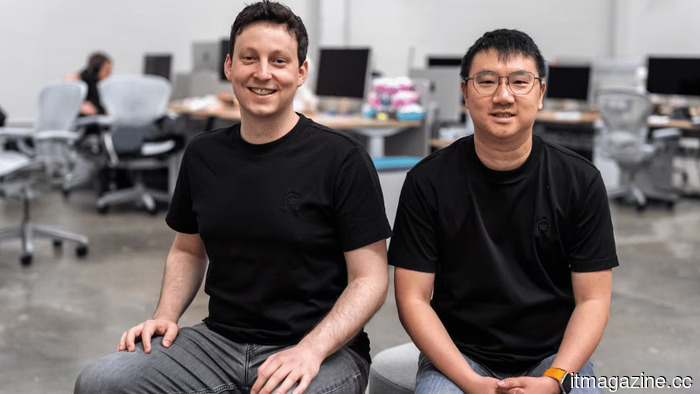
Ollama has secured $65 million in a Series B funding round led by Theory Ventures, bringing its total funding to $88 million, as its open-model runner approaches nearly 9 million developers.
Ollama secures $65 million for its open-model AI platform.
Ollama has secured $65 million in a Series B funding round led by Theory Ventures, bringing its total funding to $88 million, as its open-model runner approaches nearly 9 million developers.
 Ollama secures $65 million to support its open-model AI platform.
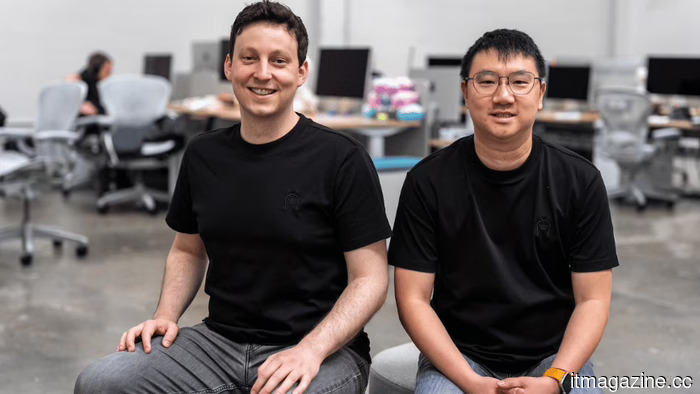
Ollama has secured $65 million in a Series B funding round led by Theory Ventures, bringing its total funding to $88 million, as its open-model runner approaches 9 million developers.
Ollama secures $65 million to support its open-model AI platform.
Ollama has secured $65 million in a Series B funding round led by Theory Ventures, bringing its total funding to $88 million, as its open-model runner approaches 9 million developers.
 Following Samsung and Apple, Oppo may be the next company to enter the growing foldable market.
Oppo might enter the expanding competition of wide foldable devices alongside Samsung and Apple, with a Snapdragon 8 Gen 6-equipped device that features a notably large 6,500mAh battery.
Following Samsung and Apple, Oppo may be the next company to enter the growing foldable market.
Oppo might enter the expanding competition of wide foldable devices alongside Samsung and Apple, with a Snapdragon 8 Gen 6-equipped device that features a notably large 6,500mAh battery.
EU's inaugural Level 4 self-driving highway trial: Aidoptation
Belgium's Aidoptation has secured the EU's initial permit to conduct tests of a Level 4 self-driving vehicle on motorways at speeds of 120 km/h, employing deterministic models rather than artificial intelligence.