

"It can genuinely harm your business": n8n’s argument for model-agnostic AI.
When asked about his company's position in the AI stack, Jan Oberhauser compared it to a car. He explained to an audience at the Raise Summit in Paris this week that the models are like the engine. The other components, such as the vehicle, the roads, and the regulations that enable the engine to function effectively, are what he aims to develop. This perspective is somewhat unconventional in a year when the focus is on the engine itself, and that is precisely the point he is making.
n8n, which Oberhauser founded in 2019, positions itself as the orchestration layer for AI, or, as Oberhauser has described it elsewhere, the “Excel of AI.” The idea is that the platform operates between the models and the existing systems of a company, integrating large language models, deterministic code, and human oversight into workflows that can withstand real-world application. Notably, it does not create its own models.
This model-agnostic approach is not a recent marketing tactic; it is integral to how the company licenses its software. n8n utilizes a Sustainable Use License, a "fair-code" model it introduced in 2022 after transitioning from Apache 2.0 with a Commons Clause. The software is open-source and can be self-hosted, but commercial usage is limited.
Oberhauser stated that the design objective was to ensure users have ownership of their data, can self-host, and avoid vendor lock-in, regardless of external circumstances. For large organizations, he argued, this flexibility is highly appealing.
In the past year, this argument transformed from a theoretical concept into a tangible demand. As OpenAI, Anthropic, and DeepSeek released new models, companies hastened to incorporate these models into their operations. Consequently, a platform that can interconnect any of these models is benefitting from the surge.
Currently, n8n boasts over 1,400 enterprise customers and approximately 1.7 million monthly active users, with notable clients including Meta, Vodafone, and Mercedes-Benz.
Oberhauser mentioned an important nuance: most customers do not frequently change models. They want the flexibility to do so, but the act of switching often leads to complications. He suggested that different models from various vendors, self-hosted versions, or even different iterations of the same model behave differently enough to necessitate evaluations before instating trust in the change.
The motives for switching models are valid: scalability costs, latency, quality, or the possibility of optimizing an open-source model for cheaper and faster operation. However, most companies, according to him, are focusing on building the infrastructure needed for future transitions rather than actively migrating.
Sovereignty has accelerated discussions around this topic. Oberhauser indicated that boards are increasingly inquiring about the implications if a provider elevates its prices, undergoes an acquisition, or faces accessibility issues in a certain region—dependencies that, as he noted, could potentially “literally kill your company.”
The emergence of shared standards for connecting models and tools has made switching appear less like an experimental initiative and more like a necessity, with European clients particularly emphasizing the control over where their data and models reside.
He suggested that the capability to transition “reasonably fast” from one provider to an open-source alternative has become a form of security.
This perspective is driving real commercial success. In May 2026, SAP invested in n8n at a reported valuation of 5.2 billion and agreed to integrate its visual workflow canvas within Joule Studio, SAP's agent development platform.
Additionally, Mercedes-Benz has implemented n8n as its global automation system, motivated in part by the self-hosted, cloud-agnostic deployment that ensures sensitive data remains within its own infrastructure.
Regarding the shift from grassroots adoption to enterprise sales, Oberhauser described a careful strategy: broadly distribute the product, allow usage to accumulate, and wait for the moment a large organization requires single sign-on, enterprise support, and similar features before initiating discussions. He emphasizes the need to communicate the return on investment clearly.
He referenced research indicating that only about 5% of corporate AI initiatives yield significant value, reflecting the findings of MIT's frequently cited "GenAI Divide" report, which revealed that 95% of enterprise pilots resulted in no measurable profit or loss impact.
In his view, successful companies regard AI as a singular element rather than the entire system. They combine it with deterministic logic that is quick, cost-effective, and reliable, supplemented by a human review at the end. This approach is decidedly unglamorous.
In a market still captivated by the allure of the engine, the company that is investing in the car, the roads, and the regulations is banking on the fact that this less glamorous component is where true financial success will ultimately emerge.
Other articles
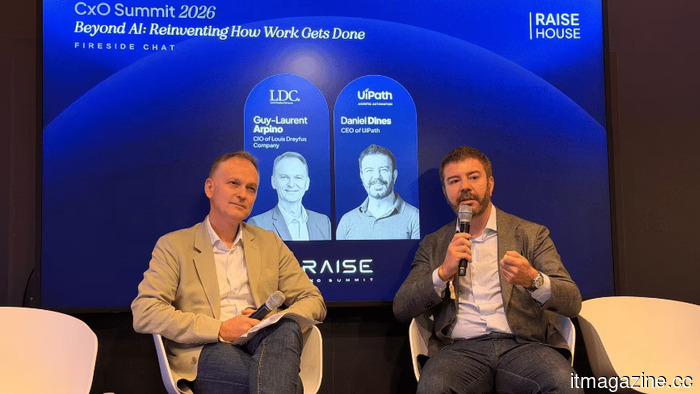 Daniel Dines believes that not recruiting junior employees is a mistake.
During the Raise summit, UiPath's Daniel Dines remarked that reducing junior hiring is a mistake, as he and LDC's Guy-Laurent Arpino outlined the future of enterprise AI.
Daniel Dines believes that not recruiting junior employees is a mistake.
During the Raise summit, UiPath's Daniel Dines remarked that reducing junior hiring is a mistake, as he and LDC's Guy-Laurent Arpino outlined the future of enterprise AI.
 Fleek secures $25 million to develop the AI infrastructure for the worldwide secondhand fashion industry.
London-based startup Fleek has secured $25 million in Series B funding, with support from Burda, an early investor in Vinted, to enhance the AI technology it employs for sorting, grading, and pricing second-hand clothing.
Fleek secures $25 million to develop the AI infrastructure for the worldwide secondhand fashion industry.
London-based startup Fleek has secured $25 million in Series B funding, with support from Burda, an early investor in Vinted, to enhance the AI technology it employs for sorting, grading, and pricing second-hand clothing.
 Looking to cancel your PS Plus subscription? Sony might have an offer for you.
PlayStation users are reporting discounts of as much as 50% on PS Plus subscriptions when they try to cancel, indicating that Sony may be experimenting with a new strategy to retain customers.
Looking to cancel your PS Plus subscription? Sony might have an offer for you.
PlayStation users are reporting discounts of as much as 50% on PS Plus subscriptions when they try to cancel, indicating that Sony may be experimenting with a new strategy to retain customers.
 Meta will turn off the camera on AI smart glasses if you interfere with or obstruct the indicator light.
Meta is introducing an update that begins with its second-generation smart glasses, which will deactivate the camera capture system if the LED light is obstructed or physically altered.
Meta will turn off the camera on AI smart glasses if you interfere with or obstruct the indicator light.
Meta is introducing an update that begins with its second-generation smart glasses, which will deactivate the camera capture system if the LED light is obstructed or physically altered.
 Affordable smartphones are facing pressure, and one factor contributing to this is AI.
An Omdia report cautions that smartphones costing less than $400 may experience a decline of over 22% by 2026, as increasing memory costs, partly driven by AI demands, transform the global smartphone market.
Affordable smartphones are facing pressure, and one factor contributing to this is AI.
An Omdia report cautions that smartphones costing less than $400 may experience a decline of over 22% by 2026, as increasing memory costs, partly driven by AI demands, transform the global smartphone market.
"It can genuinely harm your business": n8n’s argument for model-agnostic AI.
At the Raise Summit, Jan Oberhauser, the founder of n8n, argued for the importance of serving as AI’s orchestration layer as model sovereignty emerged as a key topic in boardrooms.