
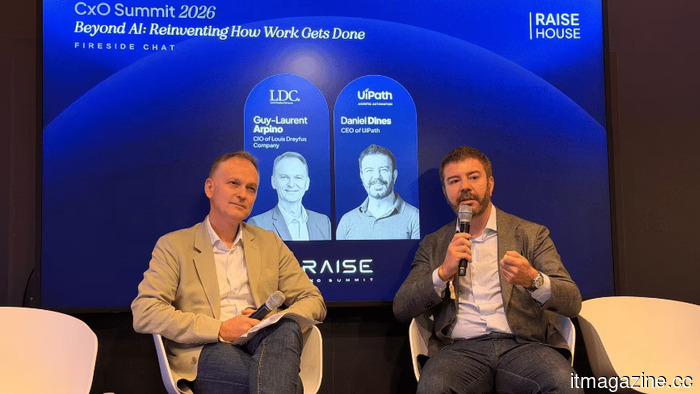
Daniel Dines believes that not recruiting junior employees is a mistake.
At the Raise summit in Paris, two leaders in the enterprise sector questioned why AI agents often fail to progress beyond pilot phases. Their solution focuses on people rather than models.
Many enterprises struggle with stalled AI implementations that linger in pilot stages without advancing to production. This was the straightforward assessment made by Daniel Dines, the CEO of UiPath, during the RAISE CxO Summit in Paris this week.
Dines criticized the overhyped expectations within the industry, arguing that the idea of a "country of geniuses" that mimics human workers is misleading and detrimental. He labeled it a "big disservice to the entire AI industry," emphasizing that one cannot simply hire an AI, provide it with a laptop, connect it to their systems, and expect it to take over all roles.
He offered a more measured perspective, stating, "AI is not going to become human-like." While it might achieve a level of AGI, it will not think or learn as humans do. Therefore, businesses need to redefine the structure of tasks.
Dines described a clear structure: AI proposes, humans decide, and automation carries out the tasks. The challenge lies in the proposals made by AI. A trivial suggestion may waste valuable time, while a flawed one could take longer to rectify than to simply perform the task. According to Dines, this discrepancy is why many pilots fail to progress.
The underlying issue is the knowledge gap. Humans learn their roles by piecing together various bits of information, from emails and tickets to quick discussions with coworkers. Organizations do not centralize this information, and AI cannot absorb it in the same manner.
Thus, Dines proposed a new position: the "cartographer." This individual's role would be to create a "map of work" for AI, outlining business entities, available actions, and their consequences. Questions such as who is responsible when an agent makes a payment, or whether a transaction can be reversed, remain undocumented today.
The organizational challenge is significant. Guy-Laurent Arpino, CIO of Louis Dreyfus Company, concurred but pointed out that the toughest aspect of transformation is the organizational change, not the technology itself.
The commodity-trading giant invested years in cleaning its data and formalizing the knowledge contained within its traders' minds. This context is now preserved in "craft databases" and knowledge drives, which Arpino refers to as "a true IP of our company." Reliable AI applications depend on this foundational work. "The worst enemy of AI agents is unreliability," he noted.
LDC is in the process of restructuring its core “contract-to-cash” process from end to end, covering everything from trade capture to logistics to payment. Some parts leverage previous automation built in collaboration with UiPath, while others clarify where agents are to be used and where human intervention is necessary.
Both Dines and Arpino consistently emphasized the human element. Dines believes one human attribute will endure through the automation trend: will. "I don’t really see AI coming with the will of itself," he remarked. Enterprises thrive on numerous human initiatives, suggesting that the future will favor "fewer passengers and more drivers."
The risk of stagnation lies within the mid-level management. While senior leaders support the transition and younger employees adapt quickly, middle managers may struggle to navigate between the two groups. LDC has implemented a “champions” program that empowers its youngest employees with the latest tools, fostering innovation from the ground up.
The importance of this discussion cannot be overstated. Dines issued a strong caution regarding hiring practices, noting that junior recruitment has sharply declined over the past 18 months, which he deemed a mistake. He warned that reducing the talent pipeline deprives the enterprise of future leaders and advocated for senior staff to take on mentoring roles.
Arpino concurred, stating that LDC continues to hire juniors despite fluctuations in entry-level positions. He admitted that the challenge lies in training them without hindering AI progress. While technology moves rapidly, the more complex task is instructing the organization and its workforce to adapt accordingly. This ongoing tension was a key theme at the Raise summit this week.
Amid Europe’s aspirations for AI, skepticism lingered about whether AI will truly deliver the growth promised by its advocates.
Other articles
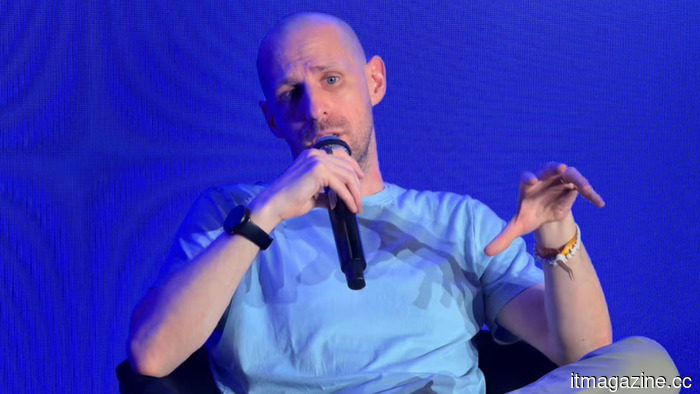 “It could genuinely jeopardize your business”: n8n’s argument for model-agnostic AI
During the Raise Summit, n8n founder Jan Oberhauser argued for the role of being AI’s orchestration layer as model sovereignty emerged as a significant topic in boardroom discussions.
“It could genuinely jeopardize your business”: n8n’s argument for model-agnostic AI
During the Raise Summit, n8n founder Jan Oberhauser argued for the role of being AI’s orchestration layer as model sovereignty emerged as a significant topic in boardroom discussions.
 Kendall supports autonomous vehicles while Burnham's team shows uncertainty.
UK tech secretary Liz Kendall has endorsed driverless cars and British AI, creating a divide with the team of potential next PM Andy Burnham during a Sifted podcast.
Kendall supports autonomous vehicles while Burnham's team shows uncertainty.
UK tech secretary Liz Kendall has endorsed driverless cars and British AI, creating a divide with the team of potential next PM Andy Burnham during a Sifted podcast.
 Kendall supports autonomous vehicles while Burnham's team hesitates.
UK tech secretary Liz Kendall has voiced her support for driverless vehicles and British AI, creating a divide with the team of potential future Prime Minister Andy Burnham, during a Sifted podcast.
Kendall supports autonomous vehicles while Burnham's team hesitates.
UK tech secretary Liz Kendall has voiced her support for driverless vehicles and British AI, creating a divide with the team of potential future Prime Minister Andy Burnham, during a Sifted podcast.
 Samsung has scheduled the Unpacked event for July 22 to unveil the Galaxy Z Fold 8 series of foldable smartphones.
During its upcoming Unpacked event, Samsung is anticipated to unveil three new foldable smartphones along with updated smartwatch versions.
Samsung has scheduled the Unpacked event for July 22 to unveil the Galaxy Z Fold 8 series of foldable smartphones.
During its upcoming Unpacked event, Samsung is anticipated to unveil three new foldable smartphones along with updated smartwatch versions.
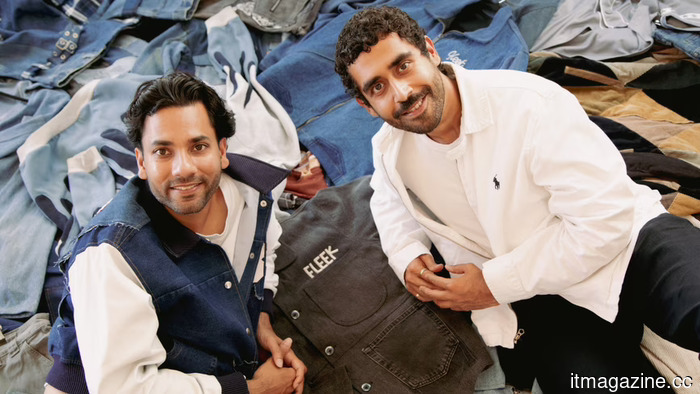 Fleek secures $25 million to develop the AI infrastructure for the worldwide secondhand fashion industry.
London-based startup Fleek has secured $25 million in Series B funding, with support from Burda, an early investor in Vinted, to enhance the AI technology it employs for sorting, grading, and pricing second-hand clothing.
Fleek secures $25 million to develop the AI infrastructure for the worldwide secondhand fashion industry.
London-based startup Fleek has secured $25 million in Series B funding, with support from Burda, an early investor in Vinted, to enhance the AI technology it employs for sorting, grading, and pricing second-hand clothing.
 Affordable smartphones are facing pressure, and one factor contributing to this is AI.
An Omdia report cautions that smartphones costing less than $400 may experience a decline of over 22% by 2026, as increasing memory costs, partly driven by AI demands, transform the global smartphone market.
Affordable smartphones are facing pressure, and one factor contributing to this is AI.
An Omdia report cautions that smartphones costing less than $400 may experience a decline of over 22% by 2026, as increasing memory costs, partly driven by AI demands, transform the global smartphone market.
Daniel Dines believes that not recruiting junior employees is a mistake.
During the Raise summit, UiPath's Daniel Dines remarked that reducing junior hiring is a mistake, as he and LDC's Guy-Laurent Arpino outlined the future of enterprise AI.