
China aims for cinemas to offer not only tickets but also karaoke and coffee.
Cinemas in China are being urged to diversify their revenue sources beyond ticket sales. The National Film Administration and the State Administration for Market Regulation have released new guidelines, as reported by Bloomberg, which recommend that theaters incorporate AI concierge services, karaoke booths, and coffee shops into their lobbies.
Additionally, the guidelines suggest that cinema operators consider creating stores selling movie-themed merchandise, licensed products, art exhibitions, and pop-up shops to transform unused screening and lobby spaces into cultural and retail hubs.
The timing of these recommendations is noteworthy. China's box office saw a 40.6% decline in the first half of 2026 compared to the previous year, totaling approximately $2.56 billion, marking the weakest first half since 2014 when excluding the pandemic years. This drop is a stark contrast to 2025, when the nation’s 93,187 cinemas—more than any other market worldwide, according to the Hollywood Reporter—generated about $7.45 billion, an increase of nearly 22% from the previous year.
In 2025, audiences flocked to theaters, but in 2026, attendance has significantly decreased for various reasons, including a less diverse release schedule and stiff competition from short videos and AI-generated micro-dramas.
The new guidance can be seen as a formal recognition of an existing concept. Last year, Luo Yang, the deputy head of the China Film Administration, described a “film-plus” initiative aimed at combining cinema with tourism, dining, technology, gaming, and merchandise, as highlighted in a Xinhua report shared by China’s State Council Information Office.
The report expressed an ambitious goal: every yuan spent at the Chinese box office is anticipated to create 15.77 yuan in related industries, which represents one of the highest multipliers globally. For instance, the popularity of Nezha-branded coffee drinks, which sold five million cups in just three days, exemplifies the kind of outcomes regulators hope to see integrated into every cinema's strategy, not just for those fortunate enough to have a blockbuster hit.
Meanwhile, Beijing has employed both subsidies and suggestions to stimulate attendance. The "Film Consumption Year" initiative, approximately budgeted at $130 million according to Screen Daily, included ticket discounts and special offers to encourage audiences to return to theaters. In contrast, the new karaoke and coffee shop guidelines take a different approach by encouraging cinemas to create additional attractions to draw customers in.
However, implementing these regulatory suggestions often proves to be more effective on paper than in reality. Converting screening rooms into retail spaces or training employees to manage a coffee counter requires funds that many cinema operators lack due to the significant decline in attendance.
The guidelines do not specify any enforcement mechanisms or financial support, placing the responsibility for implementation on cinema chains that are already feeling the financial strain that these policies aim to mitigate. Smaller, independent cinemas are likely to bear the brunt of these changes. While a national chain can experiment with a merchandise counter at a flagship location, a single-screen venue in a smaller city, operating on minimal margins with fewer film releases, has much less flexibility to invest in untested ideas like a karaoke booth.
The broader context presents a film industry trying to balance two conflicting ideas. On one hand, it aspires to be recognized as a significant cultural and economic force, citing an industry output of 817.26 billion yuan in 2025 according to the same Xinhua report, while also gradually acknowledging that ticket sales no longer encapsulate the entirety of its economic narrative.
China's AI sector has been rapidly catching up to global competitors, with its AI video generation segment expanding beyond its initial niche. Cinema operators seem to be adopting a similar strategy—if audiences are less inclined to watch films, they should be provided with an assistant, a song, and a flat white while they visit.
Nonetheless, this approach does not resolve the more fundamental issue of the film offerings themselves. A diminished slate of blockbusters, coupled with industry insights indicating a narrower window for Hollywood releases in China, seems to have contributed more to reduced attendance than any absence of coffee could. Karaoke booths and AI concierges may help sustain operations during slow periods, but they appear to serve as a stopgap in response to weak programming, rather than a solution to the issue at hand.
Other articles
 Micron initiates construction on a $9 billion expansion in Hiroshima to meet the demand for AI memory.
Micron has commenced construction on a ¥1.5 trillion expansion in Hiroshima to produce HBM chips for AI accelerators, with support from the Japanese government reaching as much as ¥775 billion.
Micron initiates construction on a $9 billion expansion in Hiroshima to meet the demand for AI memory.
Micron has commenced construction on a ¥1.5 trillion expansion in Hiroshima to produce HBM chips for AI accelerators, with support from the Japanese government reaching as much as ¥775 billion.
 Germany's cooperative and savings banks begin cryptocurrency trading.
Germany's cooperative and savings banks are introducing cryptocurrency trading to millions of retail clients, four years after labeling digital assets as an unpredictable risk.
Germany's cooperative and savings banks begin cryptocurrency trading.
Germany's cooperative and savings banks are introducing cryptocurrency trading to millions of retail clients, four years after labeling digital assets as an unpredictable risk.
 India calls on Meta regarding Instagram advertisements that endorse child sexual abuse content.
India's IT ministry has called in Meta executives following a BBC investigation which revealed that Instagram had been running paid advertisements promoting CSAM and directing users to Telegram.
India calls on Meta regarding Instagram advertisements that endorse child sexual abuse content.
India's IT ministry has called in Meta executives following a BBC investigation which revealed that Instagram had been running paid advertisements promoting CSAM and directing users to Telegram.
 Amazon discreetly enhances its Fire HD 10 tablet by adding an impressive 1GB of RAM.
Amazon has upgraded the Fire HD 10 by adding an additional gigabyte of RAM, thus prolonging the lifespan of its flagship tablet instead of introducing a completely new model.
Amazon discreetly enhances its Fire HD 10 tablet by adding an impressive 1GB of RAM.
Amazon has upgraded the Fire HD 10 by adding an additional gigabyte of RAM, thus prolonging the lifespan of its flagship tablet instead of introducing a completely new model.
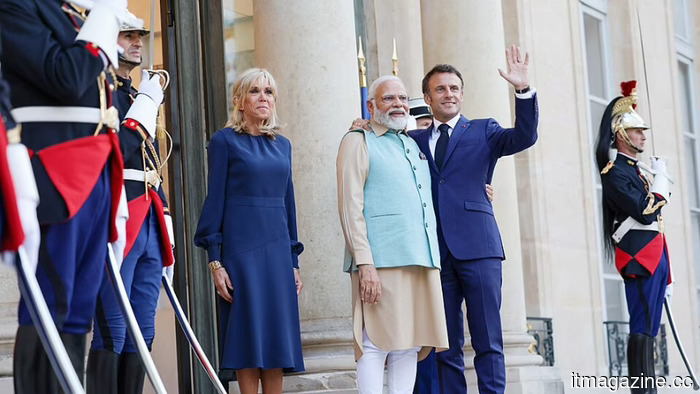 Macron and Modi engage with tech CEOs in the competition for AI infrastructure.
Macron persuaded SoftBank to invest €75 billion in French data centers. Modi obtained $48 billion from Amazon. The competition for AI infrastructure is being dominated by personal diplomacy.
Macron and Modi engage with tech CEOs in the competition for AI infrastructure.
Macron persuaded SoftBank to invest €75 billion in French data centers. Modi obtained $48 billion from Amazon. The competition for AI infrastructure is being dominated by personal diplomacy.
 China amends e-commerce legislation to oversee and protect platforms.
China's proposed amendments to its e-commerce law introduce oversight for domestic platforms and international countermeasures, as Temu and Shein encounter tariffs and penalties in the US and EU.
China amends e-commerce legislation to oversee and protect platforms.
China's proposed amendments to its e-commerce law introduce oversight for domestic platforms and international countermeasures, as Temu and Shein encounter tariffs and penalties in the US and EU.
China aims for cinemas to offer not only tickets but also karaoke and coffee.
Chinese regulators are encouraging cinemas to incorporate AI agents, karaoke booths, and coffee shops as ticket sales have dropped by 40% in the first half of 2026.