
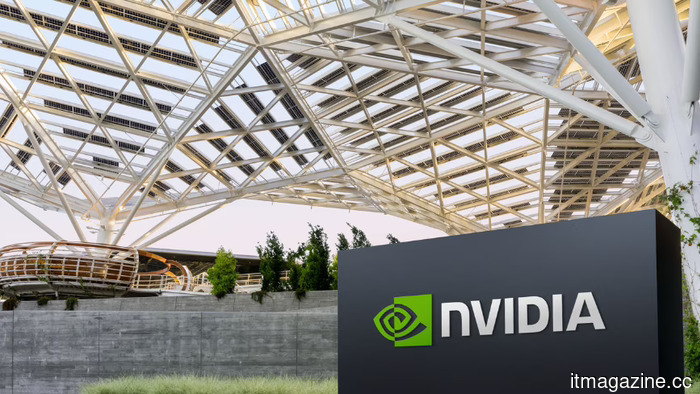
Nvidia provides computing resources to AI startups with the option to pay later.
Rather than merely selling chips, Nvidia is introducing a revenue-sharing and credit-support model for AI cloud services designed to enable access to GPUs for companies that might not be able to afford them otherwise. The company announced a new payment structure allowing AI cloud providers to obtain significant quantities of its chips in return for a portion of the revenue those chips generate, rather than requiring full payment upfront.
Nvidia explains that this initiative addresses a capital challenge. Historically, emerging AI companies have struggled to secure the capital-intensive infrastructure necessary for training and deploying large models, with even long-term customer commitments often insufficient to facilitate financing for computing resources.
Nvidia’s solution allows AI clouds to purchase its hardware and resell Nvidia-powered cloud capacity, with Nvidia earning standard product revenue from the chips and receiving a percentage of the profits from their rental.
This compute shortage has led to soaring valuations for GPU resellers like Runpod, which reached a $1 billion valuation in June by renting out chips it doesn’t own. Two companies are already utilizing this model. Sharon AI, an Australian AI cloud provider, is deploying as many as 40,000 Nvidia Grace Blackwell GB300 GPUs under a six-year, 72-megawatt agreement, a deal that its co-founder and CEO James Manning called "a pivotal moment" for the company's foray into large-scale sovereign AI computing.
Firmus, the other initial partner, is constructing a much larger facility. This Australian firm is developing a 360-megawatt Nvidia DSX AI factory in Batam, Indonesia, which aims to host up to 170,000 GPUs across Nvidia's Grace-Blackwell, Vera-Rubin, and Vera platforms. According to Bloomberg, Firmus anticipates $25 billion to $30 billion in committed offtake agreements during the first six years of the deal, contingent on the continued rise in computing demand from AI-native clients. Nvidia has identified Baseten, Fireworks AI, and Together AI as examples of targeted customers.
These companies necessitate immediate, flexible access to AI cloud capacity for training, fine-tuning, and high-volume inference without needing to make long-term hardware purchases, distinguishing them from the hyperscalers Nvidia has pursued for the past decade. This strategy focuses on the long tail of model builders, agent platforms, and enterprises seeking advanced computing capabilities without the financial risk of establishing data centers.
Additionally, this arrangement provides Nvidia with a recurring, usage-linked revenue stream on top of hardware sales, combining revenue sharing with credit support to assist smaller AI clouds in financing their purchases. While it is not a loan, it operates like vendor financing with potential equity-like benefits. The fundamental nature of Nvidia's offerings remains unchanged, and the chips retain their pricing.
What shifts is which entities can afford to purchase them and under what conditions, an important distinction. Factors like site selection, power procurement, construction, and hardware setup can take years before a startup is ready to run workloads, and Nvidia's proposal is that AI cloud partners can expedite this timeline by selling already available capacity.
This year, Nvidia has committed over $40 billion to direct AI equity investments, covering OpenAI, Nebius, and numerous smaller rounds. A revenue-sharing computing model enables a similar approach without affecting the cap table, preserving financial exposure with its cloud partners instead of on its own balance sheet.
Nvidia has not revealed how many AI clouds it anticipates signing on under this model or whether the terms for Sharon AI and Firmus will be standardized for future partners. This also increases a reliance that has drawn scrutiny, as a growing portion of the AI sector's expansion becomes contractually linked to Nvidia's success.
If this model proves successful, it will allow more computing resources to reach more startups more quickly than the traditional outright purchase method permits. However, if the demand from AI-native sectors diminishes, Nvidia's exposure to that slowdown will be twofold: through chip sales and the cloud revenue it has agreed to share.
Other articles
 Novo Nordisk's owner supports an Italian fund to expand drug startups outside of Denmark.
Novo Holdings, the €93 billion investor associated with Novo Nordisk, is supporting a fund focused on Italian pharmaceutical startups, thereby expanding its influence beyond Denmark.
Novo Nordisk's owner supports an Italian fund to expand drug startups outside of Denmark.
Novo Holdings, the €93 billion investor associated with Novo Nordisk, is supporting a fund focused on Italian pharmaceutical startups, thereby expanding its influence beyond Denmark.
 The US is negotiating with AI companies regarding voluntary standards for new models.
According to the FT, the US is in discussions regarding voluntary standards for the release of advanced AI models, based on the executive order issued by Trump in June.
The US is negotiating with AI companies regarding voluntary standards for new models.
According to the FT, the US is in discussions regarding voluntary standards for the release of advanced AI models, based on the executive order issued by Trump in June.
 The United States is in discussions with artificial intelligence companies regarding voluntary standards for new models.
According to the Financial Times, the US is in discussions about voluntary guidelines for the release of advanced AI models, following Trump's executive order from June.
The United States is in discussions with artificial intelligence companies regarding voluntary standards for new models.
According to the Financial Times, the US is in discussions about voluntary guidelines for the release of advanced AI models, following Trump's executive order from June.
 X is inviting you to launch its new streaming hub with a proposition of $1 million to incentivize your participation.
X has introduced Live Studio, a specialized streaming control center within Creator Studio, and is offering $1 million to motivate creators to broadcast live on the platform.
X is inviting you to launch its new streaming hub with a proposition of $1 million to incentivize your participation.
X has introduced Live Studio, a specialized streaming control center within Creator Studio, and is offering $1 million to motivate creators to broadcast live on the platform.
 SoftBank reintroduces its $10 billion loan supported by OpenAI, offering new incentives to lenders.
SoftBank has resumed discussions for a $10 billion loan secured by its stake in OpenAI, providing banks with a corporate guarantee following the halt of a previous arrangement.
SoftBank reintroduces its $10 billion loan supported by OpenAI, offering new incentives to lenders.
SoftBank has resumed discussions for a $10 billion loan secured by its stake in OpenAI, providing banks with a corporate guarantee following the halt of a previous arrangement.
 Microsoft teams up with a consortium led by Lightstorm to establish a subsea cable connecting India and Southeast Asia.
Microsoft has partnered with Lightstorm, Tata, Singtel, and NEC to develop the 3,600km I-2SEA subsea cable, which will connect India to Singapore and Malaysia by 2029.
Microsoft teams up with a consortium led by Lightstorm to establish a subsea cable connecting India and Southeast Asia.
Microsoft has partnered with Lightstorm, Tata, Singtel, and NEC to develop the 3,600km I-2SEA subsea cable, which will connect India to Singapore and Malaysia by 2029.
Nvidia provides computing resources to AI startups with the option to pay later.
Nvidia is providing AI clouds with a revenue-sharing and credit-support model, granting access to its GPUs for startups that may have not been able to afford them before.