
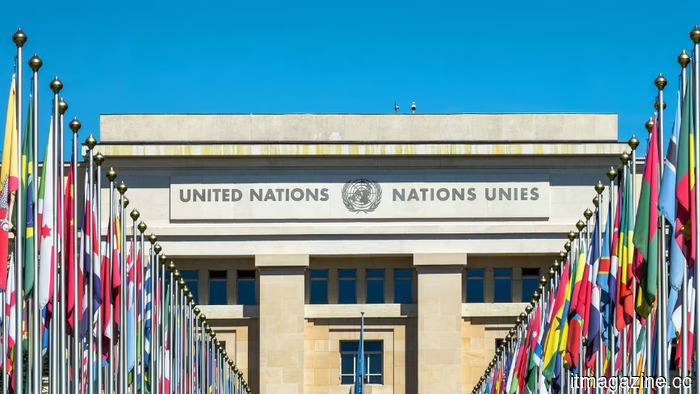
The UN's inaugural global panel on AI science cautions that the opportunity to regulate the technology is diminishing.
Artificial intelligence is progressing more rapidly than governments can manage, and the world's first global scientific organization focused on this technology asserts that immediate action is necessary. This is the primary finding of the preliminary report released by the UN Independent International Scientific Panel on Artificial Intelligence, which was introduced on Wednesday in advance of a significant governance summit in Geneva. The panel cautions that the opportunity to implement effective global oversight is still available, but may not last much longer.
The main concern highlighted is concentration. The report indicates that the United States possesses approximately three-quarters of the computing power behind the leading AI supercomputers, while China has about 15%. Together, these two nations account for nearly 90% of the computing resources used to train the most advanced systems. Additionally, most of the cutting-edge models are developed by companies based in these countries.
The issue at hand is the speed of development. The report discusses an "evidence dilemma" central to AI policy. Policymakers seek dependable scientific data prior to enacting legislation, but often by the time sufficient evidence is gathered, the technology has already progressed. Researchers quoted in the report mention that the complexity of tasks these systems can complete has been doubling every few months. The next generation is already approaching, represented by AI "agents" capable of planning tasks, utilizing digital tools, and writing software with minimal human intervention.
This type of autonomy is rapidly expanding into finance and commerce, as organizations are beginning to delegate genuine decision-making and even funds to these agents.
However, the report avoids a tone of doom. It highlights AI systems like Google DeepMind’s AlphaFold, which has successfully predicted the structures of over 200 million proteins, enhancing drug discovery and research on antibiotic resistance. Physicians are employing AI to detect diseases, such as breast cancer, at earlier stages, while early-warning systems are identifying food insecurity before it escalates into a crisis.
When used appropriately, the panel contends, this technology could significantly advance progress toward the UN’s Sustainable Development Goals in areas such as health, education, and agriculture.
But there are risks that the panel urges governments to monitor. The same technologies are contributing to sexual abuse materials and deepfakes, with women and children being the most vulnerable groups. Additionally, the report notes the threat of AI-generated misinformation, cyberattacks, and fraud, alongside the mental health risks posed by systems that may reinforce harmful beliefs.
Moreover, there is a concern about the physical impact of data centers that support AI, which are increasing greenhouse gas emissions—a matter the UN has called attention to separately. The panel warns that less affluent nations may find themselves entirely excluded, lacking the ability to build, evaluate, or audit the systems they increasingly rely on.
Formed by the UN General Assembly in 2025, this body includes 40 experts from various regions, serving in their personal capacities. Its mission is scientific rather than regulatory; it assesses evidence and publishes reports that governments can utilize, without imposing rules or enforcing standards.
The report observes that over 40 AI governance frameworks and ethical guidelines currently exist globally, yet they are inconsistent, fragmented, and seldom tested for effectiveness. Many safety evaluations remain under the control of the companies that develop the technology.
The panel advocates for more robust independent evaluations, international collaboration, and standardized practices, echoing the approach outlined in the EU’s AI Act. Its conclusions will now contribute to the UN Global Dialogue on AI Governance, commencing in Geneva on July 6. Ultimately, the panel's message is clear: AI is not inherently beneficial or detrimental, and its effects will depend on the decisions made today.
Other articles
 Anthropic has reinstated Claude Fable 5, but users will face a temporary usage restriction.
Anthropic will be re-enabling access to Claude Fable 5 worldwide on July 1, following a directive from the US government that required it to withdraw the model from all users for several weeks.
Anthropic has reinstated Claude Fable 5, but users will face a temporary usage restriction.
Anthropic will be re-enabling access to Claude Fable 5 worldwide on July 1, following a directive from the US government that required it to withdraw the model from all users for several weeks.
 Huawei's slimmest flagship tablet is now available for purchase in Europe.
Huawei has commenced sales of the MatePad Pro Max in Germany, offering its ultra-slim flagship tablet alongside complimentary accessories, an extended warranty, and software aimed at enhancing productivity.
Huawei's slimmest flagship tablet is now available for purchase in Europe.
Huawei has commenced sales of the MatePad Pro Max in Germany, offering its ultra-slim flagship tablet alongside complimentary accessories, an extended warranty, and software aimed at enhancing productivity.
 This LED sign priced at $249 aims to improve your work-life balance.
The Busy Bar display is set to be available for purchase in July. It appears to be incredibly efficient, but the price of $249 is quite steep.
This LED sign priced at $249 aims to improve your work-life balance.
The Busy Bar display is set to be available for purchase in July. It appears to be incredibly efficient, but the price of $249 is quite steep.
 Locating photos has become significantly simpler with Siri AI in iOS 27, so I no longer need to scroll.
iOS 27 allows you to describe a photo using simple English, and Siri will locate it for you. I rigorously tested it on the developer beta, and it saves more time than you might think.
Locating photos has become significantly simpler with Siri AI in iOS 27, so I no longer need to scroll.
iOS 27 allows you to describe a photo using simple English, and Siri will locate it for you. I rigorously tested it on the developer beta, and it saves more time than you might think.
 This $249 LED sign aims to improve your work-life balance.
The Busy Bar display is set to hit the market in July. It appears to be incredibly efficient, but the price of $249 is simply too high.
This $249 LED sign aims to improve your work-life balance.
The Busy Bar display is set to hit the market in July. It appears to be incredibly efficient, but the price of $249 is simply too high.
 Cross-border payroll: the $200 billion shortfall lacking infrastructure
Annually, over $200 billion is involved in cross-border payroll transfers without a unified system. Multiplier is creating the platform to address this issue.
Cross-border payroll: the $200 billion shortfall lacking infrastructure
Annually, over $200 billion is involved in cross-border payroll transfers without a unified system. Multiplier is creating the platform to address this issue.
The UN's inaugural global panel on AI science cautions that the opportunity to regulate the technology is diminishing.
The UN’s Independent International Scientific Panel on AI reports that two nations possess 90% of the top computing power, and the opportunity to regulate AI is diminishing.