
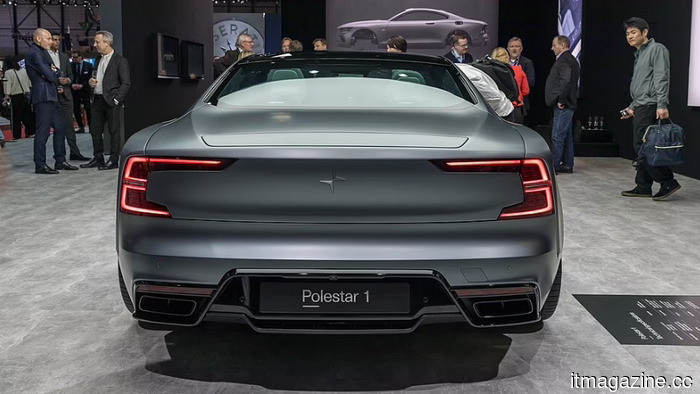
The Trump administration prevents Polestar from launching new electric vehicles in the US due to the Connected Vehicle Rule.
TL;DR: The Commerce Department has denied Polestar authorization under the Connected Vehicle Rule, preventing new sales even though the Polestar 3 is manufactured in the US. The Trump administration's decision, reported first by TechCrunch, means that Polestar cannot sell any new models in the US once the software restrictions for model year 2027 take effect.
The Connected Vehicle Rule, finalized on January 16, 2025, and effective from March 17, prohibits vehicles with software or hardware from Chinese or Russian sources in their connectivity and automated driving systems. Software restrictions begin with the 2027 model year, while hardware restrictions will apply starting with the 2030 model year.
Polestar is mainly owned by Geely, a Chinese automotive conglomerate that also has control over Volvo Cars. This ownership triggered the rule, regardless of where the vehicles are produced. The Polestar 3, the company’s leading SUV, is assembled at Volvo’s plant in Ridgeville, South Carolina, where over one billion dollars have been invested for expansion.
Manufacturing cars in the US wasn't sufficient to meet the rule because it focuses on the technology's origin inside the vehicle rather than where it is assembled. A vehicle built in the US can still be restricted if its connectivity systems use software or components linked to a covered foreign entity, which applies to Polestar due to its connection with Geely.
There is clear inconsistency as Volvo, which shares the same parent company, received authorization under the Connected Vehicle Rule in May. Despite both brands using the same South Carolina factory, only Volvo was permitted to continue selling vehicles. Neither the Commerce Department nor Polestar has provided an official explanation for this difference, though Volvo’s longer history in the US market and its distinct corporate structure may have influenced the decision.
Polestar stated that it would continue to sell existing units of the Polestar 3 and Polestar 4 in the US while they last. The Polestar 4 is produced in Busan, South Korea, by Renault Korea Motors. The company announced that global production for the Polestar 3 will move exclusively to the South Carolina facility starting in the fourth quarter of this year, a decision made prior to the denial of authorization.
In the short term, the financial impact may be limited, as 94 percent of Polestar's retail sales in the first quarter were from markets outside the US. The company is increasingly focusing on Europe, but being completely barred from the US market eliminates any possibility for increasing American sales at a time when the company is already under substantial financial stress.
This pressure is significant; Polestar reported a net loss of $383 million in the first quarter, more than twice the $166 million loss from the previous year. Revenue remained flat at $633 million, despite a seven percent increase in deliveries to 13,126 vehicles, and gross margins turned negative due to pricing pressures, tariffs, reduced carbon credit sales, and currency fluctuations.
The Connected Vehicle Rule is part of a larger US initiative to restrict Chinese technology in vehicles sold in America. A bipartisan Senate proposal aims to go further by banning Chinese-made vehicles and components entirely from the US market. Coupled with tariffs that have already removed a dozen EV models from the American market, the regulatory landscape is becoming increasingly unfavorable for any automaker with Chinese connections.
Although the rule was designed under the Biden administration, it is being enforced under the Trump administration, which has shown no sign of relaxing its application. Polestar's denial highlights how the rule can block a brand manufacturing in the US and primarily selling in Western markets, purely due to the involvement of its Chinese parent company in the vehicle's technology.
Polestar now faces a decision on whether to invest in fighting for a market that provides a small portion of its sales or to redirect resources toward Europe, where it encounters no similar restrictions. The company affirmed its commitment to all its markets but did not detail any plans to challenge the Commerce Department’s decision.
Other articles
 Coval secures $28 million to evaluate AI voice agents under pressure.
Coval has secured $28 million in funding, spearheaded by Norwest, to model and assess enterprise AI voice agents prior to their performance in actual customer calls.
Coval secures $28 million to evaluate AI voice agents under pressure.
Coval has secured $28 million in funding, spearheaded by Norwest, to model and assess enterprise AI voice agents prior to their performance in actual customer calls.
 Unconventional AI has launched its initial model, which is designed on an oscillator architecture that has the potential to reduce AI power consumption by a factor of 1000.
Naveen Rao's Unconventional AI has introduced Un-0, an image generation model that operates on a simulated oscillator chip architecture, which it asserts could significantly reduce power consumption.
Unconventional AI has launched its initial model, which is designed on an oscillator architecture that has the potential to reduce AI power consumption by a factor of 1000.
Naveen Rao's Unconventional AI has introduced Un-0, an image generation model that operates on a simulated oscillator chip architecture, which it asserts could significantly reduce power consumption.
 Taktile secures $110 million to entrust AI with banking decisions.
Taktile has secured $110 million in a Series C funding round led by Goldman Sachs, enabling banks and insurers to automate their most critical decisions using AI agents.
Taktile secures $110 million to entrust AI with banking decisions.
Taktile has secured $110 million in a Series C funding round led by Goldman Sachs, enabling banks and insurers to automate their most critical decisions using AI agents.
 Google Finance leaves beta with the launch of a dedicated Android app, portfolio management features, and AI-enhanced scheduled updates.
Google Finance has exited beta with the launch of a new Android app, portfolio dashboards, an AI research tool, and scheduled market briefings that utilize Gemini.
Google Finance leaves beta with the launch of a dedicated Android app, portfolio management features, and AI-enhanced scheduled updates.
Google Finance has exited beta with the launch of a new Android app, portfolio dashboards, an AI research tool, and scheduled market briefings that utilize Gemini.
 Netris secures $15 million in Series A funding from a16z to streamline the networking processes that hinder GPU cloud performance.
Netris has secured $15 million in funding from Andreessen Horowitz to expand its network automation platform, which is currently operational in over 35 GPU clusters globally.
Netris secures $15 million in Series A funding from a16z to streamline the networking processes that hinder GPU cloud performance.
Netris has secured $15 million in funding from Andreessen Horowitz to expand its network automation platform, which is currently operational in over 35 GPU clusters globally.
 Sarah Wynn-Williams takes legal action against Meta for attempts to silence her.
Whistleblower Sarah Wynn-Williams is taking legal action against Meta for its attempts to suppress her, following a gag order that imposed a $50,000 fine for each public criticism of the company.
Sarah Wynn-Williams takes legal action against Meta for attempts to silence her.
Whistleblower Sarah Wynn-Williams is taking legal action against Meta for its attempts to suppress her, following a gag order that imposed a $50,000 fine for each public criticism of the company.
The Trump administration prevents Polestar from launching new electric vehicles in the US due to the Connected Vehicle Rule.
The Commerce Department rejected Polestar's request for authorization under the Connected Vehicle Rule, despite the fact that its Polestar 3 is manufactured in South Carolina.