
Hadrian's $7.5 billion valuation: physical-AI wager, rejected.
Bloomberg reports that defense-factory startup Hadrian is negotiating to raise up to $1 billion at a valuation of $7.5 billion, which Hadrian describes as “inaccurate.” Nonetheless, the speculation highlights the increasing interest in physical AI and the reindustrialization of the U.S.
In a single breath, there is both a number and a denial. According to Bloomberg, Hadrian Automation is considering a funding round that could more than quadruple its valuation to around $7.5 billion. Sources claim the company is looking to raise up to $1 billion, with several current investors likely participating.
However, there are caveats. The specifics are not finalized and could change, and the amount does not include any additional debt that Hadrian might incur. A company spokesperson further emphasized the information is “inaccurate,” refusing to elaborate. Therefore, it's wise to approach the reported figures with caution.
The exact amount isn't the main point; the signal is.
A five-month markup
The heart of EU tech The latest updates from the EU tech landscape, a tale from our astute founder Boris, and some dubious AI art. It’s free, delivered weekly to your inbox. Sign up now! In January, Hadrian secured funding at a valuation of $1.6 billion led by T. Rowe Price. If it reaches $7.5 billion, that represents a significant increase in just five months. Such rapid valuation escalations typically occur when a sector is gaining substantial momentum. Investors are eager not to be left behind.
This sector has a name: physical AI. The concept suggests that the next evolution of artificial intelligence will manifest not through chatbots but in factories, robots, and machinery. When combined with another hot topic—the reindustrialization of American manufacturing—this defines the critical juncture at which Hadrian finds itself. Thus, even a contested figure has significance; it indicates where investment interest is directed.
What Hadrian actually does
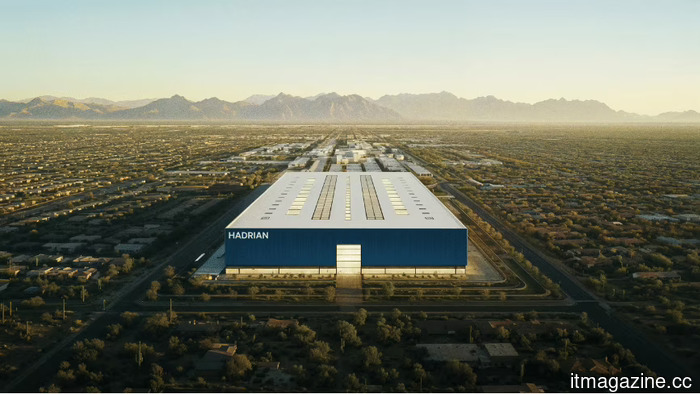
Founded in 2020 by Chris Power, Hadrian creates AI-driven factories capable of producing essential parts for aerospace and defense. It offers three types of production: precision components made to specifications, dedicated manufacturing capacity, and entire factories that it designs and operates for clients under the “Factories as a Service” model.
The backbone of its system is software named Opus, which acts as an operating system for factory autonomy. Opus processes legacy part designs and automates the surrounding manufacturing and inspection processes. The goal is to operate a plant at world-class speed and quality while employing significantly fewer specialized workers than the traditional defense manufacturing sector requires.
The hardware is tangible. Hadrian currently operates four factories, with its newest facility opening in Cherokee, Alabama, in March to support a $2.4 billion contract with the U.S. Navy for submarine component production. This Navy contract is important—it distinguishes a physical AI pitch from a physical AI business that generates revenue.
Hadrian isn't alone in this space. There’s been a surge of venture capital flowing into startups aiming to revive American manufacturing, part of what Bloomberg refers to as Silicon Valley's multibillion-dollar gamble on defense production. Many of these startups are ambitious but lack a substantial customer base. Hadrian's advantage lies in having a significant government contract that translates the idea into actual orders.
Why investors are leaning in
The proposition is based on a real crisis, not merely a trend. The American defense manufacturing sector has been significantly reduced over the years, with a measurable shortfall now evident. According to Altimeter, the Virginia and Columbia-class submarine programs alone are approximately 50 million workforce hours short each year. That’s just one set of programs.
Hadrian tackles this shortage with automation and new labor. Nearly all of its factory employees have no prior factory experience, according to the company. It trains them within about 30 days, drawing personnel from hospitality, retail, and nursing sectors, and offers above-average wages in under-invested regions.
This training approach carries a political weight. Hadrian and its investors claim that physical AI will create jobs in factories rather than eliminate them, a rare assertion in an industry anticipating automation. Over decades, the U.S. lost many defense-manufacturing jobs, and according to Altimeter, a skills gap that has formed over 40 years cannot be bridged through software alone. Hadrian's belief is that automation is what enables large-scale hiring again.
The economics are appealing. Altimeter points out that Hadrian operates its factories at 65% to 80% utilization, compared to an industry average of about 10%. By keeping the machines in operation, the returns begin to resemble those of software rather than traditional heavy industry. Altimeter views it as a compelling internal-rate-of-return narrative that is hard to overlook, suggesting that the securitization of factory outputs might just be beginning. This is the financial rationale that allows for discussions of a defense supplier at a $7.5 billion valuation.
The cap table reflects this demand. The
Other articles
 Cerebras shares decline as a construction shortage impacts operations.
Cerebras nearly doubled its revenue and surpassed 2026 sales forecasts, yet its stock dropped by 10% due to margin pressure from a shortage in the data-center sector.
Cerebras shares decline as a construction shortage impacts operations.
Cerebras nearly doubled its revenue and surpassed 2026 sales forecasts, yet its stock dropped by 10% due to margin pressure from a shortage in the data-center sector.
 The Google Home Speaker is quite remarkable, but that impression changes when you examine the power cable.
A buyer managed to get the new Google Home Speaker ahead of time and shared their initial thoughts. The sound quality is impressive, the setup is fast, but the non-removable power cable is a significant drawback for repairability.
The Google Home Speaker is quite remarkable, but that impression changes when you examine the power cable.
A buyer managed to get the new Google Home Speaker ahead of time and shared their initial thoughts. The sound quality is impressive, the setup is fast, but the non-removable power cable is a significant drawback for repairability.
 Apple suppliers rush to Hong Kong: $4 billion in a week
Apple suppliers Luxshare and Lingyi are competing to secure billions in funding to shift their focus from smartphone components to AI hardware and humanoid robots in Hong Kong.
Apple suppliers rush to Hong Kong: $4 billion in a week
Apple suppliers Luxshare and Lingyi are competing to secure billions in funding to shift their focus from smartphone components to AI hardware and humanoid robots in Hong Kong.
 OpenAI's Jalapeño chip: an alternative to Nvidia
OpenAI has introduced Jalapeño, its inaugural AI chip developed in collaboration with Broadcom for inference purposes, as it seeks to reduce its significant dependence on Nvidia.
OpenAI's Jalapeño chip: an alternative to Nvidia
OpenAI has introduced Jalapeño, its inaugural AI chip developed in collaboration with Broadcom for inference purposes, as it seeks to reduce its significant dependence on Nvidia.
 During Prime Day, the price of the Sony WH-1000XM5 drops below $200, and I believe it’s well worth the investment.
The Sony WH-1000XM5 is now available at a historic low price of $198 during Prime Day, giving you over $200 in savings on one of the top noise-canceling headphones available.
During Prime Day, the price of the Sony WH-1000XM5 drops below $200, and I believe it’s well worth the investment.
The Sony WH-1000XM5 is now available at a historic low price of $198 during Prime Day, giving you over $200 in savings on one of the top noise-canceling headphones available.
 Sentient Foundation initiates a $42 million initiative to support creators of open-source AGI.
The nonprofit is merging grants with investments that favor founders to support developers, researchers, and startups working on artificial general intelligence in an open manner, contending that the future of intelligence should not be dominated by a select few corporations.
Sentient Foundation initiates a $42 million initiative to support creators of open-source AGI.
The nonprofit is merging grants with investments that favor founders to support developers, researchers, and startups working on artificial general intelligence in an open manner, contending that the future of intelligence should not be dominated by a select few corporations.
Hadrian's $7.5 billion valuation: physical-AI wager, rejected.
Hadrian is said to be negotiating to secure $1 billion at a valuation of $7.5 billion, a figure it describes as "inaccurate." This occurs amidst the surge in physical AI and reindustrialization.