

OpenAI's Jalapeño chip: an alternative to Nvidia
OpenAI recently introduced Jalapeño, its inaugural in-house AI chip developed in collaboration with Broadcom. This chip is intended for inference rather than model training, signaling a significant move from a company that has relied heavily on Nvidia for its AI computing needs.
On Wednesday, OpenAI showcased Jalapeño, its first silicon design. This development addresses a long-standing concern for the company: what are the implications if the largest purchaser of AI computing resources chooses to stop depending solely on Nvidia?
According to Axios, the chip was developed alongside Broadcom, with OpenAI handling the fundamental design while Broadcom contributed its connectivity and networking expertise, along with its Tomahawk switching technology. Celestica, a third-party collaborator, took care of the boards and racks.
OpenAI has already begun testing the initial samples in its laboratories, where they manage Codex queries and operate workloads for a model dubbed GPT-5.3-Codex-Spark.
OpenAI isn't aiming to completely replace Nvidia immediately; instead, it is seeking to reduce its dependency as a captive customer.
Understanding Jalapeño
Jalapeño is specifically designed for inference, focusing on the regular task of responding to user inquiries rather than training new models. OpenAI refers to it as an "Intelligence Processor," emphasizing that it is a custom design rather than a general-purpose accelerator. The core advantage is its efficiency.
The company claims that preliminary testing reveals performance per watt that is significantly superior to the latest state-of-the-art options, with thermal performance also exceeding predictions.
These figures come from OpenAI itself, and a comprehensive technical report will require several months to release. Currently, the key observation is this: a chip optimized for one specific task can outperform a versatile alternative in that particular area. Since inference is where AI interacts with users, even minor improvements in cost and speed can dramatically scale across hundreds of millions of daily user queries.
OpenAI plans to deploy Jalapeño for operational use later in the year, with Broadcom forecasting that the first chips will see commercial deployment at Microsoft and other partners by the end of 2026; however, OpenAI asserts that significant quantities will be available next year. The broader ambition extends further, with the goal of achieving 10 gigawatts of computational power from its custom chips by 2029—equating to the energy output of ten nuclear reactors.
A rapid nine-month development, partially guided by AI
OpenAI and Broadcom assert they developed Jalapeño from initial design to manufacturing tape-out in nine months, claiming this is the quickest timeline recorded for an advanced, high-performance chip. Typically, achieving tape-out at this level takes much longer.
An interesting element of this process is that OpenAI utilized its own models to accelerate sections of the chip design. The same systems utilized in ChatGPT contributed to the hardware development that will soon support them. If AI can indeed assist engineers in designing chips more efficiently, it could reduce overall computing costs, reflecting the self-reinforcing cycle that OpenAI often discusses. This also sheds light on the recent surge of startups leveraging AI for chip design.
The rationale behind creating a custom chip
The driving force is as much about control as it is about reducing costs. "This provides OpenAI with full stack control," stated Richard Ho, the head of the company's hardware program. By designing the model, software, serving systems, and now the chip itself, OpenAI aims to optimize the entire structure toward one objective: more affordable and faster intelligence.
Broadcom's CEO, Hock Tan, directly stated the case. “Ultimately, you cannot and should not depend on a third-party GPU for such an essential component,” indicating the clear target is Nvidia, whose chips have powered nearly all of OpenAI's training and inference thus far, and whose market position large clients are now eager to negotiate.
OpenAI enters a competitive arena
OpenAI has arrived at a stage where its biggest competitors have already established their own solutions. Google has its TPUs, Amazon its Trainium and Graviton lines, and Microsoft its Maia accelerators. Each of these integrates custom silicon with Nvidia chips rather than attempting to replace them outright. Anthropic is also venturing into chip development.
The underlying logic remains consistent: at this scale, designing proprietary silicon is often less expensive than continuously paying Nvidia's margins.
Broadcom's name frequently appears across these partnerships. The company now supports many custom accelerators in the industry, including Google's and Jalapeño, while also forming significant compute agreements with Anthropic and Google.
Broadcom has effectively positioned itself as a key player in the post-Nvidia chip landscape, providing critical connectivity and manufacturing capabilities that many AI labs lack.
OpenAI is already diversifying its strategy. In addition to Nvidia, it has recently begun utilizing Cerebras chips for inference in an effort to challenge Nvidia in this specific domain, which is seen as the best opportunity for competitors to break Nvidia's stronghold. With Jalapeño, OpenAI transforms this
Other articles
 Sentient Foundation initiates a $42 million initiative to support creators of open-source AGI.
The nonprofit is merging grants with investments that favor founders to support developers, researchers, and startups working on artificial general intelligence in an open manner, contending that the future of intelligence should not be dominated by a select few corporations.
Sentient Foundation initiates a $42 million initiative to support creators of open-source AGI.
The nonprofit is merging grants with investments that favor founders to support developers, researchers, and startups working on artificial general intelligence in an open manner, contending that the future of intelligence should not be dominated by a select few corporations.
 Tecno's EllaClaw AI assistant aims to organize your phone and handle your tasks.
Tecno's EllaClaw agent goes beyond typical chatbot responses and begins performing actual tasks, such as clearing RAM, conserving battery, requesting rides, and facilitating shopping within your applications, all while ensuring you remain in control.
Tecno's EllaClaw AI assistant aims to organize your phone and handle your tasks.
Tecno's EllaClaw agent goes beyond typical chatbot responses and begins performing actual tasks, such as clearing RAM, conserving battery, requesting rides, and facilitating shopping within your applications, all while ensuring you remain in control.
 GTA VI has finally been given a price and will have a no-disc policy for its physical edition.
Pre-orders for GTA 6 will commence at midnight on June 25, offered in both standard and ultimate editions, with prices starting at $79.99 in the United States.
GTA VI has finally been given a price and will have a no-disc policy for its physical edition.
Pre-orders for GTA 6 will commence at midnight on June 25, offered in both standard and ultimate editions, with prices starting at $79.99 in the United States.
 During Prime Day, the price of the Sony WH-1000XM5 drops below $200, and I believe it’s well worth the investment.
The Sony WH-1000XM5 is now available at a historic low price of $198 during Prime Day, giving you over $200 in savings on one of the top noise-canceling headphones available.
During Prime Day, the price of the Sony WH-1000XM5 drops below $200, and I believe it’s well worth the investment.
The Sony WH-1000XM5 is now available at a historic low price of $198 during Prime Day, giving you over $200 in savings on one of the top noise-canceling headphones available.
 Superhuman acquires GPTZero: the irony of AI detection
Superhuman (previously known as Grammarly) is acquiring the AI detector GPTZero for an undisclosed amount. This reflects the belief that the phrase "created by a human" will evolve into a product.
Superhuman acquires GPTZero: the irony of AI detection
Superhuman (previously known as Grammarly) is acquiring the AI detector GPTZero for an undisclosed amount. This reflects the belief that the phrase "created by a human" will evolve into a product.
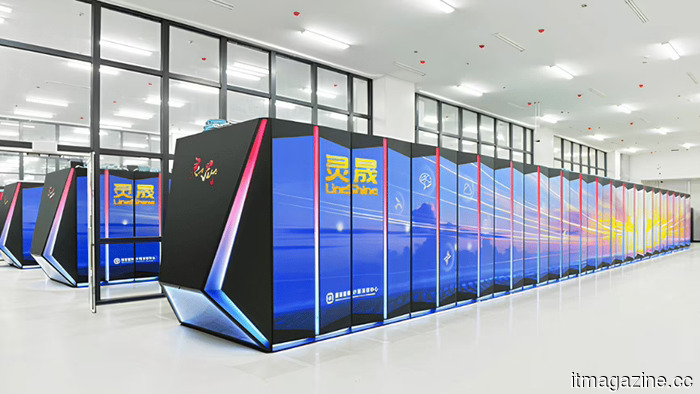 China claims the title of the world's top supercomputer without relying on US chips.
China's LineShine is the fastest supercomputer globally, constructed entirely without the use of chips from Nvidia, AMD, or Intel, in response to US export restrictions.
China claims the title of the world's top supercomputer without relying on US chips.
China's LineShine is the fastest supercomputer globally, constructed entirely without the use of chips from Nvidia, AMD, or Intel, in response to US export restrictions.
OpenAI's Jalapeño chip: an alternative to Nvidia
OpenAI has introduced Jalapeño, its inaugural AI chip developed in collaboration with Broadcom for inference purposes, as it seeks to reduce its significant dependence on Nvidia.