
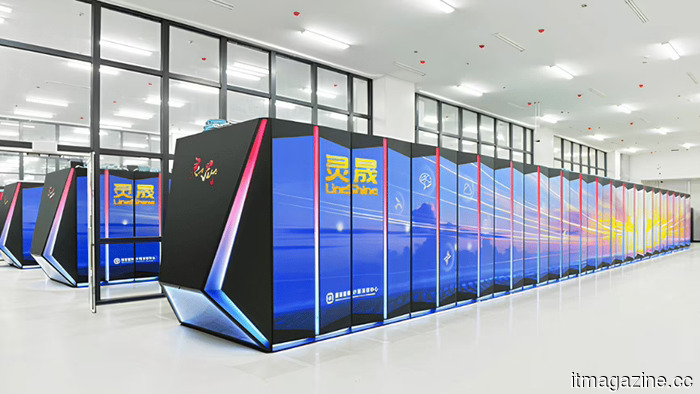
China claims the title of the world's top supercomputer without relying on US chips.
A supercomputer in Shenzhen has claimed the top spot in the global rankings for the first time since 2017. While the headline focuses on its speed, the real significance lies in the silicon: it operates without any chips from Nvidia, AMD, or Intel.
China has regained the supercomputing title. At the ISC conference in Hamburg on Tuesday, a machine named LineShine was announced as the fastest in the world, breaking a long-standing American dominance on the highly monitored TOP500 list.
LineShine, located at the National Supercomputing Center in Shenzhen, achieved a remarkable 2.198 exaflops on the standard benchmark, surpassing El Capitan by over 20%. The US Department of Energy's machine had maintained its lead since November 2024 and is used to support the American nuclear arsenal. LineShine marks the first Chinese system to reach number one in nearly ten years.
The speed is impressive, but the method of achieving it is crucial. LineShine was constructed entirely without American chips, serving as a direct response to years of US export restrictions.
Designed as an all-CPU system, it diverges from the trend of top supercomputers that typically rely on graphics processing units, the Nvidia and AMD chips integral to the AI boom. LineShine uniquely passed two exaflops of sustained double-precision performance using only standard processors.
The design is ambitious. The machine incorporates nearly 14 million computing cores in 90 cabinets, consuming about 42 megawatts of power. With an efficiency of around 52 gigaflops per watt, it stands out for its size. It has successfully executed a complete simulation of Earth's systems and a model of the human brain—heavy scientific work for which it was designed. Its custom LX2 processors utilize Armv9, an instruction set licensed from Britain's Arm Holdings.
Operating with KylinOS, a Chinese version of Linux, LineShine is linked by a domestic network called LingQi. Reports suggest that Huawei is involved in this chip development, raising concerns in Washington about its resurgence in the tech frontier.
Instead of distributing tasks between CPUs and GPUs, LineShine integrates GPU-like computations directly into the processors. Jack Dongarra, a TOP500 organizer, reviewed the machine and expressed admiration, noting that it represents a significant advancement by not depending on GPUs.
Additionally, LineShine ranks at the top of a secondary list that evaluates real-world workloads, and its creators have submitted 14 entries for the prestigious Gordon Bell Prize in scientific computing. However, they have not disclosed details about the chip manufacturers or the production process, information that would be of great interest to Washington.
This entry into the TOP500 is notable, as China had halted submissions in 2023 following the tightening of US chip export regulations. Thus, the decision to present LineShine was a bold statement rather than a mere formality. Dongarra learned that the system was developed without government funding, which enabled its designers to enter it freely.
“I’m not surprised it’s the number one system,” stated Addison Snell from Intersect360 Research. “What surprises me is that they submitted it.”
The timing aligns with a broader trend. US restrictions intended to hinder China's technological advancement have inadvertently spurred its pursuit of self-reliance, resulting in a domestic array of chips, software, and networking that no longer requires American components. A system that operates without parts from Nvidia, AMD, or Intel exemplifies the effectiveness of this strategy.
Moreover, this situation reveals a significant gap in regulatory framework. The US government has focused on restricting GPUs, which are crucial for AI, while CPUs fall under much lighter restrictions. “The US government should impose stricter controls on the export and production of CPUs for the Chinese market,” said Jimmy Goodrich of the University of California Institute on Global Conflict and Cooperation. “It is a loophole in the current regulations.” This gap reflects a broader regulatory challenge that Washington is attempting to address concerning foreign subsidiaries.
However, it's important to note that topping the TOP500 does not automatically equate to success in the AI race, and the two categories are diverging. The list measures high-precision computations, the 64-bit calculations essential for climate modeling and nuclear simulations, while contemporary AI often relies on less precise, faster approximations.
In benchmarks designed to simulate AI workloads, LineShine only ranked fourth, achieving 7.92 exaflops—a modest improvement over its primary score compared to what a GPU system could achieve. Its all-CPU design lacks the specialized low-precision circuitry that enables GPUs to excel in training models.
Adding to the context, many leading American AI systems, operated by companies like xAI, Microsoft, Amazon, and Google, do not participate in the TOP500, as they are commercial rather than academic systems. “If the hyperscalers submitted their systems, this ‘world’s fastest’ would not crack the top five,” Goodrich remarked
Other articles
 GTA VI has officially received a price and will follow a no-disc policy for its physical edition.
Pre-orders for GTA 6 will begin at midnight on June 25, and it will be offered in both standard and ultimate editions, with prices starting at $79.99 in the United States.
GTA VI has officially received a price and will follow a no-disc policy for its physical edition.
Pre-orders for GTA 6 will begin at midnight on June 25, and it will be offered in both standard and ultimate editions, with prices starting at $79.99 in the United States.
 iOS 27 developer beta 2 has arrived. Below is a list of all the new features included.
Apple has released the second developer beta of iOS 27, featuring a significantly quicker Siri, a resolved cropping issue, Wallet Insight, inline RCS responses, and several other appreciated enhancements. Here’s a summary of all the new features.
iOS 27 developer beta 2 has arrived. Below is a list of all the new features included.
Apple has released the second developer beta of iOS 27, featuring a significantly quicker Siri, a resolved cropping issue, Wallet Insight, inline RCS responses, and several other appreciated enhancements. Here’s a summary of all the new features.
 Tecno's EllaClaw AI assistant aims to organize your phone and manage your tasks.
Tecno's EllaClaw agent goes beyond typical chatbot responses and begins performing actual tasks, such as clearing RAM and conserving battery, as well as booking rides and making purchases within your apps, all while ensuring you maintain control.
Tecno's EllaClaw AI assistant aims to organize your phone and manage your tasks.
Tecno's EllaClaw agent goes beyond typical chatbot responses and begins performing actual tasks, such as clearing RAM and conserving battery, as well as booking rides and making purchases within your apps, all while ensuring you maintain control.
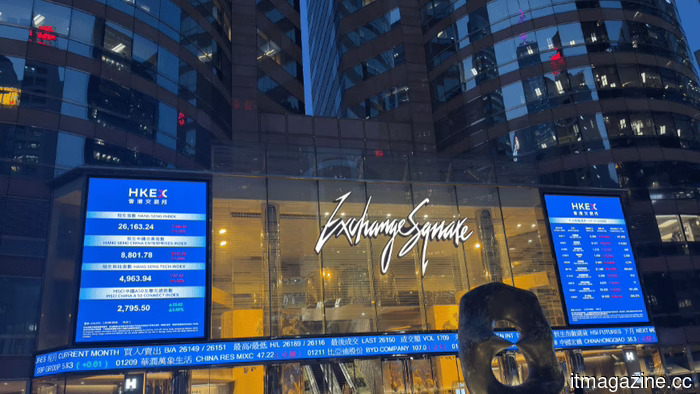 Apple suppliers rush to Hong Kong: $4 billion in a week
Apple suppliers Luxshare and Lingyi are competing to secure billions in funding to shift their focus from smartphone components to AI hardware and humanoid robots in Hong Kong.
Apple suppliers rush to Hong Kong: $4 billion in a week
Apple suppliers Luxshare and Lingyi are competing to secure billions in funding to shift their focus from smartphone components to AI hardware and humanoid robots in Hong Kong.
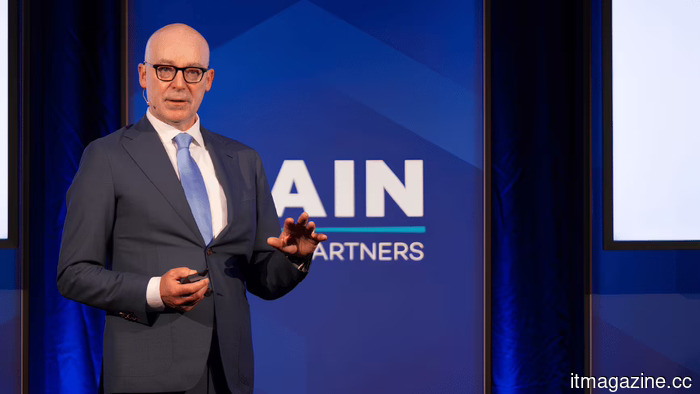 Main Capital €5.25 billion: wagering on stability amid the AI anxiety
Main Capital raised €5.25 billion, marking the largest buyout fund in the Netherlands, with a loss rate below 0.5% and a contrarian approach that anticipates AI will enhance enterprise software.
Main Capital €5.25 billion: wagering on stability amid the AI anxiety
Main Capital raised €5.25 billion, marking the largest buyout fund in the Netherlands, with a loss rate below 0.5% and a contrarian approach that anticipates AI will enhance enterprise software.
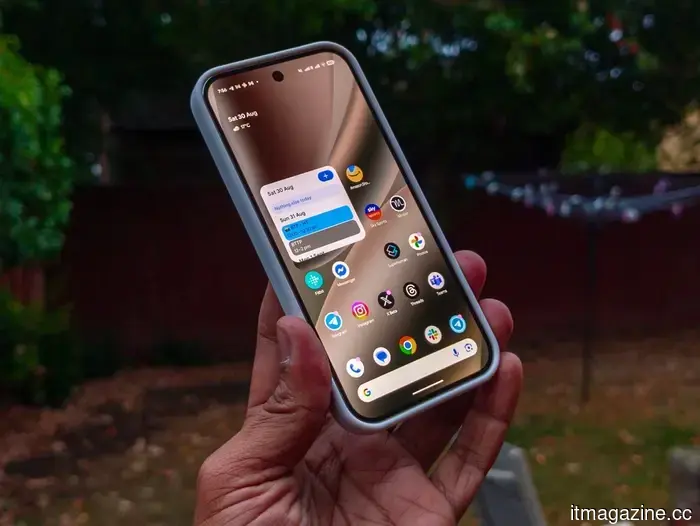 At $684, the Pixel 10 Pro is the top phone deal I've come across this Prime Day, and it's challenging to discover a better value at the moment.
The Pixel 10 Pro is now priced at only $684 for Prime Day, which is a significant $315 reduction, making it the lowest price for this flagship phone to date.
At $684, the Pixel 10 Pro is the top phone deal I've come across this Prime Day, and it's challenging to discover a better value at the moment.
The Pixel 10 Pro is now priced at only $684 for Prime Day, which is a significant $315 reduction, making it the lowest price for this flagship phone to date.
China claims the title of the world's top supercomputer without relying on US chips.
China's LineShine is the fastest supercomputer globally, constructed entirely without the use of chips from Nvidia, AMD, or Intel, in response to US export restrictions.