
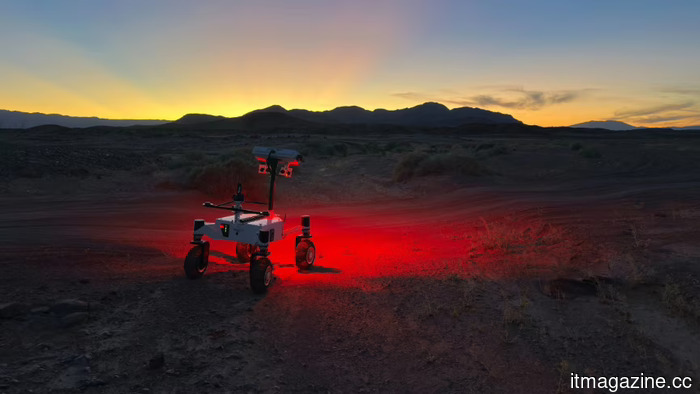
NASA's latest rover prototype traveled 16 miles in a week, achieving a speed that is ten times quicker than any of its current equipment on Mars.
NASA's ERNEST rover prototype traveled 16 miles in 37 hours during testing in the desert, achieving a speed of 0.6 mph, which is about 10 times faster than the agency's current Mars rovers, Perseverance and Curiosity. Developed by NASA’s Jet Propulsion Laboratory, the four-wheeled ERNEST rover performed this feat during field tests in California's Colorado Desert in March 2026. While its speed might seem slow for humans, it marks a significant advancement in robotic exploration for planetary missions.
ERNEST, which stands for Exploration Rover for Navigating Extreme Sloped Terrain, measures 4 feet in length and features mesh wheels, diverging from the rigid aluminum wheels that have posed challenges on Mars. Its key innovation is an active suspension system with two powered joints per wheel, enabling it to navigate obstacles, move sideways, and switch between various movement gaits, including what JPL refers to as "squirming," wheel-walking, and obstacle-climbing modes.
A clutch mechanism allows ERNEST to switch between active and passive suspension seamlessly. In passive mode, it conserves energy on flat surfaces, while in active mode, it can handle gradients and obstacles that would halt traditional rocker-bogie suspension systems used by all NASA Mars rovers since Sojourner's landing in 1997.
The speed is important because current rovers on Mars move very slowly. Curiosity and Perseverance, which landed in 2012 and 2021 respectively, reach a maximum speed of approximately 0.06 mph. Since 1997, NASA has deployed five rovers to Mars, but only Curiosity and Perseverance remain operational. Their movement is restricted due to their suspension design and cautious navigation software that directs them across unfamiliar landscapes. ERNEST addresses both challenges.
JPL developed the rover's navigation system using reinforcement learning in its DARTS simulation lab, undertaking thousands of hours of virtual driving over procedurally generated terrain before the rover touched real ground. This method allows faster decision-making about wheel placement without awaiting commands from Earth, where communication delays between four and 24 minutes exist.
The Colorado Desert test was not ERNEST's first experience; it was previously evaluated in JPL's Mars Yard obstacle course before proceeding to the desert for a more realistic examination of natural terrain. The rover was tested in low-light conditions to simulate the dim lighting at the lunar south pole, where future missions would occur during twilight.
Throughout seven days of intermittent testing, ERNEST covered its 16 miles over 37 hours of active movement. Prior to the 4-foot prototype, JPL constructed two smaller versions at 2 feet long and explored 11 different suspension configurations before finalizing the design. The hardware for the current prototype was completed in September 2024, with project work commencing in 2022, originally funded by JPL’s internal research budget.
Since then, external support has emerged, with backing from NASA’s Mars Exploration Program and its Exploration Science Strategy and Integration Office, indicating that the agency sees potential in ERNEST's technology beyond a research project. JPL's principal technologist, Hari Nayar, along with Issa Nesnas, who oversaw the field testing, have suggested that a larger, faster version of the rover could eventually be deployed for lunar missions.
This lunar application is strategically advantageous. NASA is increasingly partnering with commercial entities to reduce planetary mission costs, and a faster rover would enable the agency to explore more terrain during limited windows of operational opportunity at the lunar poles, where power and sunlight are inconsistent.
While the rocket-bogie suspension that ERNEST aims to replace is notably robust, having successfully navigated Sojourner, Spirit, Opportunity, Curiosity, and Perseverance on Mars—Opportunity even journeyed over 28 miles in 15 years—it prioritizes stability over speed and lacks the active terrain adaptation of ERNEST's powered joints.
JPL planetary scientist James Keane has highlighted ERNEST’s potential to explore areas currently unreachable, such as steep crater walls, lava tubes, and permanently shadowed regions near the lunar south pole where water ice is thought to exist. In such environments, a rover capable of adjusting its wheels and altering its gait would have a significant advantage over one that relies solely on passive geometry.
It is important to note that ERNEST is still in prototype form and has not yet been qualified for flight. The transition from successful desert testing to a rover that can endure the challenges of launch, landing, and long-term operation on another celestial body is considerable. JPL has not disclosed a specific mission timeline or when a flight-ready version may become available.
Nevertheless, the achievement of 16 miles in 37 hours is a noteworthy milestone that shifts the conversation regarding rover capabilities. In contrast, Curiosity has traveled around 21 miles over 14 years on Mars, while ERNEST managed to traverse three-quarters of that distance within just
Other articles
 Trump stated that he no longer considers Anthropic a national security risk following his G7 meeting with the CEO.
Trump informed Axios that Anthropic has "acted very responsibly" and indicated that he might relax restrictions on its Fable 5 and Mythos 5 AI models.
Trump stated that he no longer considers Anthropic a national security risk following his G7 meeting with the CEO.
Trump informed Axios that Anthropic has "acted very responsibly" and indicated that he might relax restrictions on its Fable 5 and Mythos 5 AI models.
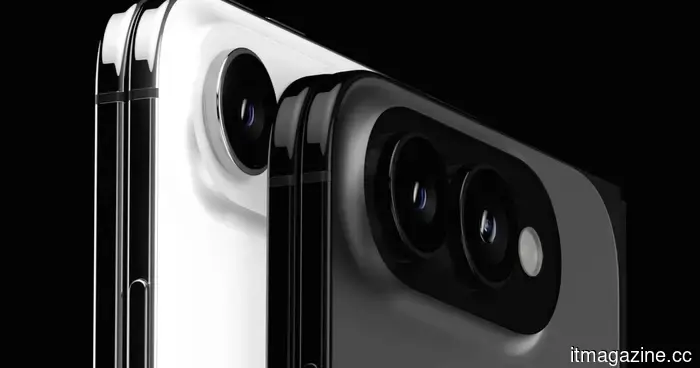 The most recent leak of the iPhone Ultra reveals almost everything and features an eagerly anticipated iOS capability.
Prosser's latest video on the iPhone Ultra showcases what appears to be the final design and introduces the iOS feature that foldable users have been anticipating since it was introduced on Android in 2016.
The most recent leak of the iPhone Ultra reveals almost everything and features an eagerly anticipated iOS capability.
Prosser's latest video on the iPhone Ultra showcases what appears to be the final design and introduces the iOS feature that foldable users have been anticipating since it was introduced on Android in 2016.
 This free app provides your photos with the distinctive style of the Game Boy Camera, without requiring a cartridge.
Epilogue's latest Flashback app emulates the grainy, low-resolution photography style of the Game Boy Camera utilizing your smartphone's camera.
This free app provides your photos with the distinctive style of the Game Boy Camera, without requiring a cartridge.
Epilogue's latest Flashback app emulates the grainy, low-resolution photography style of the Game Boy Camera utilizing your smartphone's camera.
 This free application allows your photos to have the classic appearance of the Game Boy Camera, without requiring a cartridge.
Epilogue's latest Flashback app mimics the grainy, low-resolution photographic style of the Game Boy Camera, utilizing your phone's camera.
This free application allows your photos to have the classic appearance of the Game Boy Camera, without requiring a cartridge.
Epilogue's latest Flashback app mimics the grainy, low-resolution photographic style of the Game Boy Camera, utilizing your phone's camera.
 AI agents require more than just reasoning abilities; they need to actively utilize the web.
A company launches an AI customer service assistant. The underlying model is modern and adequately equipped for the task. The assistant becomes operational. However, within a week, the support tickets worsen instead of improving. The issue does not lie with the model; rather, it’s the company's own website. The return policy that the assistant has to reference is located in [...]
AI agents require more than just reasoning abilities; they need to actively utilize the web.
A company launches an AI customer service assistant. The underlying model is modern and adequately equipped for the task. The assistant becomes operational. However, within a week, the support tickets worsen instead of improving. The issue does not lie with the model; rather, it’s the company's own website. The return policy that the assistant has to reference is located in [...]
 Trump states that he no longer considers Anthropic a national security risk following his G7 meeting with the company's CEO.
Trump mentioned to Axios that Anthropic has "acted very responsibly" and indicated that he might relax restrictions on its Fable 5 and Mythos 5 AI models.
Trump states that he no longer considers Anthropic a national security risk following his G7 meeting with the company's CEO.
Trump mentioned to Axios that Anthropic has "acted very responsibly" and indicated that he might relax restrictions on its Fable 5 and Mythos 5 AI models.
NASA's latest rover prototype traveled 16 miles in a week, achieving a speed that is ten times quicker than any of its current equipment on Mars.
The ERNEST rover from JPL traveled 16 miles over 37 hours of operation during testing in the desert, utilizing active suspension and reinforcement learning for terrain navigation.