

AI agents require more than just reasoning abilities; they need to actively utilize the web.
A company introduces an AI customer service assistant, which is built on a capable and up-to-date model. Once the assistant launches, however, support tickets quickly worsen instead of improving.
The issue isn't with the model itself; it's with the company's website. The assistant must reference the return policy located in a PDF. It needs to use a shipping calculator embedded in a complex multi-step form. The specifications of products are hidden behind tabs that only load after being clicked. While a human user can navigate the site seamlessly, the AI struggles, resulting in incomplete access to important information.
This challenge is a common barrier for many AI deployment efforts today, largely unrelated to the quality of the underlying model.
According to McKinsey's 2025 State of AI report, 23% of organizations are now scaling agentic AI systems in at least one business function, while another 39% are in the experimental phase. Many of these implementations will face similar obstacles: websites designed for human users that don't accommodate the requirements of AI needing structured data. For AI agents to advance, it's essential for them to be able to navigate and utilize live internet content effectively.
The three essential tasks for an AI agent on the web are:
1. **Search**: The agent must find accurate information—not just URLs to lists of links but actual content it can analyze and use. If a customer asks an insurance chatbot about a specific event covered by their policy, the agent should retrieve the relevant policy section rather than simply provide a list of search results.
2. **Scrape**: Once the agent locates the page, it needs to interpret the content accurately. Many modern websites complicate this due to JavaScript that has to run before the content is displayed. Information is often hidden within expandable sections, tabs, or lazy-loading formats, resulting in the HTML data received by the agent looking very different from what a human user sees.
3. **Interact**: This is where many demonstrations of AI fail in real-world applications. Important information is often not available via a simple URL; it may be hidden behind buttons for "loading more," search fields, multi-step forms, navigation menus, or require logging in. A scraper that can only access static pages is unable to retrieve such information, whereas an agent capable of interaction (clicking, navigating, filling out forms, submitting) can access it. The ability to interact is critical to whether the AI can perform its intended function.
Among these tasks, interaction is the newest and most challenging. It also represents a significant opportunity for valuable applications, such as shopping assistants that compare prices across websites, research tools that extract data from interactive dashboards, and customer support bots that navigate documentation sites like a genuine user.
**Firecrawl is developing the foundational technology to support these functions.**
Firecrawl is one of the companies creating the infrastructure to facilitate all three essential tasks. Its platform acts as an intermediary between AI agents and the live web, managing search, scraping, and interaction through a unified API. The open-source project has gained over 120,000 stars on GitHub and is utilized by clients such as Lovable, Replit, and Zapier. In 2025, Nexus Venture Partners led a $14.5 million Series A funding round, with Shopify CEO Tobi Lütke investing after initially using Firecrawl as a customer.
The core proposition is clear: An AI agent built using Firecrawl doesn't require its developers to create custom code for every website it interacts with. Instead, it can call an API, allowing the platform to handle much of the technical intricacies, such as rendering JavaScript, navigating dynamic pages, performing interactions, and providing structured output for AI systems.
“Every AI company needed clean web data, and nobody was solving it effectively,” states Eric Ciarla, one of Firecrawl's cofounders. “So we created Firecrawl.”
Ciarla and his cofounders encountered this issue firsthand while working on their previous venture, Mendable, an AI search platform used by various organizations. Although the search functionality was effective, the system for extracting data from customer websites was not reliable. Each new integration involved reconstructing fragile extraction code that would fail when a customer's website underwent any changes. This struggle is not uncommon; many AI firms integrating web data encounter similar issues, often needing to repeatedly rebuild their internal extraction tools.
**The evolution of how people discover information**
A significant shift is occurring in conjunction with these technical advancements, which raises the stakes for businesses that haven't considered the implications of AI agents accessing their websites.
For the past twenty years, the journey from “a customer is searching for something” to “a customer finds your business” typically involved traditional search engines. Now, AI assistants are increasingly becoming the starting point for individuals seeking recommendations, comparisons, or answers. The AI assistant retrieves information from relevant websites on behalf of the user and returns a synthesized response. If the AI cannot decipher your site, your business remains absent from the answer.
C
Other articles
 This free app provides your photos with the distinctive style of the Game Boy Camera, without requiring a cartridge.
Epilogue's latest Flashback app emulates the grainy, low-resolution photography style of the Game Boy Camera utilizing your smartphone's camera.
This free app provides your photos with the distinctive style of the Game Boy Camera, without requiring a cartridge.
Epilogue's latest Flashback app emulates the grainy, low-resolution photography style of the Game Boy Camera utilizing your smartphone's camera.
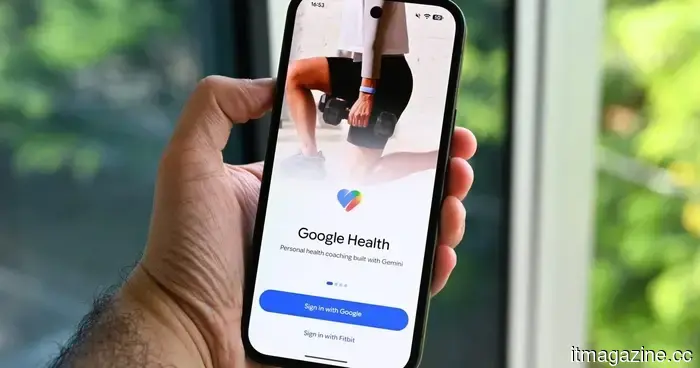 If you noticed that Hourly Activity and Naps were absent from Google Health, a recent update has reinstated them.
The 5.02 update for Google Health brings back two features that were lost during the redesign and introduces several genuinely beneficial enhancements.
If you noticed that Hourly Activity and Naps were absent from Google Health, a recent update has reinstated them.
The 5.02 update for Google Health brings back two features that were lost during the redesign and introduces several genuinely beneficial enhancements.
 Trump stated that he no longer considers Anthropic a national security risk following his G7 meeting with the CEO.
Trump informed Axios that Anthropic has "acted very responsibly" and indicated that he might relax restrictions on its Fable 5 and Mythos 5 AI models.
Trump stated that he no longer considers Anthropic a national security risk following his G7 meeting with the CEO.
Trump informed Axios that Anthropic has "acted very responsibly" and indicated that he might relax restrictions on its Fable 5 and Mythos 5 AI models.
 NASA's latest rover prototype traveled 16 miles in a week, achieving a speed that is ten times quicker than any of its current equipment on Mars.
The ERNEST rover from JPL traveled 16 miles over 37 hours of operation during testing in the desert, utilizing active suspension and reinforcement learning for terrain navigation.
NASA's latest rover prototype traveled 16 miles in a week, achieving a speed that is ten times quicker than any of its current equipment on Mars.
The ERNEST rover from JPL traveled 16 miles over 37 hours of operation during testing in the desert, utilizing active suspension and reinforcement learning for terrain navigation.
 This massive ASUS gaming laptop is priced equivalent to three new MacBook Pros.
The Asus ROG Strix SCAR 18 2026 is now globally released, featuring state-of-the-art hardware and a high price that makes MacBook Pros seem affordable.
This massive ASUS gaming laptop is priced equivalent to three new MacBook Pros.
The Asus ROG Strix SCAR 18 2026 is now globally released, featuring state-of-the-art hardware and a high price that makes MacBook Pros seem affordable.
 Seventeen fusion startups have now secured more than $100 million each, and the total continues to rise.
Private investment in fusion has exceeded $13 billion, with 17 startups securing more than $100 million each. However, no company has yet demonstrated that energy generation on a commercial scale is viable.
Seventeen fusion startups have now secured more than $100 million each, and the total continues to rise.
Private investment in fusion has exceeded $13 billion, with 17 startups securing more than $100 million each. However, no company has yet demonstrated that energy generation on a commercial scale is viable.
AI agents require more than just reasoning abilities; they need to actively utilize the web.
A company launches an AI customer service assistant. The underlying model is modern and adequately equipped for the task. The assistant becomes operational. However, within a week, the support tickets worsen instead of improving. The issue does not lie with the model; rather, it’s the company's own website. The return policy that the assistant has to reference is located in [...]