
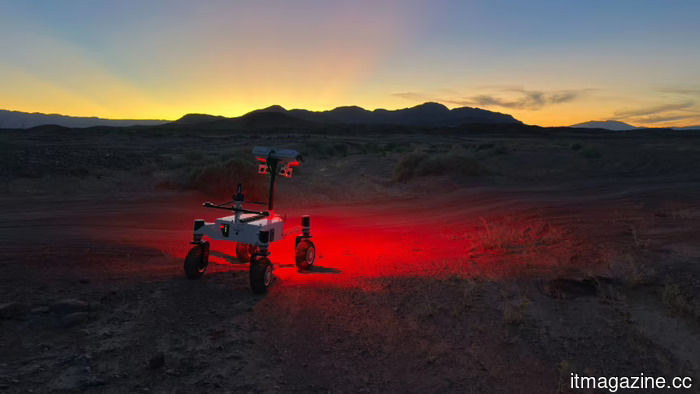
NASA's latest rover prototype traveled 16 miles over the course of a week, achieving speeds that are 10 times greater than any of its current operations on Mars.
**TL;DR** NASA’s ERNEST rover prototype traveled 16 miles in 37 hours during desert testing, achieving a speed of 0.6mph, which is about 10 times faster than the Perseverance and Curiosity rovers on Mars.
NASA's Jet Propulsion Laboratory has developed a rover prototype named ERNEST that successfully navigated 16 miles in 37 hours of operation, making it approximately ten times swifter than any rover currently deployed on Mars. During a field trial in California’s Colorado Desert in March 2026, the four-wheeled rover reached speeds of up to 0.6mph. While this speed may seem slow for a person walking, it signifies a major evolution in the capabilities of robotic exploration on other planets.
ERNEST, which stands for Exploration Rover for Navigating Extreme Sloped Terrain, measures 4 feet in length and is equipped with mesh wheels, which differ from the rigid aluminum wheels that have faced difficulties on Mars. Its standout feature is an active suspension system with two motorized joints per wheel, enabling the rover to maneuver over obstacles, traverse sideways, and switch between various movement modes, including what JPL refers to as “squirming,” wheel-walking, and climbing.
A clutch mechanism allows ERNEST to switch between active and passive suspension modes dynamically. In passive mode, it conserves energy on flat ground, whereas in active mode, it can handle slopes and barriers that would hinder or immobilize the rocker-bogie suspension found on all NASA Mars rovers since Sojourner's landing in 1997.
The significance of speed is highlighted by the sluggishness of the current Mars rovers. Curiosity, operational since 2012, and Perseverance, which landed in 2021, both have maximum speeds of around 0.06mph. NASA has deployed five rovers to Mars since 1997, with only Curiosity and Perseverance still functioning.
These rovers' speeds are restricted partly by their suspension design and partly due to the cautious navigation software that directs their movement across unfamiliar landscapes. ERNEST successfully addresses both of these limitations.
JPL trained ERNEST's navigation system with reinforcement learning in its DARTS simulation lab, accumulating thousands of virtual driving hours in procedurally generated environments before it ever set wheel on real ground. This method enables ERNEST to make quicker decisions about wheel placements without needing to wait for commands from Earth, where communication delays to Mars can range from four to 24 minutes in each direction.
The Colorado Desert was not the first setting for the rover; it initially underwent tests in JPL's Mars Yard obstacle course in Pasadena before transitioning to the desert for a more realistic assessment of natural terrains. During testing, the rover was operated in low light to simulate the dim lighting conditions expected at the lunar south pole, where future missions will operate during twilight.
Over seven days of intermittent testing, ERNEST achieved its 16-mile distance in 37 hours of driving time. Prior to this 4-foot prototype, JPL constructed two smaller versions at 2 feet long and evaluated 11 suspension configurations to perfect the final design. The current prototype's hardware was finalized in September 2024, and the project's initial stages began in 2022, initially financed by JPL's internal research and development budget.
The work has now garnered external funding, with support from NASA’s Mars Exploration Program and its Exploration Science Strategy and Integration Office, indicating that the agency recognizes the technology's potential beyond mere laboratory experiments. Hari Nayar, the principal technologist overseeing the ERNEST team, and Issa Nesnas, who directed the field testing, have suggested that a larger and faster version of the rover could eventually serve a lunar mission.
Utilizing this technology on the Moon represents a strategic advantage. As NASA increasingly collaborates with commercial partners to reduce the costs of planetary missions, a faster rover could cover greater distances within the limited operational opportunities at the lunar poles, where sunlight and power are inconsistent.
The rocker-bogie suspension system that ERNEST seeks to replace has demonstrated remarkable durability. It has successfully supported the journeys of Sojourner, Spirit, Opportunity, Curiosity, and Perseverance across Mars, with Opportunity managing over 28 miles during its 15 years of service. However, this design favors stability over speed and lacks the active adaptability to varied terrain that ERNEST's powered joints provide.
JPL planetary scientist James Keane has highlighted the rover's potential for exploring currently inaccessible areas, including steep crater walls, lava tubes, and the permanently shadowed regions near the lunar south pole believed to contain water ice. In such environments, a rover capable of elevating its wheels and altering its movement strategy would hold a significant advantage over one dependent on passive stability.
It is important to recognize that ERNEST is still a prototype and not a flight-qualified vehicle. The transition from successful desert testing to a rover that can endure
Other articles
 AI agents require more than just reasoning skills; they also need to actively utilize the web.
A company launches an AI customer service assistant. The underlying model is up-to-date and proficient for the role. The assistant becomes operational. However, after a week, support tickets are increasing rather than decreasing. The model itself isn't at fault. The issue lies with the company’s website. The return policy that the assistant must reference is located in […]
AI agents require more than just reasoning skills; they also need to actively utilize the web.
A company launches an AI customer service assistant. The underlying model is up-to-date and proficient for the role. The assistant becomes operational. However, after a week, support tickets are increasing rather than decreasing. The model itself isn't at fault. The issue lies with the company’s website. The return policy that the assistant must reference is located in […]
 Amazon has canceled its nearly completed Sam Altman film, just four months after investing $50 billion in OpenAI.
Amazon MGM Studios has decided to cancel the release of Artificial, a film centered on Altman's firing from OpenAI in 2023, despite having received favorable test screenings and featuring a star-studded cast.
Amazon has canceled its nearly completed Sam Altman film, just four months after investing $50 billion in OpenAI.
Amazon MGM Studios has decided to cancel the release of Artificial, a film centered on Altman's firing from OpenAI in 2023, despite having received favorable test screenings and featuring a star-studded cast.
 Asus is pricing an RTX 5080 gaming laptop at $4,799, which is more expensive than last year’s RTX 5090 model.
Asus has priced the 2026 ROG Zephyrus G16 equipped with an RTX 5080 at $4,799. Meanwhile, the 2025 version, which features a quicker RTX 5090 and 64GB of RAM, is available for $200 less.
Asus is pricing an RTX 5080 gaming laptop at $4,799, which is more expensive than last year’s RTX 5090 model.
Asus has priced the 2026 ROG Zephyrus G16 equipped with an RTX 5080 at $4,799. Meanwhile, the 2025 version, which features a quicker RTX 5090 and 64GB of RAM, is available for $200 less.
 If you noticed that Hourly Activity and Naps were absent from Google Health, a recent update has reinstated them.
The 5.02 update for Google Health brings back two features that were lost during the redesign and introduces several genuinely beneficial enhancements.
If you noticed that Hourly Activity and Naps were absent from Google Health, a recent update has reinstated them.
The 5.02 update for Google Health brings back two features that were lost during the redesign and introduces several genuinely beneficial enhancements.
 Are you gearing up to watch season 3 of House of the Dragon? HBO Max is providing a substantial discount.
HBO Max is offering discounts on its annual subscriptions in anticipation of the third season of House of the Dragon, providing both new and returning subscribers a more affordable option to return to Westeros.
Are you gearing up to watch season 3 of House of the Dragon? HBO Max is providing a substantial discount.
HBO Max is offering discounts on its annual subscriptions in anticipation of the third season of House of the Dragon, providing both new and returning subscribers a more affordable option to return to Westeros.
 Norway is prohibiting generative AI in primary schools beginning this fall.
Norway will prohibit students aged 6 to 13 from utilizing generative AI tools in schools starting in late August. Teens aged 14 to 16 will only be allowed to use these tools with teacher supervision.
Norway is prohibiting generative AI in primary schools beginning this fall.
Norway will prohibit students aged 6 to 13 from utilizing generative AI tools in schools starting in late August. Teens aged 14 to 16 will only be allowed to use these tools with teacher supervision.
NASA's latest rover prototype traveled 16 miles over the course of a week, achieving speeds that are 10 times greater than any of its current operations on Mars.
The ERNEST rover from JPL traveled 16 miles in 37 hours during desert trials, utilizing active suspension and reinforcement learning to maneuver through the terrain.