

Telegram contests India's directive that temporarily restricts the app.
The company has approached the Delhi High Court regarding a ban related to alleged cheating on a national medical entrance examination, a situation impacting over 150 million users. Telegram is seeking the Delhi High Court's intervention to lift an Indian government-imposed temporary block on the messaging app, marking the company's most significant legal challenge in one of its largest markets.
This order, effective until 22 June, was established after the National Testing Agency claimed that organized cheating networks were utilizing Telegram to deceive candidates during a re-examination for NEET-UG, India's national medical entrance test.
The nature of the block is extensive. Telecom service providers have been directed to restrict access, and the application has been taken off app stores, a move that affects more than 150 million users across India.
The re-test is slated for 21 June, and the government has positioned the block as a temporary and focused effort to prevent the dissemination of leaked exam materials and associated scams in the days leading up to the examination.
Telegram’s contention revolves around the disproportionality of the response. The company argues that shutting down an entire platform affecting millions in order to target a handful of cheating rings represents an overly broad approach to a specific issue, a sentiment echoed by founder Pavel Durov, who has labeled the ban as disproportionate.
The Delhi High Court is now tasked with determining whether the block is a valid and narrowly focused response or an excessive measure that unintentionally impacts lawful users to address unlawful ones.
This debate is familiar territory for Telegram, which has often found itself in conflict with governments seeking either its data or its removal. For instance, the app faced a two-year ban in Russia due to its refusal to provide encryption keys to security services, a prohibition that Moscow eventually deemed impractical. It has also encountered suspensions and threats across nations from Spain to Indonesia. In many of these circumstances, the app emerged with a larger user base than before, a trend Durov has readily highlighted.
India presents a more complex situation, not due to differing legal issues but because of the size of the market. While Spain paused its own Telegram ban to assess its impact on users beforehand, India has opted for a strategy of implementation first and legal action later.
The scale of those affected is a key part of Telegram’s argument and a factor contributing to the government’s belief that a brief and decisive block is warranted.
Additionally, India and Telegram share a history that does not involve a total ban. The government has previously mandated the platform to eliminate thousands of channels linked to piracy and exam paper leaks under the country’s IT Act, which is now being cited to justify the current block.
This history is relevant to the proportionality debate: the state can reference past, narrower interventions that it claims failed to resolve the issue, while Telegram can argue that escalating from channel removals to a nationwide shutdown exemplifies the disproportion it opposes.
Currently, the timeline speaks volumes. The ban is set to remain until 22 June, with the re-test taking place on 21 June, and the High Court will rule on the order’s standing in that interim period. The outcome will hinge on a long-standing question regarding how much of a network a government may disable and for what duration in order to curtail the misuse by a few.
Other articles
.jpg) What Distinguishes Success from Failure in AI Implementation (Insights from Automotive Retail)
Dek: AI necessitates a commitment to responsibility and purposeful use. Below are illustrations of how car retailers are applying AI successfully and securely. Recall the classic Spider-Man saying? The one his Uncle Ben imparts (or Aunt May in the latest films) regarding how "with great power comes great responsibility"? If there was ever a […]
What Distinguishes Success from Failure in AI Implementation (Insights from Automotive Retail)
Dek: AI necessitates a commitment to responsibility and purposeful use. Below are illustrations of how car retailers are applying AI successfully and securely. Recall the classic Spider-Man saying? The one his Uncle Ben imparts (or Aunt May in the latest films) regarding how "with great power comes great responsibility"? If there was ever a […]
 Europe worries about American AI as the tech industry converges in France.
The G7 in Evian and VivaTech in Paris commence this week, focusing on European AI sovereignty, just days after the US restricted access to Anthropic's leading models.
Europe worries about American AI as the tech industry converges in France.
The G7 in Evian and VivaTech in Paris commence this week, focusing on European AI sovereignty, just days after the US restricted access to Anthropic's leading models.
 Europe is concerned about American AI as the technology sector gathers in France.
The G7 meeting in Evian and VivaTech in Paris begin this week, with a strong focus on European AI sovereignty, just days after the US restricted access to Anthropic’s leading models.
Europe is concerned about American AI as the technology sector gathers in France.
The G7 meeting in Evian and VivaTech in Paris begin this week, with a strong focus on European AI sovereignty, just days after the US restricted access to Anthropic’s leading models.
 A hacking group has asserted that it infiltrated Novo Nordisk and is requesting a ransom of $25 million.
FulcrumSec claims to have extracted 1.3TB of data from Novo Nordisk and is requesting $25 million. The manufacturer of Ozempic acknowledged the breach but declined to make any payment.
A hacking group has asserted that it infiltrated Novo Nordisk and is requesting a ransom of $25 million.
FulcrumSec claims to have extracted 1.3TB of data from Novo Nordisk and is requesting $25 million. The manufacturer of Ozempic acknowledged the breach but declined to make any payment.
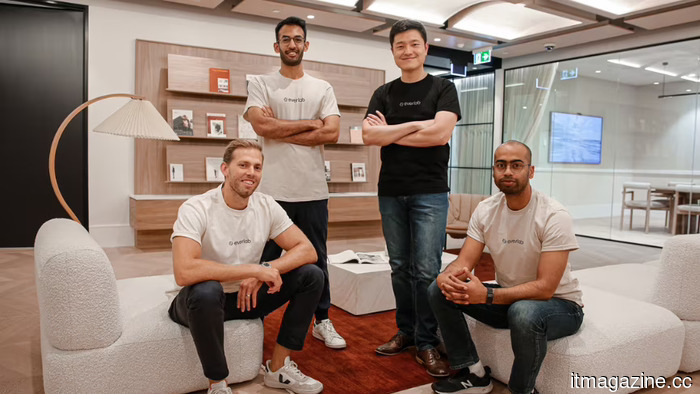 Everlab secures AU$65 million to shift primary care focus from treatment to prevention.
Melbourne healthtech company Everlab has successfully secured AU$65 million in an oversubscribed Series A round, led by Airtree. This funding will support its launch in the UK and efforts to expand into preventative care.
Everlab secures AU$65 million to shift primary care focus from treatment to prevention.
Melbourne healthtech company Everlab has successfully secured AU$65 million in an oversubscribed Series A round, led by Airtree. This funding will support its launch in the UK and efforts to expand into preventative care.
 Shareholders have filed a lawsuit against Microsoft regarding the slowdown in Azure and its expenditures on artificial intelligence.
A pension fund from Michigan has accused Microsoft of hiding a slowdown in Azure and rising AI expenses prior to a January decline that led to a loss of $357 billion in market value.
Shareholders have filed a lawsuit against Microsoft regarding the slowdown in Azure and its expenditures on artificial intelligence.
A pension fund from Michigan has accused Microsoft of hiding a slowdown in Azure and rising AI expenses prior to a January decline that led to a loss of $357 billion in market value.
Telegram contests India's directive that temporarily restricts the app.
Telegram has approached the Delhi High Court regarding a government directive that has blocked the platform until June 22, in connection with alleged cheating on India's NEET-UG medical examination.