
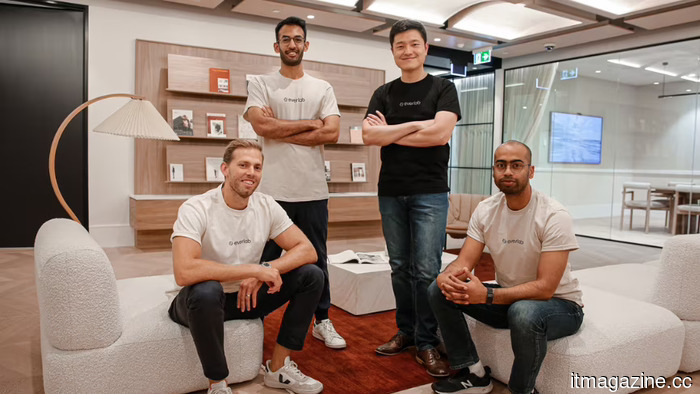
Everlab secures AU$65 million to shift primary care focus from treatment to prevention.
The Melbourne-based healthtech company Everlab, which recently closed an oversubscribed Series A funding round led by Airtree Ventures, is using the AU$65 million raised to expand into the UK and develop a system that manages a patient’s health data throughout their lifetime rather than just during individual appointments.
Most healthcare systems are designed to respond after an issue arises, with appointments made only when symptoms appear, resulting in fragmented records and numerous specialists who seldom communicate. In contrast, Everlab, established in 2023, focuses on the idea that a more valuable system is one that identifies health problems before they become apparent to patients.
Participating in the Series A, which was well received beyond expectations, were Airtree Ventures from Australia, Europe's Plural, and existing supporters such as Left Lane Capital in the US and b2venture in Europe. Notably, Australian Test cricket captain Pat Cummins is among the angel investors. This new funding marks a significant increase from the US$10 million seed round that the company secured less than a year ago in July 2025.
The funding will facilitate a transition from a variety of services to a unified platform. Everlab’s application integrates diagnostics, doctors, specialists, prescriptions, and what it calls continuous AI care, allowing patients to have a comprehensive view of their health over time, rather than just fragmented snapshots.
The company reports that it works with over 1,850 health-provider locations, more than 180 active clinicians, and over 30 wearable devices, processing around 200,000 health reports monthly.
Marc Hermann, Everlab’s co-founder and CEO, noted, “The existing system is fragmented, passing patients between providers while hoping that information is shared.” He emphasized that Everlab was designed to provide a complete view, highlight health blind spots, and coordinate next steps in care.
This concept echoes throughout the healthcare industry, as seen with companies like Perplexity Health and various medical wearables that feed data into clinical platforms. The emphasis is shifting from the device or appointment itself to the layer that bridges and interprets these elements.
Everlab's metrics focus on engagement and detection. The company claims to have conducted over 40,000 consultations for 20,000 patients, including corporate clients such as Boston Consulting Group, BHP, and Bain & Company, processing more than 21 million biomarker results. Over a quarter of its members have had health issues identified that the traditional system overlooked, a key element of its preventive approach.
Carina Namih, a partner at Plural, highlighted this distinction as the core of the investment strategy, stating, “Companies that have attempted to take control of the patient journey have generally ended up either charging by the minute for doctor consultations or reselling lab tests with narrow profit margins.” She believes that “Everlab is creating the layer above both.”
John Henderson from Airtree was more direct about the company’s ambitions, describing Everlab as “a generational health business” already leading in Australia and poised to expand successfully on a global scale.
The initial step in this international expansion is the United Kingdom, which Everlab identifies as its first market outside Australia and a gateway into the $10 trillion global consumer healthcare market. The funding will be directed towards enhancing its clinical and technological frameworks and accelerating its launch.
The real challenge for the company is proving that preventive care, which is highly sought after in health systems but not often operationalized effectively, can be implemented at scale while remaining financially viable.
Other articles
 According to The Information, OpenAI incurred a loss of $3.7 billion in the first quarter.
In the first quarter of 2026, OpenAI incurred expenses of $3.7 billion, which is more than half of its revenue of $5.7 billion, with both amounts having tripled compared to the previous year, according to The Information. The company currently has $73 billion in cash.
According to The Information, OpenAI incurred a loss of $3.7 billion in the first quarter.
In the first quarter of 2026, OpenAI incurred expenses of $3.7 billion, which is more than half of its revenue of $5.7 billion, with both amounts having tripled compared to the previous year, according to The Information. The company currently has $73 billion in cash.
 A hacking group has asserted that it infiltrated Novo Nordisk and is requesting a ransom of $25 million.
FulcrumSec claims to have extracted 1.3TB of data from Novo Nordisk and is requesting $25 million. The manufacturer of Ozempic acknowledged the breach but declined to make any payment.
A hacking group has asserted that it infiltrated Novo Nordisk and is requesting a ransom of $25 million.
FulcrumSec claims to have extracted 1.3TB of data from Novo Nordisk and is requesting $25 million. The manufacturer of Ozempic acknowledged the breach but declined to make any payment.
 Telegram contests India's directive to temporarily suspend the app.
Telegram has approached the Delhi High Court regarding a government directive that restricts its services until 22 June, related to supposed cheating in India’s NEET-UG medical examination.
Telegram contests India's directive to temporarily suspend the app.
Telegram has approached the Delhi High Court regarding a government directive that restricts its services until 22 June, related to supposed cheating in India’s NEET-UG medical examination.
.jpg) What Distinguishes Success from Failure in AI Implementation (Insights from Automotive Retail)
Dek: AI necessitates a commitment to responsibility and purposeful use. Below are illustrations of how car retailers are applying AI successfully and securely. Recall the classic Spider-Man saying? The one his Uncle Ben imparts (or Aunt May in the latest films) regarding how "with great power comes great responsibility"? If there was ever a […]
What Distinguishes Success from Failure in AI Implementation (Insights from Automotive Retail)
Dek: AI necessitates a commitment to responsibility and purposeful use. Below are illustrations of how car retailers are applying AI successfully and securely. Recall the classic Spider-Man saying? The one his Uncle Ben imparts (or Aunt May in the latest films) regarding how "with great power comes great responsibility"? If there was ever a […]
 Europe worries about American AI as the tech industry converges in France.
The G7 in Evian and VivaTech in Paris commence this week, focusing on European AI sovereignty, just days after the US restricted access to Anthropic's leading models.
Europe worries about American AI as the tech industry converges in France.
The G7 in Evian and VivaTech in Paris commence this week, focusing on European AI sovereignty, just days after the US restricted access to Anthropic's leading models.
 Intel advances 18A-P into risk production to demonstrate its manufacturing capabilities.
Intel has announced that the next version of its 18A process has begun risk production, asserting a 9% increase in performance as it aims to attract external foundry clients.
Intel advances 18A-P into risk production to demonstrate its manufacturing capabilities.
Intel has announced that the next version of its 18A process has begun risk production, asserting a 9% increase in performance as it aims to attract external foundry clients.
Everlab secures AU$65 million to shift primary care focus from treatment to prevention.
Melbourne healthtech company Everlab has successfully secured AU$65 million in an oversubscribed Series A round, led by Airtree. This funding will support its launch in the UK and efforts to expand into preventative care.