
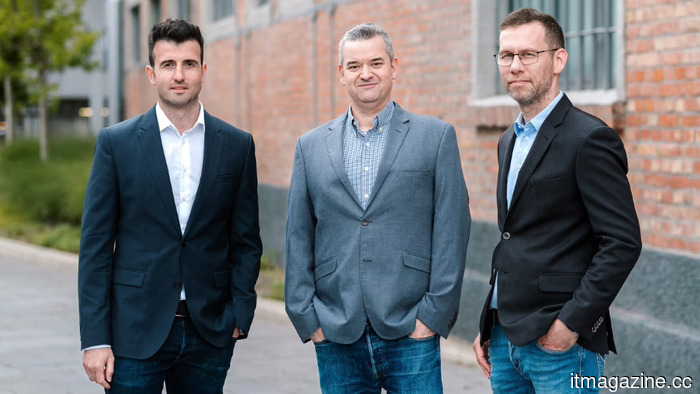
Kodesage secures $6.6 million to bring enterprise legacy software into the AI age, ensuring it remains within the organization.
The startup based in London and Budapest operates its modernization AI entirely on-premise, targeting banks and insurers whose core systems still rely on COBOL and Oracle Forms. Often, the most crucial software within a bank is also the least understood; it has been running core processes for decades, and the engineers who originally developed it are no longer around. Modifying this software is typically slow, costly, and risky, leading to a situation where much of it remains unchanged. Kodesage aims to address this issue and recently secured $6.6M in funding to pursue its goals.
The seed funding round is led by VentureFriends, with pre-seed lead Portfolion returning alongside a diverse group of angel investors: Christian Szegedy, co-founder of Elon Musk’s xAI, and Mario Götze, the footballer who scored the winning goal for Germany in the 2014 World Cup. This follows a pre-seed round of about €2.3M the company obtained in early 2025.
Kodesage, established in 2024 by Gergely Dombi, Miklos Szurdi, and Gyorgy Szilagyi, has a significant pedigree that enhances its pitch. Dombi and Szurdi previously created a consultancy with over 300 employees that specialized in modernizing legacy systems, repeatedly encountering the same challenge: projects that extended for years due to the knowledge being confined to a select few specialists. Szilagyi, a co-founder of Tresorit—an encrypted storage company acquired by Swiss Post in 2021—also adds to the team’s qualifications.
The core technical challenge Kodesage is tackling is straightforward but unremarkable. Legacy systems built using COBOL, PL/SQL, PowerBuilder, RPG, or Oracle Forms often do not organize their business logic in a clear manner within the source code. Instead, logic is buried in stored procedures, database schemas, and configuration—much of which is undocumented and has accumulated over decades.
The Kodesage platform conducts what the company describes as automated deep discovery of these codebases, extracting the hidden logic and creating a live documentation layer accessible by both human teams and AI agents. From this base, it enables context-aware code conversion, automated test generation, and AI-assisted production support.
A key differentiator for Kodesage is the environment in which it operates. Unlike modern cloud AI coding tools that exist outside organizational boundaries, the heavily regulated sectors needing legacy modernization—such as banking, insurance, energy, transport, and the public sector—cannot connect their core databases to a public cloud. Consequently, the institutional knowledge that AI would best serve is often restricted due to compliance regulations.
Kodesage’s solution is to function entirely within the client’s environment: on-premise, in a virtual private cloud, or fully air-gapped when necessary. This ensures that source code, schemas, and database content stay under the organization’s control.
This architecture also separates costs from per-token cloud pricing, which the company argues makes expenses more predictable for enterprises cautious of unpredictable AI billing. Szilagyi’s experience with Tresorit, a business founded on the principle of keeping data within user control, is evident in the model’s design.
Kodesage is particularly focused on modernizing Oracle Forms, offering a dedicated toolkit aimed at a stack that remains prevalent in regulated sectors and is often inadequately served by mainstream tools. The company claims that its migration methods, such as converting Oracle Forms to Oracle APEX, can speed up conversions by as much as threefold and reduce documentation efforts by over 80%. These figures come from the company and have not been independently verified, and the "multi-trillion-dollar drag" referenced by CEO Gergely Dombi relates to the significance of the problem rather than a formally assessed figure.
Dombi’s vision extends beyond mere migration. He envisions “self-healing enterprise applications,” systems where AI agents handle preparation, testing, and implementation of fixes, allowing engineers to focus on review and approval instead of diagnosis and coding from scratch. This concept is quite different from simple automated documentation, and the company presents it as a future direction rather than an immediate product offering.
The new funding will facilitate a go-to-market strategy in the United States and Europe, as well as increased hiring in engineering and product development. Kodesage is joining a competitive landscape focused on leveraging AI for enterprises grappling with unresolved legacy software issues. Its strategy is that the most successful players will be those permitted to operate within the enterprise environment.
Other articles
 The UK regulator has established new regulations for Google search, which include an option to opt-out of AI training.
The UK's CMA has established new conduct rules for Google search, allowing publishers to opt out of AI training and requiring fair ranking and selection screens.
The UK regulator has established new regulations for Google search, which include an option to opt-out of AI training.
The UK's CMA has established new conduct rules for Google search, allowing publishers to opt out of AI training and requiring fair ranking and selection screens.
 ChatGPT reached 1 billion monthly users more quickly than any other app in history.
According to estimates from Sensor Tower, ChatGPT reached over 1 billion monthly active app users in approximately three years, making it the fastest app to achieve this milestone.
ChatGPT reached 1 billion monthly users more quickly than any other app in history.
According to estimates from Sensor Tower, ChatGPT reached over 1 billion monthly active app users in approximately three years, making it the fastest app to achieve this milestone.
 The Anker Solix S2000 can sustain your refrigerator during extended power outages and is now available for purchase.
The Anker SOLIX S2000 is currently priced at $680 and provides up to 35 hours of uninterrupted refrigerator support, features exclusive OptiSave Technology, and has a battery lifespan of 15 years.
The Anker Solix S2000 can sustain your refrigerator during extended power outages and is now available for purchase.
The Anker SOLIX S2000 is currently priced at $680 and provides up to 35 hours of uninterrupted refrigerator support, features exclusive OptiSave Technology, and has a battery lifespan of 15 years.
 The Anker Solix S2000 can maintain your refrigerator's operation during extended power outages, and it’s now available for purchase.
The Anker SOLIX S2000 is now priced at $680, providing up to 35 hours of uninterrupted refrigerator support, exclusive OptiSave Technology, and a battery lifespan of 15 years.
GitLab will reduce its workforce by 14% and withdraw from 22 countries as part of a restructuring known as the ‘agentic era.’
GitLab plans to reduce its workforce by approximately 350 positions and withdraw from 22 countries, as revealed in its Q1 report, which showed a 23% increase in revenue to $264.2 million.
The Anker Solix S2000 can maintain your refrigerator's operation during extended power outages, and it’s now available for purchase.
The Anker SOLIX S2000 is now priced at $680, providing up to 35 hours of uninterrupted refrigerator support, exclusive OptiSave Technology, and a battery lifespan of 15 years.
GitLab will reduce its workforce by 14% and withdraw from 22 countries as part of a restructuring known as the ‘agentic era.’
GitLab plans to reduce its workforce by approximately 350 positions and withdraw from 22 countries, as revealed in its Q1 report, which showed a 23% increase in revenue to $264.2 million.
Kodesage secures $6.6 million to bring enterprise legacy software into the AI age, ensuring it remains within the organization.
Kodesage secured $6.6 million in seed funding, led by VentureFriends, to update outdated enterprise software using on-premise AI that remains within the customer's environment.