
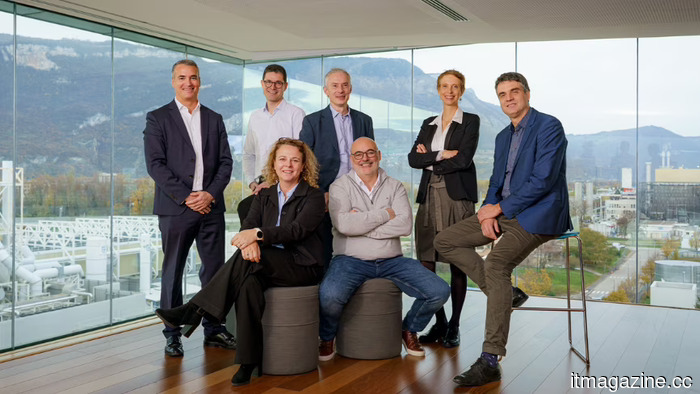
France's Quobly secures €115 million to place a quantum computer on a silicon chip.
Many quantum-computing startups seek to create an entirely new industry around them, involving exotic materials, custom fabrication, and supply chains that currently do not exist. However, Quobly is opting for a more understated approach. The Grenoble-based company believes the pathway to a practical quantum machine lies within the already established silicon chip industry, and on Wednesday, it secured €115M, approximately $133M, to support this vision.
The Series A funding round is led by Bpifrance, a state-backed entity from France, along with chip manufacturer STMicroelectronics and SEALSQ, and includes contributions from the European Innovation Council Fund, Blast, Air Liquide’s venture capital branch ALIAD, and existing investor Innovacom. This funding marks a significant increase from the roughly €21M the company raised last year to create a 100-qubit chip, and it is specifically geared toward industrialization instead of research.
The investor lineup reflects this strategy. STMicroelectronics is one of Europe’s prominent chip manufacturers, and Quobly's concept relies heavily on partnerships with such entities. Instead of developing a new method for constructing qubits, Quobly integrates them into silicon using the same manufacturing processes that currently produce conventional processors at scale. If successful, this could allow quantum chips to benefit from the cost efficiencies and manufacturing capabilities of an industry that has honed its ability to create silicon affordably and reliably over many years.
This potential is what draws a significant amount of strategic and government funding to Quobly. Bpifrance brings government backing and a commitment to support quantum initiatives worth half a billion euros; STMicroelectronics offers manufacturing facilities; and SEALSQ contributes a stake in the European sovereign-infrastructure narrative that has become central to the continent's technology policy.
Quantum computing is part of a broader strategy for autonomy that also encompasses chips, AI processing, and defense initiatives throughout Europe. Quobly intends to launch its first commercial machine, named Alloy, in the cloud by the end of 2026. The initial system, Alloy Pioneer, will target early adopters in high-performance computing and research, becoming accessible remotely in 2026, followed by its integration into HPC infrastructure in 2027. This phased approach is significant as it paves the way for blending with existing supercomputing resources rather than pursuing a standalone quantum breakthrough.
However, there are limitations that affect the entire sector. Silicon-based, or spin-qubit, quantum computing is just one of several competing methodologies, which include superconducting circuits, trapped ions, photonics, and neutral atoms. None of these architectures have yet proven a definitive, large-scale advantage in terms of fault tolerance. Quobly argues that manufacturability will ultimately outweigh mere qubit quantity in importance, although this remains a future projection rather than an established fact. A 100-qubit chip represents a crucial milestone, but it does not equate to a functioning fault-tolerant computer.
This funding indicates that European investors are ready to support the long-term vision. The €115M is among the largest quantum funding rounds seen in Europe, and the combination of public and strategic financing reflects an intent to retain the technology and its underlying manufacturing within Europe.
The broader context involves a continent that observed the AI computing sector become predominantly dominated by American companies and is now determined to avoid a similar situation in the quantum domain. Whether silicon will ultimately emerge as the preferred material for quantum computing remains to be seen and will depend on ongoing scientific developments. What has been clarified by Wednesday's funding is that Quobly now possesses the necessary resources to investigate this potential and has a chipmaker involved in its development process. The debut of its first cloud machine is anticipated by the end of the year, and the critical next step is to ensure the qubits' effectiveness.
Other articles
 Martin Scorsese has officially aligned himself with the AI movement, and it's not what anyone anticipated.
Martin Scorsese has joined as a partner and advisor at the AI startup Black Forest Labs, utilizing its technology for storyboarding in an upcoming film.
Martin Scorsese has officially aligned himself with the AI movement, and it's not what anyone anticipated.
Martin Scorsese has joined as a partner and advisor at the AI startup Black Forest Labs, utilizing its technology for storyboarding in an upcoming film.
 Instagram will cease overwhelming teenagers with repetitive, obsessively unhealthy content.
Meta is trialing a new feature on Instagram aimed at stopping teens from repeatedly encountering the same content, as it rolls out 13+ content settings worldwide.
Instagram will cease overwhelming teenagers with repetitive, obsessively unhealthy content.
Meta is trialing a new feature on Instagram aimed at stopping teens from repeatedly encountering the same content, as it rolls out 13+ content settings worldwide.
 Martin Scorsese has officially aligned himself with the AI group, and it's not what anyone anticipated.
Martin Scorsese has agreed to join as a partner and advisor to the AI startup Black Forest Labs, utilizing its technology for storyboarding in an upcoming film.
Martin Scorsese has officially aligned himself with the AI group, and it's not what anyone anticipated.
Martin Scorsese has agreed to join as a partner and advisor to the AI startup Black Forest Labs, utilizing its technology for storyboarding in an upcoming film.
 Amazfit has recently launched a smartwatch designed for individuals who train intensely but find recovery challenging.
The Amazfit Balance Ultra is designed for individuals who frequently run, lift weights, and train, equipped with features that indicate when the body is prepared to exert effort and when it requires recovery.
Amazfit has recently launched a smartwatch designed for individuals who train intensely but find recovery challenging.
The Amazfit Balance Ultra is designed for individuals who frequently run, lift weights, and train, equipped with features that indicate when the body is prepared to exert effort and when it requires recovery.
 Silo season 3 will finally reveal how the world came to an end.
The trailer for season 3 of Silo has arrived, offering a glimpse into the long-awaited origin story, featuring a split timeline, alterations of memory, and a conspiracy set before the apocalypse.
Silo season 3 will finally reveal how the world came to an end.
The trailer for season 3 of Silo has arrived, offering a glimpse into the long-awaited origin story, featuring a split timeline, alterations of memory, and a conspiracy set before the apocalypse.
 Instagram will cease overwhelming teenagers with repetitive, excessively unhealthy content.
Meta is trialing a new feature on Instagram aimed at preventing teenagers from receiving the same content multiple times, while it rolls out 13+ content settings worldwide.
Instagram will cease overwhelming teenagers with repetitive, excessively unhealthy content.
Meta is trialing a new feature on Instagram aimed at preventing teenagers from receiving the same content multiple times, while it rolls out 13+ content settings worldwide.
France's Quobly secures €115 million to place a quantum computer on a silicon chip.
French quantum startup Quobly secured €115 million ($133 million) in funding, with Bpifrance, STMicroelectronics, and SEALSQ leading the investment, to advance the industrialization of its silicon-based quantum computers.