
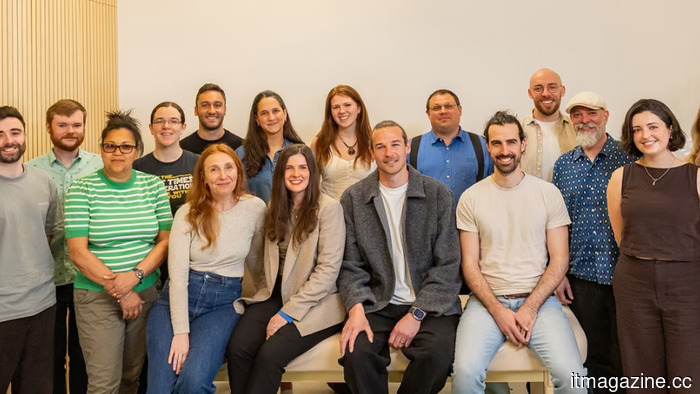
Flok Health secures $12.5M to expand an AI physiotherapist approved by the NHS for unsupervised operations.
The Cambridge clinic has received regulatory approval to triage, treat, and discharge patients without a clinician involved. It now aims to extend this model to cover hip, knee, and pelvic health conditions.
What makes Flok Health notable is not simply that an AI conducts physiotherapy sessions; rather, it is that the NHS has sanctioned the AI to operate independently. This Cambridge-based company has regulatory approval to diagnose, treat, and discharge patients without any clinician overseeing the process. Recently, it secured $12.5 million to broaden its model to encompass more areas of the body and reach a larger geographic scope.
The oversubscribed Series A funding round is led by AlbionVC, with participation from existing supporters Eka VC and Form Ventures, along with new investor Mercia Ventures. The funding will facilitate the scaling of Flok’s back-pain service throughout the UK and support the launch of three additional care pathways—hip and knee pain, as well as women’s pelvic health—set to debut in the UK this year.
What distinguishes Flok from the wide range of healthcare chatbots is its regulatory approval. The company is the first AI system in Europe to obtain Class IIa medical device certification for independently managing complete care pathways, and it is the only digital musculoskeletal service recognized as a healthcare provider by the UK’s Care Quality Commission.
These approvals enable it to triage, treat, and discharge NHS patients without human supervision—an achievement that most AI health tools have intentionally avoided.
Flok's product is uniquely engineered. Instead of using an animated avatar, it utilizes actual footage of a human physiotherapist to create a live video experience that responds in real time to patient interactions. This design aims to maintain the feel of a clinician-led session, providing patients with a sense of being seen and guided, while the underlying system handles clinical reasoning.
The product was developed by Finn Stevenson, a former medic and rower, alongside Ric da Silva, a software engineer, who met while working at the surgical robotics firm CMR Surgical.
Trust in the service is founded on NHS data rather than theoretical claims. The service now reaches over 2.4 million patients across eleven NHS areas, offering immediate back-pain appointments without waitlists. In one rollout in England, over 80% of patients rated the AI clinic as “as good or better than” traditional physiotherapy, and the pathway saved an average of 856 clinical hours per month at a single trust, allowing physiotherapists to focus on more complex cases that still require human intervention.
This last point is critically important for Flok, as it emphasizes a genuine need. Low back pain is the leading cause of disability globally, with over 390,000 individuals awaiting musculoskeletal treatment in England alone, even though most conditions are treatable.
Chief Executive Stevenson describes the company's objective as bridging a supply-demand gap that hiring more clinicians one by one cannot resolve. The new pathways would enable the AI to manage conditions affecting over 20 million people annually in the UK.
However, questions surrounding autonomous care remain unresolved by a funding round. An AI that discharges patients without clinician involvement presents a different liability profile compared to one that provides advice. Issues surrounding edge cases and missed red flags become more significant when there is no human reviewing decisions, and while Flok has demonstrated strong results in back pain, the pathways for hip, knee, and pelvic health are untested territory. The regulatory approval Flok has achieved is specific to the conditions it has already demonstrated proficiency in.
For the time being, the company has accomplished what many digital health startups only promise: it has introduced an autonomous clinical product to millions of actual patients within a real healthcare system and produced reliable results. The recent $12.5 million investment is a wager that the model effective for back pain will also succeed for other conditions. Ultimately, as is often the case in healthcare, the proof will lie in the upcoming pathways rather than the previous ones.
Other articles
 A malware campaign targeting Minecraft is said to have infected more than 116,000 players.
According to researchers, a malware campaign masquerading as Minecraft mods and cheats has infected more than 116,000 devices via Discord servers and gaming communities.
A malware campaign targeting Minecraft is said to have infected more than 116,000 players.
According to researchers, a malware campaign masquerading as Minecraft mods and cheats has infected more than 116,000 devices via Discord servers and gaming communities.
 A breakthrough in storage technology offers the possibility of secure data recovery even if hackers compromise your computer.
A storage-focused cybersecurity system enables the recovery of deleted data for up to 126 days while maintaining minimal effect on drive performance.
A breakthrough in storage technology offers the possibility of secure data recovery even if hackers compromise your computer.
A storage-focused cybersecurity system enables the recovery of deleted data for up to 126 days while maintaining minimal effect on drive performance.
 A storage innovation offers the potential for secure data recovery, even in the event that hackers compromise your computer.
A storage-oriented cybersecurity system allows for the recovery of deleted data for up to 126 days while only slightly affecting drive performance.
A storage innovation offers the potential for secure data recovery, even in the event that hackers compromise your computer.
A storage-oriented cybersecurity system allows for the recovery of deleted data for up to 126 days while only slightly affecting drive performance.
 DeepSeek secures its initial external funding: a $7 billion round valuing the company at up to $59 billion.
China's DeepSeek plans to raise approximately $7 billion in its initial funding round, with supporters including Tencent and CATL, at a valuation of as much as $59 billion.
DeepSeek secures its initial external funding: a $7 billion round valuing the company at up to $59 billion.
China's DeepSeek plans to raise approximately $7 billion in its initial funding round, with supporters including Tencent and CATL, at a valuation of as much as $59 billion.
 Amazfit has recently launched a smartwatch designed for individuals who train intensely but find recovery challenging.
The Amazfit Balance Ultra is designed for individuals who frequently run, lift weights, and train, equipped with features that indicate when the body is prepared to exert effort and when it requires recovery.
Amazfit has recently launched a smartwatch designed for individuals who train intensely but find recovery challenging.
The Amazfit Balance Ultra is designed for individuals who frequently run, lift weights, and train, equipped with features that indicate when the body is prepared to exert effort and when it requires recovery.
 France's Quobly secures €115M to develop a quantum computer on a silicon chip.
French quantum startup Quobly secured €115 million ($133 million) in funding, with Bpifrance, STMicroelectronics, and SEALSQ leading the investment to industrialize its silicon-based quantum computing technology.
France's Quobly secures €115M to develop a quantum computer on a silicon chip.
French quantum startup Quobly secured €115 million ($133 million) in funding, with Bpifrance, STMicroelectronics, and SEALSQ leading the investment to industrialize its silicon-based quantum computing technology.
Flok Health secures $12.5M to expand an AI physiotherapist approved by the NHS for unsupervised operations.
Flok Health secured $12.5 million in a Series A funding round led by AlbionVC to expand its CQC-approved AI physiotherapy clinic, which is currently providing treatment for back pain to 2.4 million NHS patients.