
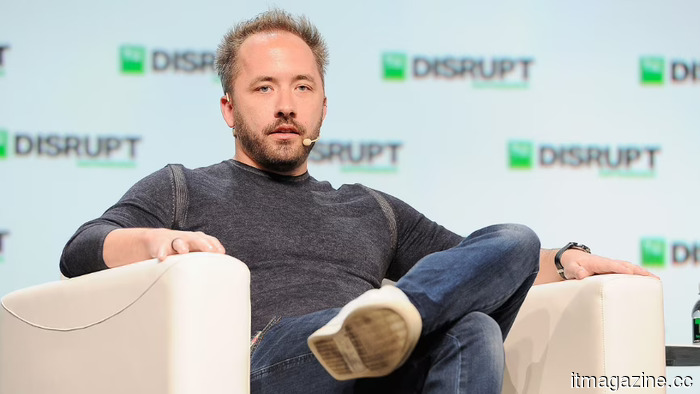
Dropbox co-founder Drew Houston resigns from his position as CEO.
**Summary**: Drew Houston is resigning as CEO of Dropbox after 19 years, with Ashraf Alkarmi, the former Vimeo CPO, succeeding him. The company’s market value has decreased by 50% since its 2018 IPO due to competition from Google, Apple, and Microsoft in the storage market.
Drew Houston, co-founder of Dropbox, which evolved from a Y Combinator demo into a platform with over 700 million registered users, is stepping down from his role as CEO. Ashraf Alkarmi, currently the head of product at Dropbox, has been appointed co-CEO effective immediately. Following a transition period, Houston will assume the role of executive chairman, and Alkarmi will then fully take over as CEO.
Dropbox shares fell about 2.4% in premarket trading after the announcement. The company's market capitalization now exceeds $6 billion, halved since its peak on its first trading day in March 2018.
At 43, Houston indicated to CNBC that his next endeavors will be entrepreneurial and focused on AI. He did not specify his next project but clarified that retirement or sailing is not in his plans. Alkarmi, 47, joined Dropbox in November 2024 as senior vice president and general manager of Dropbox Core. Previously, he served as the chief product officer at Vimeo from 2022 to 2024 and held senior product roles at Amazon from 2018 to 2022, where he led Amazon Freevee. Alkarmi also managed product development at Meta and co-founded PresAsk, an audience engagement platform. Houston acknowledged Alkarmi for enhancing the company's responsiveness to customers and for pursuing more innovative approaches.
This leadership transition coincides with another senior appointment. Michael Torres, currently vice president of product at Google Chrome, will join Dropbox as chief product officer on July 7. Torres previously held the position of vice president and general manager of Kindle at Amazon.
The leadership change reflects Dropbox's long-standing strategic challenges. While Dropbox was a pioneer in consumer cloud storage, it faced significant competition as Google Drive, Apple iCloud, and Microsoft OneDrive integrated comparable features into their operating systems and productivity tools for free. Although Dropbox's core file synchronization business generated $629.5 million in revenue in the first quarter of 2026, growth has plateaued at below 1% year-over-year. Excluding FormSwift, which the company plans to discontinue by the end of 2026, revenue grew by 2%.
In recent years, Houston focused on repositioning Dropbox with an emphasis on AI. The centerpiece of this initiative is Dropbox Dash, an AI-driven universal search tool that consolidates content from over 30 workplace applications, such as Slack, Gmail, Google Workspace, and Microsoft Teams, into a single searchable platform. Dash utilizes retrieval-augmented generation to summarize documents, compare files, and provide answers across a company's dispersed information.
However, the challenges stem from competitors developing similar capabilities within their own platforms. Google has introduced an AI agent platform at Cloud Next 2026 that integrates search, summarization, and workflow automation into Workspace. Microsoft has embedded Copilot across OneDrive, Teams, and the entire 365 suite. Both companies possess the distribution channels, data, and computational resources that Dropbox lacks.
In response, Dropbox has implemented cost-cutting measures, laying off 16% of its workforce in 2023 and undergoing further restructuring in 2024. It ended the first quarter of 2026 with $1.3 billion in cash reserves. However, improved efficiency alone does not address the growth dilemma, and Alkarmi's primary task is to establish a product-led strategy moving forward.
Transitions from founder-led to operator-led CEOs are common in evolving tech firms, but they come with risks. The new leader inherits both the strategic direction and cultural identity established by the founder. Alkarmi's tenure at Dropbox has been just 18 months. It remains uncertain whether he can achieve the product innovation necessary while maintaining employee loyalty amid previous layoffs.
For Houston, this resignation marks the conclusion of a journey that began in 2007 when he lost a USB drive on a bus and sought to provide a solution. Dropbox ultimately defined an entire product category. The fact that larger platform companies have since absorbed that category does not diminish Houston's accomplishments but highlights the reasons for his departure and the need for a different type of leadership for the next phase.
Other articles
 Netcraze has introduced Stellar 6 - an outdoor Wi-Fi 6 access point with PoE support.
The device expands the capabilities of the Netcraze ecosystem in professional scenarios where network equipment requires stable operation outdoors across a wide temperature range and under the influence of adverse weather conditions.
Netcraze has introduced Stellar 6 - an outdoor Wi-Fi 6 access point with PoE support.
The device expands the capabilities of the Netcraze ecosystem in professional scenarios where network equipment requires stable operation outdoors across a wide temperature range and under the influence of adverse weather conditions.
 An Intel leak suggests that the forthcoming Nova Lake Edge processors will feature an unusual core configuration.
Intel's Nova Lake Edge is said to be omitting P-cores altogether, opting instead for eight E-cores and 12 Xe graphics cores.
An Intel leak suggests that the forthcoming Nova Lake Edge processors will feature an unusual core configuration.
Intel's Nova Lake Edge is said to be omitting P-cores altogether, opting instead for eight E-cores and 12 Xe graphics cores.
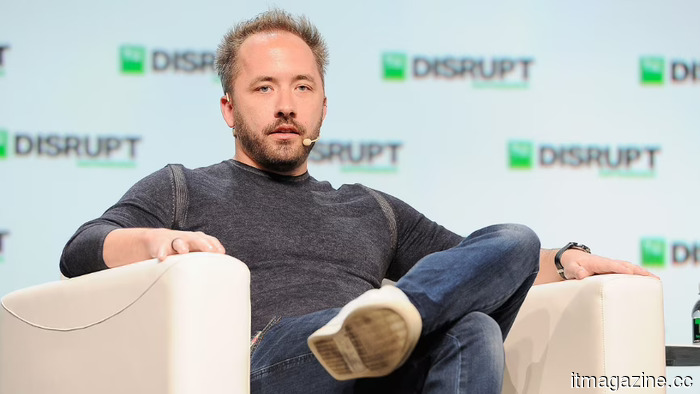 Drew Houston, the founder of Dropbox, has resigned from his position as CEO.
Drew Houston resigns as CEO of Dropbox after 19 years at the helm. Ashraf Alkarmi, a former executive at Vimeo and Amazon, is set to lead a company whose market capitalization has decreased by 50% since 2018.
Drew Houston, the founder of Dropbox, has resigned from his position as CEO.
Drew Houston resigns as CEO of Dropbox after 19 years at the helm. Ashraf Alkarmi, a former executive at Vimeo and Amazon, is set to lead a company whose market capitalization has decreased by 50% since 2018.
 Netherlands prevents US company from acquiring DigiD cloud hosting provider.
The Netherlands has prohibited Kyndryl's acquisition of Solvinity for EUR 100 million, which is the DigiD cloud provider, due to concerns over public interest and potential issues related to the CLOUD Act, marking the first instance of a block on a US deal.
Netherlands prevents US company from acquiring DigiD cloud hosting provider.
The Netherlands has prohibited Kyndryl's acquisition of Solvinity for EUR 100 million, which is the DigiD cloud provider, due to concerns over public interest and potential issues related to the CLOUD Act, marking the first instance of a block on a US deal.
 Brussels intends to set aside two-thirds of the EU mobile-satellite spectrum specifically for European companies.
The EU plans to allocate two-thirds of its future 2 GHz mobile-satellite-services spectrum for European companies, allowing Starlink and Kuiper to compete for the remaining one-third.
Brussels intends to set aside two-thirds of the EU mobile-satellite spectrum specifically for European companies.
The EU plans to allocate two-thirds of its future 2 GHz mobile-satellite-services spectrum for European companies, allowing Starlink and Kuiper to compete for the remaining one-third.
 Brussels intends to reserve two-thirds of the EU mobile-satellite spectrum for companies based in Europe.
The EU plans to allocate two-thirds of its upcoming 2 GHz mobile-satellite-services spectrum exclusively for European companies, allowing Starlink and Kuiper to compete for the remaining one-third.
Brussels intends to reserve two-thirds of the EU mobile-satellite spectrum for companies based in Europe.
The EU plans to allocate two-thirds of its upcoming 2 GHz mobile-satellite-services spectrum exclusively for European companies, allowing Starlink and Kuiper to compete for the remaining one-third.
Dropbox co-founder Drew Houston resigns from his position as CEO.
Drew Houston has resigned as CEO of Dropbox after 19 years. Ashraf Alkarmi, a past executive at Vimeo and Amazon, will succeed him at a company whose market capitalization has decreased by half since 2018.