
Waymo's robotaxis continue to navigate into floodwaters. The software update was ineffective. Five cities are currently in lockdown.
Waymo has paused its robotaxi services in five U.S. cities after a recent software update failed to prevent autonomous vehicles from driving into flooded areas. The halt in operations began on May 21, following an incident where a driverless Waymo vehicle became stuck in floodwaters in Midtown Atlanta during severe storms. This issue mirrors a previous recall on May 8 and a service interruption in San Antonio the month prior.
Operations have been suspended in Atlanta, Austin, Dallas, Houston, and San Antonio, which had already been offline since late April. Additionally, freeway rides have been halted in San Francisco, Los Angeles, Phoenix, and Miami while the company works on enhancing its vehicles’ performance in construction zones. Waymo has stated that it aims to resume these routes soon but has not specified when.
The underlying issue is a software design flaw that could lead vehicles to slow down and then inadvertently drive into standing water on high-speed roads. In the April 20 incident in San Antonio, an empty Waymo robotaxi detected flooding on a road with a 40 mph speed limit, slowed down, and then drove into the water due to a lack of a hard-stop option within its decision-making system, resulting in the vehicle being carried into a creek. Waymo issued a voluntary recall for 3,791 robotaxis and implemented an interim software update that aimed to limit operations during flood risks, although it did not prevent the Atlanta incident.
Waymo has acknowledged that a permanent solution is still not available. When the recall was issued, the company recognized that the "final remedy" for avoiding flooded areas had yet to be developed. The Atlanta flooding occurred before any official flash flood warnings were issued by the National Weather Service, which meant Waymo's weather-monitoring system, dependent on such alerts, had no information to act upon. The company stated to the BBC that safety remains its “highest priority” and that it is monitoring forecasts and weather conditions closely.
This flooding issue marks Waymo’s third recall since February 2024. The initial recall involved 444 vehicles after two Phoenix robotaxis collided with the same improperly towed vehicle. The second recall in May 2025 included 1,212 vehicles that were involved in low-speed collisions with fixed obstacles like parking gates and telephone poles. Two ongoing investigations by the National Highway Traffic Safety Administration (NHTSA) are also looking into separate failure modes, including one concerning a January incident where a Waymo robotaxi struck a child.
The suspension of freeway services was prompted by a related concern after a Waymo passenger reported on May 19 that a robotaxi accelerated to highway speeds through construction zones on a closed freeway, triggering a police pursuit. Waymo has not addressed this specific incident but has stated it is reviewing its vehicles' freeway performance in such areas.
These service disruptions come as Waymo is rapidly expanding. Uber recently signed a deal valued at up to $1.25 billion for up to 50,000 autonomous Rivian R2 robotaxis, and Waymo currently provides over 500,000 paid trips weekly in various U.S. cities. The company plans to expand to San Diego, Las Vegas, and Detroit by 2026, aiming for one million paid rides per week by year-end. Waymo also hopes to introduce a robotaxi service in London later this year.
Meanwhile, Wayve, a London-based autonomous driving startup supported by Uber, raised $1.5 billion in February at an $8.6 billion valuation and plans to pilot robotaxi programs in London and Tokyo in 2026. Its AI-centered approach learns from driving data, contrasting with Waymo’s sensor-heavy, rules-based methodology. The flooding incidents highlight the shortcomings of Waymo’s system, which cannot account for every possible scenario, such as water on a well-mapped road.
Over the past year, driverless car services have experienced a series of issues that may appear minor when viewed individually but collectively diminish public trust. A large power outage in San Francisco in December 2025 left Waymo vehicles stalled across the city, creating significant disruption. In April, an Apollo Go robotaxi outage in Wuhan, China, caused over a hundred autonomous cars to halt mid-traffic. Each occurrence underscores a critical point: autonomous vehicles excel under conditions for which they were designed but can fail dramatically in unanticipated situations.
The autonomous vehicle industry is investing heavily in the belief that technology will eventually manage all driving scenarios a human can. Waymo is further along than other commercial operators, boasting a safety record over hundreds of millions of miles that is statistically strong. However, floods are not edge cases—they are common weather events. A robotaxi service that cannot operate effectively during heavy rains in cities like Atlanta or San Antonio, where such weather is typical, has not yet gained the trust necessary for its ambitious expansion plans. The eventual solution must not only address the software issue but also the trust deficit created by three recalls and service suspensions in five cities.
Other articles
 Moz Pro now monitors your brand within ChatGPT and Gemini | TNW Deals
The new AI Visibility feature from Moz Pro monitors your brand's presence in ChatGPT and Gemini responses, as well as your standing against competitors. Experience it for free.
Moz Pro now monitors your brand within ChatGPT and Gemini | TNW Deals
The new AI Visibility feature from Moz Pro monitors your brand's presence in ChatGPT and Gemini responses, as well as your standing against competitors. Experience it for free.
 Anthropic's Claude Mythos identified 10,000 critical vulnerabilities within a single month. The patches are unable to keep pace.
The partners of Project Glasswing utilized Claude Mythos to identify 1,094 verified high-severity vulnerabilities in over 1,000 open-source projects. Only 97 of these have been resolved.
Waymo's robotaxis continue to enter floodwaters. The software update was ineffective. Five cities are currently on lockdown.
A recall that occurred two weeks ago was intended to address the issue. However, an unmanned Waymo became stranded in a flood in Atlanta on Wednesday. A lasting solution is not available yet.
Anthropic's Claude Mythos identified 10,000 critical vulnerabilities within a single month. The patches are unable to keep pace.
The partners of Project Glasswing utilized Claude Mythos to identify 1,094 verified high-severity vulnerabilities in over 1,000 open-source projects. Only 97 of these have been resolved.
Waymo's robotaxis continue to enter floodwaters. The software update was ineffective. Five cities are currently on lockdown.
A recall that occurred two weeks ago was intended to address the issue. However, an unmanned Waymo became stranded in a flood in Atlanta on Wednesday. A lasting solution is not available yet.
 South Korea's deputy prime minister stated that the wealth generated by AI should serve the public good, highlighting this point through the recent Samsung strike.
Deputy PM Bae cautioned that labor disputes fueled by AI will continue to arise with the emergence of "super-large companies" and urged for the establishment of an "AI-inclusive society."
Corsair has begun to include Chinese DRAM in its DDR5 memory kits. This might lead to a decrease in memory prices.
CXMT chips have been identified within Corsair Vengeance DDR5 modules, as Samsung, SK Hynix, and Micron focus on AI memory instead of consumer PCs.
South Korea's deputy prime minister stated that the wealth generated by AI should serve the public good, highlighting this point through the recent Samsung strike.
Deputy PM Bae cautioned that labor disputes fueled by AI will continue to arise with the emergence of "super-large companies" and urged for the establishment of an "AI-inclusive society."
Corsair has begun to include Chinese DRAM in its DDR5 memory kits. This might lead to a decrease in memory prices.
CXMT chips have been identified within Corsair Vengeance DDR5 modules, as Samsung, SK Hynix, and Micron focus on AI memory instead of consumer PCs.
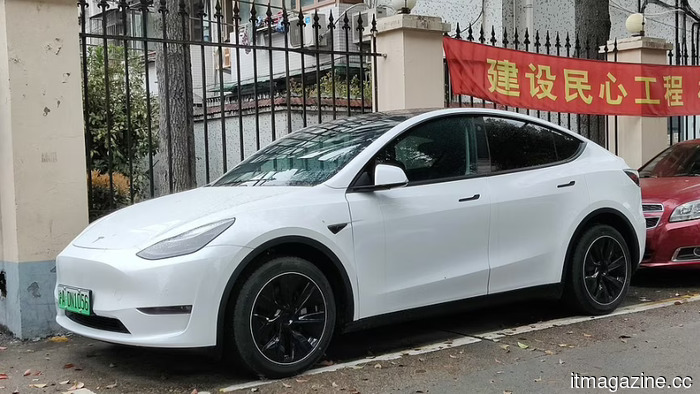 Tesla has finally introduced FSD in China, while its competitors have been offering self-driving vehicles in the country for several years.
Tesla's Full Self-Driving (Supervised) is now available in China, following Musk's visit with Trump to Beijing last week. Meanwhile, Chinese competitors are already providing Level 3 autonomy.
Tesla has finally introduced FSD in China, while its competitors have been offering self-driving vehicles in the country for several years.
Tesla's Full Self-Driving (Supervised) is now available in China, following Musk's visit with Trump to Beijing last week. Meanwhile, Chinese competitors are already providing Level 3 autonomy.
Waymo's robotaxis continue to navigate into floodwaters. The software update was ineffective. Five cities are currently in lockdown.
A recall that took place two weeks ago was intended to resolve the issue. An unmanned Waymo became trapped in a flood in Atlanta on Wednesday. There is still no permanent solution available.