
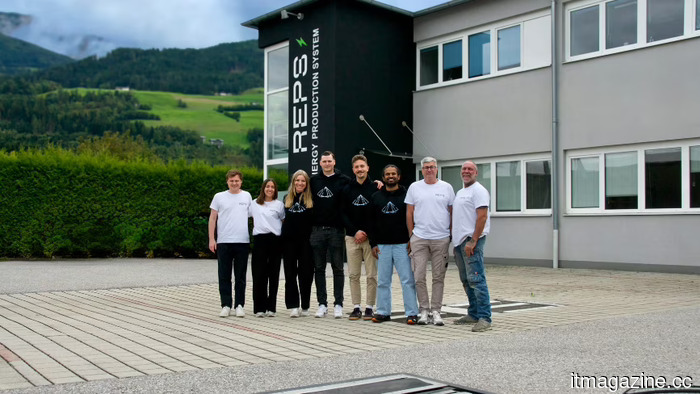
Austrian startup REPS secures $23.6 million to convert road traffic into electricity.
The Tyrol-based company REPS has connected its first "road power plant" to the Port of Hamburg. The subsequent challenge is to see if the economics hold up in other locations.
REPS, an Austrian startup established in 2023 by Alfons Huber, has raised $23.6 million to advance a technology with a straightforward concept: embed a slab in the roadway, allow trucks to traverse it, and capture the energy lost through friction and heat.
On Friday, the startup announced that the funding round will support the deployment of its patented Road Energy Production System to ports, logistics centers, and urban areas, though it did not disclose the identity of the leading investor.
This proposal falls under the category of energy harvesting, which has been intriguing in theory but disappointing in practice over the past twenty years. Previous converters lacked efficiency and had short lifespans, resulting in unviable economics.
Huber claims that REPS dedicated six years to redesigning the mechanical converter, achieving a result that is reportedly 254 times more efficient than the next best system available, although this figure has not been independently verified.
For the time being, the project's credibility is backed by just one installation. Since November 2025, a 12-meter REPS unit has been functioning at Hamburger Container Service in the Port of Hamburg, situated on a road where empty-container trucks decelerate to enter the depot.
REPS reports that over 115,000 trucks have passed over it since installation, producing more than 6,700 kWh of electricity, with these figures provided directly by the company rather than from a third-party meter.
"The installation at our facility illustrates REPS’s potential: where vehicles slow down anyway, clean energy is recovered and can be utilized directly at the point of need," said HCS CEO Justin Karnbach in a statement. "All of this is achieved without disrupting traffic and without needing extra space."
This final point succinctly encapsulates the commercial argument. Solar energy requires land. Wind energy relies on wind. Roads are already in place, traffic is already flowing, and the energy lost from braking is otherwise wasted.
Where traffic patterns are predictable and concentrated, the argument appears compelling on paper. REPS indicates it is currently in discussions with over 90 port operators across Europe, the Middle East, Asia, and North America.
However, the longer-term claims warrant more skepticism. REPS projects that a comprehensive deployment of around 230 units on the public roads of the Port of Hamburg could potentially generate about 10 GWh annually, sufficient to power approximately 2,800 homes, with a repayment period of under four years.
On a city-wide scale, it envisions 64,000 units in a location the size of Dubai, accounting for 10.8 percent of total electricity consumption.
The company also mentions a worldwide theoretical potential of supplying 5 percent of global electricity demand through road traffic alone. These projected numbers are theoretical models rather than actual measurements, and they presume that installations will occur in brake-intensive, high-mass routes where the physics are most advantageous.
Austrian state secretary for energy, Elisabeth Zehetner, characterized the funding round as a trial to determine whether the country can retain deep-tech developments domestically.
"A road transforms into a power plant, and existing infrastructure becomes a cornerstone for a sustainable future," she stated, highlighting REPS as an example of what Austrian startups can achieve when scaling capital is accessible.
This concern resonates across European capitals that observe their leading climate technology firms being drawn to US and Asian buyers as soon as growth-stage funding becomes necessary.
Currently, REPS employs twelve individuals and anticipates expanding to fifty by the year's end. Huber has mentioned that roads are merely the initial application, with the underlying converter potentially suitable for use wherever heavy masses repetitively move over the same location.
At this moment, the evidence is rooted in a single slab of asphalt located near a container terminal in Hamburg, along with a projection spreadsheet hypothesizing the outcomes if this solution is applied elsewhere.
Other articles
 Spotify's new AI application is capable of creating daily briefings and customized podcasts tailored to your preferences.
Spotify's new Studio app utilizes AI to create personalized podcasts and daily updates based on your listening habits, calendar, and email.
Spotify's new AI application is capable of creating daily briefings and customized podcasts tailored to your preferences.
Spotify's new Studio app utilizes AI to create personalized podcasts and daily updates based on your listening habits, calendar, and email.
 Italian law enforcement has confiscated a piracy application that illegally broadcast Sky, DAZN, and Netflix by using stolen legitimate accounts.
Italy's Guardia di Finanza has confiscated CINEMAGOAL, a piracy application that decoded streams from Sky, DAZN, and Netflix by utilizing credentials from fake legitimate subscribers.
Italian law enforcement has confiscated a piracy application that illegally broadcast Sky, DAZN, and Netflix by using stolen legitimate accounts.
Italy's Guardia di Finanza has confiscated CINEMAGOAL, a piracy application that decoded streams from Sky, DAZN, and Netflix by utilizing credentials from fake legitimate subscribers.
 JBL created the most impressive transparent earbuds that appear as if they came straight from The Matrix.
JBL’s Soundgear Clips are now available in a special transparent Emerald Green edition, introducing a beautiful new color exclusive to China in its open-ear collection.
JBL created the most impressive transparent earbuds that appear as if they came straight from The Matrix.
JBL’s Soundgear Clips are now available in a special transparent Emerald Green edition, introducing a beautiful new color exclusive to China in its open-ear collection.
 Chinese EV brands surpass 15% market share in Europe, with the UK taking the lead.
Chinese automakers, spearheaded by BYD and Chery, captured over 15% of the European electric vehicle market in April 2026, with deliveries reaching 38,281 units, as reported by Dataforce.
Chinese EV brands surpass 15% market share in Europe, with the UK taking the lead.
Chinese automakers, spearheaded by BYD and Chery, captured over 15% of the European electric vehicle market in April 2026, with deliveries reaching 38,281 units, as reported by Dataforce.
 Samsung is getting ready to launch the open-ear Galaxy Buds Able earbuds, and I’m quite enthusiastic about it.
Samsung's Galaxy Buds Able adopt a unique method for audio delivery. They don’t obstruct the ear canal or provide isolation; instead, they feature a clip that rests on the outer ear.
Samsung is getting ready to launch the open-ear Galaxy Buds Able earbuds, and I’m quite enthusiastic about it.
Samsung's Galaxy Buds Able adopt a unique method for audio delivery. They don’t obstruct the ear canal or provide isolation; instead, they feature a clip that rests on the outer ear.
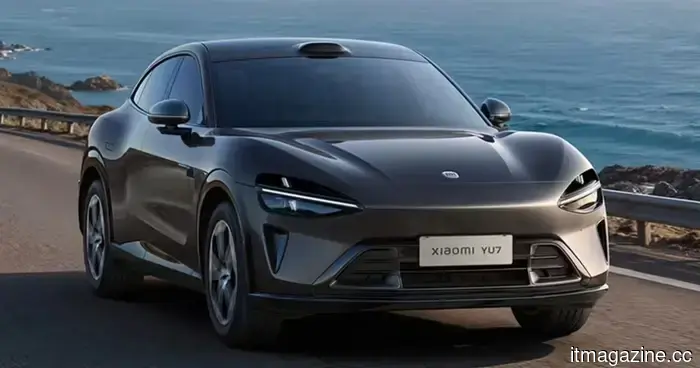 Xiaomi's new electric SUV, priced at $34,500, offers a longer range than the Tesla Model Y while being more affordable.
Xiaomi's new entry-level YU7 variant is priced $4,350 lower than the Tesla Model Y, while also providing an additional range of 31 miles.
Xiaomi's new electric SUV, priced at $34,500, offers a longer range than the Tesla Model Y while being more affordable.
Xiaomi's new entry-level YU7 variant is priced $4,350 lower than the Tesla Model Y, while also providing an additional range of 31 miles.
Austrian startup REPS secures $23.6 million to convert road traffic into electricity.
Austrian startup REPS has secured $23.6 million to expand its road-embedded energy converters, with its first commercial unit operational at the Port of Hamburg since 2025.