
Spotify and Universal have reached a licensing agreement for AI-generated covers and remixes.
Premium subscribers will have the opportunity to create AI versions of songs by participating UMG artists. The specific financial details were not revealed.
On Thursday, Spotify and Universal Music Group announced licensing agreements that will enable premium subscribers to generate AI covers and remixes of songs from participating UMG artists. This marks the first occasion the streaming service has officially licensed generative AI for its catalog and provides the most definitive response from the major-label system regarding payment for AI-generated music.
The companies described the product as a paid add-on for Premium users, though a public release date has not been specified. UMG and Spotify indicated that the model is based on “consent, credit, and compensation,” allowing artists and songwriters to opt in and receive a share of the revenue from the AI-generated renditions of their works.
The names of the UMG artists involved were not disclosed; however, the label’s roster includes names like Taylor Swift, Ariana Grande, Drake, and Billie Eilish, though this does not imply any involvement from them.
The market viewed the deal as significant, leading to a 14-16% rise in Spotify's shares, as AI-generated remixes present a new revenue source at a time when the company's core subscription business is reaching maturity.
The companies have not made public the financial terms, including the revenue split among Spotify, UMG, and individual artists.
The licensing model is crucial in addressing certain issues. AI music tools have operated in a grey area for the past two years, with companies like Suno and Udio facing lawsuits from major labels for using copyrighted catalogs without permission.
By acquiring rights at the platform level and allowing users to generate content within Spotify rather than uploading AI tracks, the two companies are creating a structure where the label, artist, songwriter, and platform can all earn from the same generated file.
Spotify faces the risk of criticism it has historically received regarding its handling of AI-generated content. The platform has been accused of allowing AI tracks associated with deceased artists to proliferate without the approval of their estates and of being slow to label or identify AI music, a contrast that TNW explored in detail last year.
A licensed creator tool, with rights secured upstream, presents a clearer narrative for investors and regulators compared to an enforcement system attempting to manage uploads retrospectively.
Whether this is a clearer narrative for artists depends entirely on undisclosed terms. Songwriters have typically received the smallest portion of streaming revenue, raising the question of whether this new licensing tier addresses that discrepancy or simply adds another revenue category to an existing imbalance.
Additionally, the timing of the deal coincides with Spotify’s acknowledgment that its catalog of AI-generated content remains unlabelled. Once launched, the remix product will be the first AI music on the platform with proper documentation. The remainder of the catalog continues to present a more challenging issue.
Other articles
 Hark, the AI hardware startup founded by Brett Adcock, has secured $700 million in funding, achieving a valuation of $6 billion.
Hark, established by serial entrepreneur Brett Adcock, has secured $700 million at a valuation of $6 billion. Notable investors include Nvidia, AMD, and Intel.
Hark, the AI hardware startup founded by Brett Adcock, has secured $700 million in funding, achieving a valuation of $6 billion.
Hark, established by serial entrepreneur Brett Adcock, has secured $700 million at a valuation of $6 billion. Notable investors include Nvidia, AMD, and Intel.
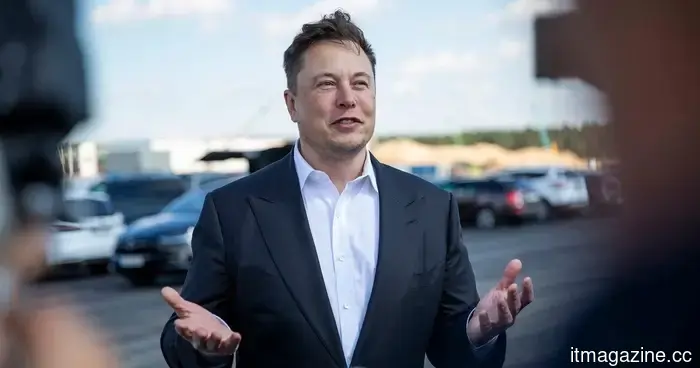 Elon Musk will receive a record-breaking salary if he establishes a colony of one million people on Mars.
Elon Musk’s compensation plan for SpaceX could lead to a substantial stock grant if the company achieves a significant valuation and establishes a colony on Mars with one million inhabitants.
Elon Musk will receive a record-breaking salary if he establishes a colony of one million people on Mars.
Elon Musk’s compensation plan for SpaceX could lead to a substantial stock grant if the company achieves a significant valuation and establishes a colony on Mars with one million inhabitants.
 Anthropic is set to open an office in Milan, boosting its efforts in Italy following a repositioning spearheaded by the Vatican.
According to Reuters, Anthropic plans to establish an office in Milan to solidify its commercial presence in Italy, furthering its expansion across Europe, which already includes locations in London, Dublin, Zurich, Paris, and Munich.
Anthropic is set to open an office in Milan, boosting its efforts in Italy following a repositioning spearheaded by the Vatican.
According to Reuters, Anthropic plans to establish an office in Milan to solidify its commercial presence in Italy, furthering its expansion across Europe, which already includes locations in London, Dublin, Zurich, Paris, and Munich.
 Brett Adcock's AI hardware company Hark has secured $700 million at a valuation of $6 billion.
Hark, established by serial entrepreneur Brett Adcock, has secured $700 million at a valuation of $6 billion. Among the listed investors are Nvidia, AMD, and Intel.
Brett Adcock's AI hardware company Hark has secured $700 million at a valuation of $6 billion.
Hark, established by serial entrepreneur Brett Adcock, has secured $700 million at a valuation of $6 billion. Among the listed investors are Nvidia, AMD, and Intel.
 Chinese researchers assert that a solid-state EV battery can be charged in only a few minutes.
Chinese researchers assert that a new solid-state battery can endure ultra-fast charging and provide significantly higher energy density, which could transform the future of electric vehicles. Scientists from the Chinese Academy of Sciences state they have created a solid-state lithium-metal battery that can achieve exceptionally high energy density while withstanding ultra-fast charging conditions – a combination […]
Chinese researchers assert that a solid-state EV battery can be charged in only a few minutes.
Chinese researchers assert that a new solid-state battery can endure ultra-fast charging and provide significantly higher energy density, which could transform the future of electric vehicles. Scientists from the Chinese Academy of Sciences state they have created a solid-state lithium-metal battery that can achieve exceptionally high energy density while withstanding ultra-fast charging conditions – a combination […]
 AI is energizing "wizards" on 4Chan who fulfill requests to alter images of women by nudifying them.
A recent analysis by ISD and a report from WIRED reveal how users on 4chan are establishing a systematic approach to creating nonconsensual AI-generated nude images, which relies on requests, status updates, and the transfer of content between private platforms.
AI is energizing "wizards" on 4Chan who fulfill requests to alter images of women by nudifying them.
A recent analysis by ISD and a report from WIRED reveal how users on 4chan are establishing a systematic approach to creating nonconsensual AI-generated nude images, which relies on requests, status updates, and the transfer of content between private platforms.
Spotify and Universal have reached a licensing agreement for AI-generated covers and remixes.
Spotify Premium subscribers will have the opportunity to create AI-generated covers and remixes of UMG songs thanks to a new licensing agreement. The financial aspects of the deal have not been revealed.