
Google Antigravity 2.0 has been launched featuring a CLI, SDK, and AI agents.
Google announced Antigravity 2.0 at I/O 2026, enhancing its agentic coding tool into a comprehensive developer platform that includes an updated desktop app, a new command-line interface (CLI) built in Go, and a software development kit (SDK) for creating custom agents. The update also rolls out an AI Ultra plan priced at $100/month, while discontinuing the Gemini CLI for consumer users.
In a bold move in the fast-evolving agentic coding market, Google unveiled Antigravity 2.0 at I/O 2026. What began as competition for Cursor has now expanded into a vast developer platform featuring a redesigned desktop app, a new command-line tool, and an SDK for building custom agents.
The initial Antigravity was launched in November 2025 alongside Gemini 3 as a free, agent-focused integrated development environment (IDE). Version 2.0 represents a significant transformation. The key feature is the overhauled desktop application, which emphasizes multi-agent orchestration. Developers can now deploy multiple agents to tackle problems concurrently, create custom subagent workflows, and schedule tasks to run automatically in the background.
The integration capabilities are extensive. Antigravity 2.0 connects seamlessly with Google AI Studio, Firebase, and Android, allowing developers to export projects from AI Studio to their local Antigravity instance while maintaining full context. For those who favor terminal use, Google is introducing a completely new Antigravity CLI built in Go, which promises to be quicker and more responsive than its predecessor.
The previous CLI, Gemini CLI, will soon be discontinued. Google has confirmed that consumer access to Gemini CLI and Gemini Code Assist IDE extensions will end on June 18, 2026, for AI Pro, AI Ultra, and free-tier users. Enterprise customers using Gemini Code Assist Standard or Enterprise licenses will maintain their access, but it is clear that Antigravity is the way forward.
Completing the platform is the Antigravity SDK, which provides developers with the tools necessary to create custom agents atop Google’s coding infrastructure. Google Cloud clients can connect directly to Antigravity, and custom agent templates are available in AI Studio for enterprise applications. Google reports that it has already utilized Antigravity in-house to develop consumer features, including custom UI generation in Google Search.
At the core of this platform is the new Gemini 3.5 Flash model, which Google claims surpasses Gemini 3.1 Pro on coding and agentic benchmarks while operating four times faster than competing frontier models. Notably, Google mentions that Gemini 3.5 Flash was co-developed using Antigravity. Additionally, the desktop app now supports native voice commands, allowing developers to communicate with their agents verbally.
Regarding pricing, Google is introducing a new AI Ultra tier for $100 per month, offering five times the usage limitations of the AI Pro plan. The current highest-tier AI Ultra subscription has been reduced from $250 to $200 per month, providing 20 times the limits of the Pro plan. This new pricing positions Google directly against OpenAI’s recently launched ChatGPT Pro tier and Anthropic’s Claude Max, both priced at $100 per month for enhanced access to coding tools. The $200 premium tier aligns with Anthropic’s highest Claude Max plan.
The timing of this launch is strategic, as the agentic coding tools market is thriving, with major AI labs vying for developer loyalty. GitHub has recently halted new Copilot sign-ups in response to the transformative nature of agentic workloads on AI-assisted development economics, and GitLab has begun restructuring for what it refers to as the “agentic era.” With Antigravity 2.0, Google is placing its bet on the future of coding being dominated by the ability to coordinate the most agents, at the fastest speeds, across the widest range of applications.
Other articles
 Google introduces Android CLI 1.0 for AI programming assistants.
Google's stable Android CLI 1.0 allows AI agents such as Claude Code, Codex, and Antigravity to access Android Studio's toolchain directly from the command line.
Google introduces Android CLI 1.0 for AI programming assistants.
Google's stable Android CLI 1.0 allows AI agents such as Claude Code, Codex, and Antigravity to access Android Studio's toolchain directly from the command line.
 You can now explore AI-created versions of actual locations with Google’s Project Genie.
Google's experimental Project Genie is moving beyond creating worlds solely from imagination. With the inclusion of Street View, the distinction between actual locations and AI-generated environments is beginning to blend in intriguing ways.
You can now explore AI-created versions of actual locations with Google’s Project Genie.
Google's experimental Project Genie is moving beyond creating worlds solely from imagination. With the inclusion of Street View, the distinction between actual locations and AI-generated environments is beginning to blend in intriguing ways.
 Google Search will now inform you whether an image is generated by AI and provide detailed information about it.
Google is broadening the use of its SynthID technology in Search, Chrome, and Android to assist users in more easily recognizing images that are either generated or edited by AI.
Google Search will now inform you whether an image is generated by AI and provide detailed information about it.
Google is broadening the use of its SynthID technology in Search, Chrome, and Android to assist users in more easily recognizing images that are either generated or edited by AI.
 Google showcases audio glasses designed in collaboration with Gentle Monster and Warby Parker.
Google has finally provided us with a sneak peek at the Android XR audio glasses, which are powered by Gemini and set to be released later this year.
Google showcases audio glasses designed in collaboration with Gentle Monster and Warby Parker.
Google has finally provided us with a sneak peek at the Android XR audio glasses, which are powered by Gemini and set to be released later this year.
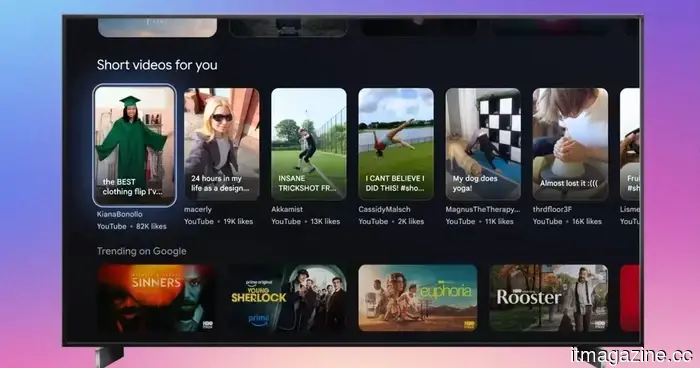 Google aims to transform your TV remote with Gemini and pointer controls.
Google is transforming the future of televisions with Gemini-enhanced discovery and a new method for navigating applications. Nonetheless, the most significant shift might not be on the display itself, but rather in your remote control.
At I/O 2026, Google introduces voice prompts for Docs, Keep, and Gmail.
At I/O 2026, Google introduced voice-activated AI functionalities for Docs, Keep, and Gmail, enabling users to generate documents and search their inboxes through speech rather than typing.
Google aims to transform your TV remote with Gemini and pointer controls.
Google is transforming the future of televisions with Gemini-enhanced discovery and a new method for navigating applications. Nonetheless, the most significant shift might not be on the display itself, but rather in your remote control.
At I/O 2026, Google introduces voice prompts for Docs, Keep, and Gmail.
At I/O 2026, Google introduced voice-activated AI functionalities for Docs, Keep, and Gmail, enabling users to generate documents and search their inboxes through speech rather than typing.
Google Antigravity 2.0 has been launched featuring a CLI, SDK, and AI agents.
Google introduces Antigravity 2.0 at I/O 2026, featuring multi-agent orchestration, a new command-line interface tool, a software development kit for custom agents, and an AI Ultra plan priced at $100 per month.