

You can now explore AI-created versions of actual locations with Google’s Project Genie.
Google is advancing its experimental AI world-building initiative into impressively realistic realms. The company revealed that Project Genie can now utilize actual imagery from Google Street View to create interactive virtual environments that merge real locations with imaginative AI-generated aesthetics.
At its essence, Genie functions as a “world model” according to Google — an AI system that can generate explorable digital spaces where AI agents, robots, or users can interact seamlessly. Up until now, these worlds were primarily artificial. However, with this latest update, Genie can ground itself in actual locations extracted directly from Street View images, which significantly enhances the feeling of peering into the future of simulation.
Google invites you to explore AI fantasies.
This feature is part of Project Genie, which is Google’s experimental Labs prototype. Users can select locations in the U.S. using a Maps pin before transforming these sites into stylized AI environments. For example, the Golden Gate Bridge might morph into an underwater exploration area bustling with marine life, while the Fort Worth Stockyards could be envisioned as a grainy black-and-white depiction of the 1920s, complete with saloons and classic automobiles.
Users can also personalize the characters navigating these spaces, whether they wish to become a comic book hero, an animal, or even a claymation creature. The intriguing aspect lies not only in the creative potential but also in how Google is teaching AI to comprehend real-world geography and environments through simulation.
Google's broader AI objectives are becoming more evident.
According to Google, Genie has been employed internally for AI research and by Waymo to replicate realistic driving scenarios. Grounding such simulations in Street View data could significantly enhance the practicality of future AI training.
Project Genie is being rolled out globally to qualifying Google AI Ultra subscribers, although Google still regards the platform as experimental, which likely explains their cautious approach in promoting it at this stage.
Google aims to revolutionize your TV remote with Gemini and pointer controls.
Google is making a more significant move into the living room, focusing not just on what you watch but also on how you engage with your television. At Google I/O 2026, the company introduced a new set of updates for Google TV and Android TV developers, all centered around one concept: TVs are no longer mere passive screens in your home. With over 300 million monthly active devices across Google TV and Android TV, Google clearly views the television as a key area for AI development, with Gemini at the forefront of this strategy.
The company reports that Gemini is already assisting users in discovering content through natural voice interactions. However, Google aims for the experience to be more dynamic and conversational, akin to browsing the web — but from the comfort of your couch. Rather than presenting only static results, Gemini on Google TV can now respond with a mixture of visuals, videos, and text snippets to fulfill inquiries. For example, if someone requests a thriller featuring a strong female protagonist or a space exploration documentary, Gemini retrieves contextual recommendations directly from streaming applications and their metadata.
Currently, nearly every major AI chatbot follows a similar strategy: attract users with a surprisingly capable free tier and then gently guide them toward a subscription as they start relying on it more. For many users, the free versions are already sufficiently effective. Users can ask questions, create images, summarize documents, and brainstorm ideas without constantly encountering paywalls. This is why an observed change in Google’s Gemini app is particularly noteworthy.
A user on X reported a screenshot implying that Google might be testing stricter usage tracking and possible weekly limits within Gemini. The screenshot indicates a new section explaining, “Plan limits determine how much you can use Gemini over time.” This suggests that Google might be preparing a more assertive system to monitor how often free users engage with Gemini, especially when utilizing more demanding AI models.
Scientists have just set a new wireless speed record that may influence the future of 6G.
Researchers achieved a wireless connection speed of 112Gbps over a 560GHz frequency, utilizing soliton microcombs to create a more stable terahertz signal for future 6G systems. The immediate goal isn’t to produce faster devices but to enhance the hidden infrastructure that manages traffic between network sites, where backhaul capacity can determine if future 6G speeds are viable or hindered by congested network connections. This makes it a noteworthy 6G speed advancement to observe, even if consumers won’t see it reflected in specifications anytime soon.







Other articles
 Discord automatically encrypts all voice and video calls.
Discord has enabled end-to-end encryption for all voice and video calls automatically, without the need for users to opt in. The DAVE protocol ensures that even Discord itself cannot eavesdrop.
Discord automatically encrypts all voice and video calls.
Discord has enabled end-to-end encryption for all voice and video calls automatically, without the need for users to opt in. The DAVE protocol ensures that even Discord itself cannot eavesdrop.
 Google substitutes the search box with AI agents at I/O 2026.
At I/O 2026, Google revealed its most significant Search overhaul in 25 years, featuring information agents, a generative user interface, and mini-apps driven by Gemini 3.5 Flash.
At I/O 2026, Google introduces voice prompting features for Docs, Keep, and Gmail.
At I/O 2026, Google introduced voice-enabled AI capabilities for Docs, Keep, and Gmail, allowing users to generate documents and search their emails through voice commands rather than typing.
At I/O 2026, Google introduces voice prompting for Docs, Keep, and Gmail.
At I/O 2026, Google introduced voice-activated AI functionalities for Docs, Keep, and Gmail, allowing users to generate documents and search their inboxes through voice commands rather than by typing.
Google substitutes the search box with AI agents at I/O 2026.
At I/O 2026, Google revealed its most significant Search overhaul in 25 years, featuring information agents, a generative user interface, and mini-apps driven by Gemini 3.5 Flash.
At I/O 2026, Google introduces voice prompting features for Docs, Keep, and Gmail.
At I/O 2026, Google introduced voice-enabled AI capabilities for Docs, Keep, and Gmail, allowing users to generate documents and search their emails through voice commands rather than typing.
At I/O 2026, Google introduces voice prompting for Docs, Keep, and Gmail.
At I/O 2026, Google introduced voice-activated AI functionalities for Docs, Keep, and Gmail, allowing users to generate documents and search their inboxes through voice commands rather than by typing.
 Google introduces Universal Cart and enhances AP2 at I/O 2026.
Google introduced Universal Cart, an AI shopping center that integrates Search, Gemini, YouTube, and Gmail, while also updating its Agent Payments Protocol for automated purchases.
Google introduces Universal Cart and enhances AP2 at I/O 2026.
Google introduced Universal Cart, an AI shopping center that integrates Search, Gemini, YouTube, and Gmail, while also updating its Agent Payments Protocol for automated purchases.
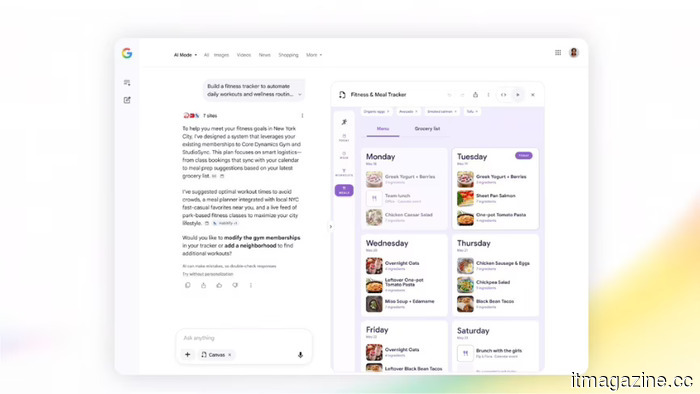 Google introduces always-on information agents in Search at I/O 2026.
Google's updated information agents operate continuously in AI Mode, compiling news, monitoring prices, and sending alerts, transforming the previous Google Alerts system into an agent-driven AI model.
Google introduces always-on information agents in Search at I/O 2026.
Google's updated information agents operate continuously in AI Mode, compiling news, monitoring prices, and sending alerts, transforming the previous Google Alerts system into an agent-driven AI model.
You can now explore AI-created versions of actual locations with Google’s Project Genie.
Google's experimental Project Genie is moving beyond creating worlds solely from imagination. With the inclusion of Street View, the distinction between actual locations and AI-generated environments is beginning to blend in intriguing ways.