
Google introduces Android CLI 1.0 for AI programming assistants.
TL;DR Google launched Android CLI 1.0 during Google I/O 2026, allowing AI coding agents like Claude Code, OpenAI Codex, and Antigravity to access Android Studio’s toolchain directly from the command line. This stable release enables agents to conduct semantic analysis, display Compose previews, and execute UI tests without needing to open the IDE.
Google has introduced Android CLI in a stable 1.0 version, providing AI coding agents with direct access to Android Studio’s features without requiring the IDE to be opened. This announcement, made at Google I/O 2026 on May 19, acknowledges that many developers are now utilizing third-party AI agents for Android development instead of Google’s own tools.
The new toolset allows agents such as Anthropic's Claude Code, OpenAI's Codex, and Google's Antigravity to perform essential Android development tasks from the terminal. Using a new command called android studio, agents can conduct semantic symbol resolution, analyze files for warnings, render Jetpack Compose previews, and perform end-to-end UI tests through a feature known as "Journeys."
Practically, this means a developer can instruct an AI agent to create a new project, check it for lint warnings, preview a Compose layout, and run automated UI tests, all without switching to a graphical interface. The CLI serves as a link connecting the expanding ecosystem of AI coding agents with the production-grade tools already offered by Android Studio.
Additionally, Google has integrated Android CLI support directly into Antigravity, its agentic development platform, which received a significant 2.0 update at the same event. Developers using Antigravity can install the Android CLI and relevant knowledge resources during onboarding or later via the settings menu. Once installed, the Antigravity agent can manage tasks ranging from project creation to deploying an app on a virtual Android device.
This initiative aligns with a broader trend seen at this year’s I/O, where Google launched Gemini 3.5 Flash as the engine for its managed agents in the Gemini API, introduced native Android app creation within AI Studio, and delivered Antigravity 2.0 with parallel agent orchestration. The Android CLI is positioned at the core of these efforts, ensuring that any developer’s preferred agent can effectively communicate with Android Studio.
For developers currently using non-Google AI tools for Android, this release alleviates a significant friction point. Specialized knowledge about Android's build system, Compose rendering pipeline, and testing framework is now accessible programmatically at d.android.com/tools/agents, rather than being confined to a desktop application.
Whether this increased accessibility will speed up Android development or merely shift bottlenecks from code writing to code review remains unclear. What is evident is that Google is investing in the future of Android tooling relying on agents, aiming for seamless integration with its platform for all developers.
Other articles
 Google Antigravity 2.0 is launched, featuring a CLI, SDK, and AI agents.
At I/O 2026, Google introduced Antigravity 2.0, featuring multi-agent orchestration, a new command-line interface tool, a software development kit for custom agents, and a $100 monthly AI Ultra subscription plan.
Google Antigravity 2.0 is launched, featuring a CLI, SDK, and AI agents.
At I/O 2026, Google introduced Antigravity 2.0, featuring multi-agent orchestration, a new command-line interface tool, a software development kit for custom agents, and a $100 monthly AI Ultra subscription plan.
 Google AI Studio can now create Android applications without requiring you to write any code.
At I/O 2026, Google AI Studio introduces Android app development capabilities, integration with Google Workspace, personalized design tools, and a mobile application.
Google AI Studio can now create Android applications without requiring you to write any code.
At I/O 2026, Google AI Studio introduces Android app development capabilities, integration with Google Workspace, personalized design tools, and a mobile application.
 Android Halo might be the crucial connection between Android and AI agents.
Google's latest Android Halo feature suggests a future where AI subtly supports you rather than requiring your constant focus. The most intriguing aspect is how minimally it interferes with your activities.
Android Halo might be the crucial connection between Android and AI agents.
Google's latest Android Halo feature suggests a future where AI subtly supports you rather than requiring your constant focus. The most intriguing aspect is how minimally it interferes with your activities.
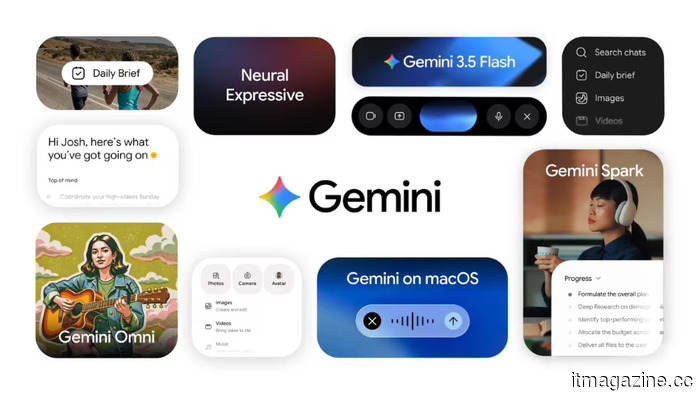 Google Gemini introduces Daily Brief and a redesigned Neural Expressive at I/O 2026.
At I/O 2026, Google introduced Daily Brief, a redesign of Neural Expressive, and the Spark AI agent for Gemini's 900 million users, enhancing its competition with ChatGPT and Claude.
Google Gemini introduces Daily Brief and a redesigned Neural Expressive at I/O 2026.
At I/O 2026, Google introduced Daily Brief, a redesign of Neural Expressive, and the Spark AI agent for Gemini's 900 million users, enhancing its competition with ChatGPT and Claude.
 Google showcases audio glasses created in collaboration with Gentle Monster and Warby Parker.
Google has unveiled a first glance at the Android XR audio glasses, which are powered by Gemini and set to be released later this year.
Google showcases audio glasses created in collaboration with Gentle Monster and Warby Parker.
Google has unveiled a first glance at the Android XR audio glasses, which are powered by Gemini and set to be released later this year.
 Google introduces Universal Cart and refreshes AP2 at I/O 2026.
Google introduced Universal Cart, an AI-driven shopping center that integrates Search, Gemini, YouTube, and Gmail, while also updating its Agent Payments Protocol for automated transactions.
Google introduces Universal Cart and refreshes AP2 at I/O 2026.
Google introduced Universal Cart, an AI-driven shopping center that integrates Search, Gemini, YouTube, and Gmail, while also updating its Agent Payments Protocol for automated transactions.
Google introduces Android CLI 1.0 for AI programming assistants.
Google's stable Android CLI 1.0 allows AI agents such as Claude Code, Codex, and Antigravity to access Android Studio's toolchain directly from the command line.