
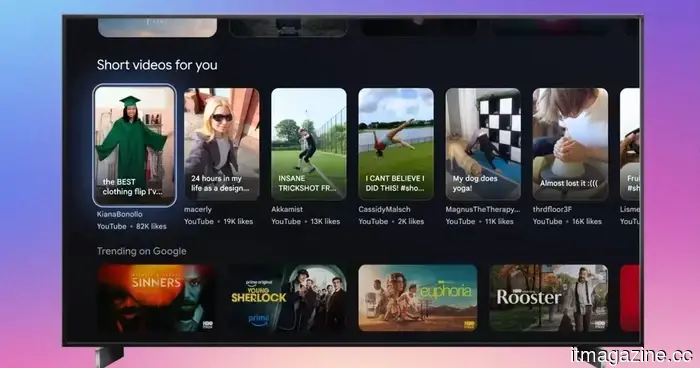
Google aims to transform your TV remote with Gemini and pointer controls.
Google is intensifying its focus on the living room, expanding its vision beyond just what viewers watch to how they engage with their TVs. At Google I/O 2026, the company unveiled a new set of updates for Google TV and Android TV developers, all revolving around the concept that TVs are no longer just passive displays in our homes. With over 300 million monthly active devices on Google TV and Android TV, Google perceives the television as a significant arena for AI development. Central to this strategy is Gemini.
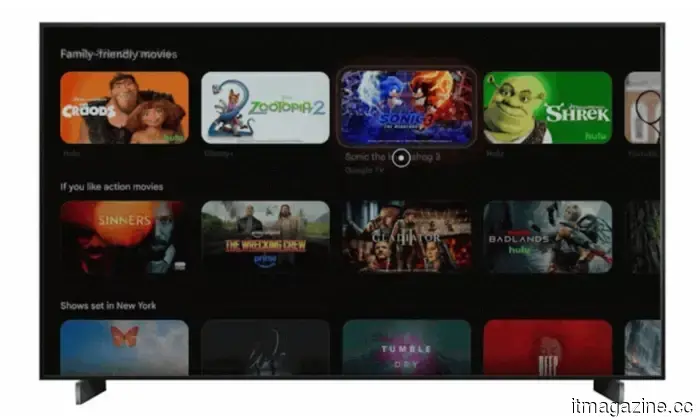
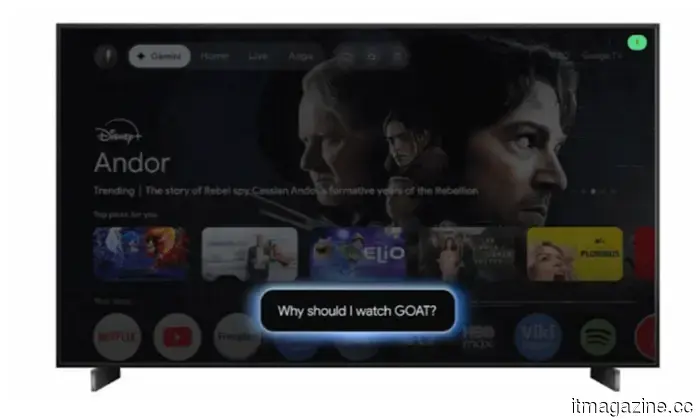
Google asserts that Gemini is already enhancing content discovery through natural voice interactions, but the company aims to make the experience feel more dynamic and conversational—similar to web searching, but from the comfort of your couch. Rather than only providing static results, Gemini on Google TV can now combine visuals, videos, and text snippets to respond to inquiries. So, when someone requests a thriller featuring a strong female lead or a space exploration documentary, Gemini retrieves contextual recommendations straight from streaming apps and their metadata.
This marks a significant change for streaming platforms. Traditionally, discovering content on TVs has been chaotic, fragmented, and largely reliant on whichever app was accessed first. Google appears to be establishing Gemini as an overarching layer, serving as an intelligent content guide rather than merely a basic search tool.
The evolution of your TV remote
Interestingly, Google’s most noteworthy announcement may not truly be Gemini itself, but rather the remote control. The company has indicated that upcoming Google TV devices will increasingly support "pointer remotes," which introduce motion and cursor-based navigation for televisions. This concept serves as a middle ground between a conventional TV remote and a computer mouse. While this may seem trivial, it significantly alters how TV apps will function.
Most current TV interfaces rely on rigid D-pad navigation—up, down, left, right, and select. Pointer controls introduce features like hovering, free-form movement, touchpad scrolling, and cursor clicks. This transformation means that TV apps will need to operate more like desktop or tablet interfaces. Google is now urging developers to prepare their apps for this change, which includes integrating hover states for buttons and UI elements, facilitating smoother scrolling, and ensuring that apps respond appropriately to cursor-based clicks instead of just directional focus controls.
This shift feels long overdue. TV interfaces have been surprisingly cumbersome for years, especially when compared to the seamlessness of smartphones and tablets. Streaming apps often come across as slow, limited, and difficult to navigate, particularly when exploring extensive content libraries. Pointer-based interaction could significantly enhance this experience—provided developers optimize their apps properly.
Google encourages developers to start preparing
To assist developers in this adaptation, Google states that apps built with Jetpack Compose already have an easier path moving forward due to the native support of many modern interaction models. The company is also motivating developers to experiment with these new interactions now by using standard Bluetooth or wired mice connected to Google TV devices. This will help them grasp how hover effects, scrolling behaviors, and cursor inputs operate on large-screen interfaces. Google acknowledges, however, that pointer remotes tend to be less precise than actual mice since users usually sit several feet from the TV and make loose gestures from the couch. Consequently, developers are advised to create larger interactive targets and more forgiving UI designs.
Developers can now officially indicate pointer remote support on Google Play, making it simpler for users with newer remotes to find compatible TV apps. This development clearly outlines the direction in which Google TV is heading. Televisions are gradually becoming more active, AI-driven computing platforms rather than merely streaming devices. Gemini facilitates discovery, pointer remotes enhance navigation, and developers are being encouraged to rethink the long-standing TV app experience. Whether users will embrace waving remotes in their living rooms remains to be seen. However, Google is convinced that the future of TV interaction must feel more intelligent, faster, and significantly less reliant on incessantly clicking directional buttons.
Other articles
 Google DeepMind links Street View to the Project Genie world model | TNW
Google DeepMind has connected two decades of Street View images to its Genie world model, enabling AI Ultra subscribers to navigate AI-created simulations of actual streets.
Google DeepMind links Street View to the Project Genie world model | TNW
Google DeepMind has connected two decades of Street View images to its Genie world model, enabling AI Ultra subscribers to navigate AI-created simulations of actual streets.
 Google introduces Universal Cart and announces updates to AP2 at I/O 2026.
Google introduced Universal Cart, an AI shopping platform that integrates Search, Gemini, YouTube, and Gmail, along with enhancements to its Agent Payments Protocol for autonomous transactions.
Google introduces Universal Cart and announces updates to AP2 at I/O 2026.
Google introduced Universal Cart, an AI shopping platform that integrates Search, Gemini, YouTube, and Gmail, along with enhancements to its Agent Payments Protocol for autonomous transactions.
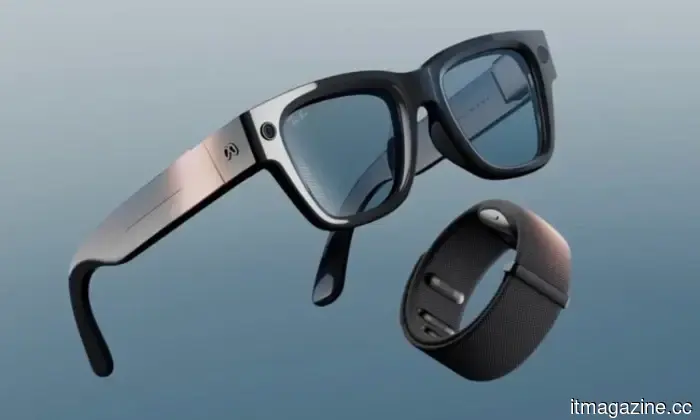 The Marshall Milton ANC is priced at $229, offers a battery life of 80 hours, and features a replaceable battery.
The Marshall Milton ANC offers 80 hours of battery life with active noise cancellation turned off and 50 hours when it's activated, supports LDAC, and allows for battery replacement when it becomes depleted.
At I/O 2026, Google introduces voice prompting features for Docs, Keep, and Gmail.
At I/O 2026, Google introduced voice-enabled AI capabilities for Docs, Keep, and Gmail, allowing users to generate documents and search their emails through voice commands rather than typing.
The Marshall Milton ANC is priced at $229, offers a battery life of 80 hours, and features a replaceable battery.
The Marshall Milton ANC offers 80 hours of battery life with active noise cancellation turned off and 50 hours when it's activated, supports LDAC, and allows for battery replacement when it becomes depleted.
At I/O 2026, Google introduces voice prompting features for Docs, Keep, and Gmail.
At I/O 2026, Google introduced voice-enabled AI capabilities for Docs, Keep, and Gmail, allowing users to generate documents and search their emails through voice commands rather than typing.
 Google Antigravity 2.0 is launched, featuring a CLI, SDK, and AI agents.
At I/O 2026, Google introduced Antigravity 2.0, featuring multi-agent orchestration, a new command-line interface tool, a software development kit for custom agents, and a $100 monthly AI Ultra subscription plan.
Google Antigravity 2.0 is launched, featuring a CLI, SDK, and AI agents.
At I/O 2026, Google introduced Antigravity 2.0, featuring multi-agent orchestration, a new command-line interface tool, a software development kit for custom agents, and a $100 monthly AI Ultra subscription plan.
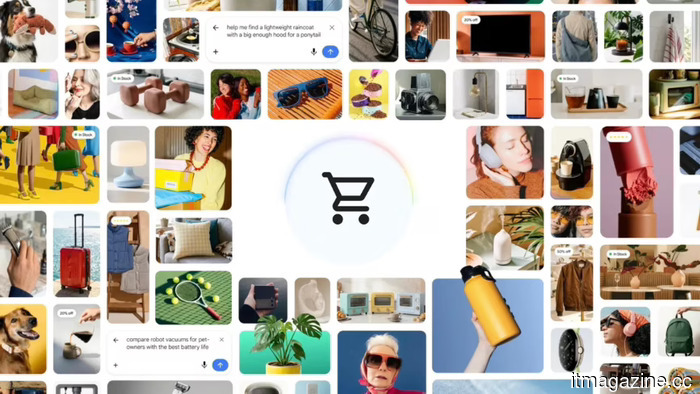 Google announces Universal Cart and releases AP2 updates at I/O 2026.
Google introduced Universal Cart, an AI-driven shopping platform that integrates Search, Gemini, YouTube, and Gmail, while also announcing enhancements to its Agent Payments Protocol for automated purchases.
Google announces Universal Cart and releases AP2 updates at I/O 2026.
Google introduced Universal Cart, an AI-driven shopping platform that integrates Search, Gemini, YouTube, and Gmail, while also announcing enhancements to its Agent Payments Protocol for automated purchases.
Google aims to transform your TV remote with Gemini and pointer controls.
Google is transforming the future of televisions with Gemini-enhanced discovery and a new method for navigating applications. Nonetheless, the most significant shift might not be on the display itself, but rather in your remote control.