
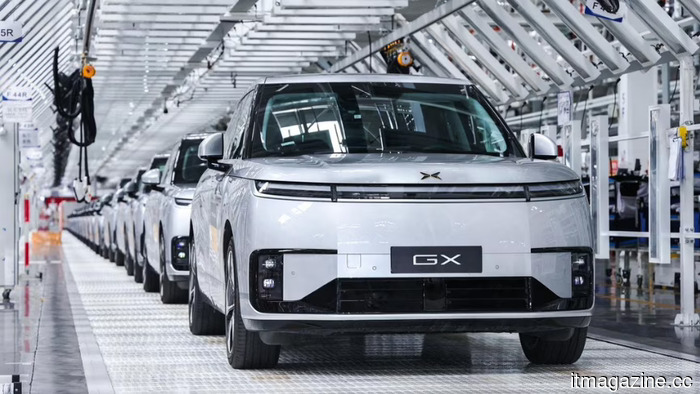
XPeng launches its robotaxi service in Guangzhou, three years after the industry leaders and ahead of any other Chinese car manufacturer.
The first car produced on Monday signifies the beginning of a gradual increase in production. Public pilot tests are scheduled for the second half of the year, with full driverless functionality expected by early 2027. XPeng announced on Monday that its first robotaxi has come off the production line in Guangzhou, positioning itself as the first Chinese automaker to initiate mass production of a robotaxi designed entirely with its own technology.
This vehicle is constructed on XPeng’s new GX platform and is built to support Level 4 autonomous driving directly from the factory, rather than requiring retrofitting later. The headline is specific in a significant way. While XPeng is not the initial company in China to deploy robotaxis, given that Baidu’s Apollo Go operates over 1,000 vehicles in 22 cities and is the leading commercial operator in the country, and Pony.ai’s fleet reached 1,446 vehicles by late March, aiming for 3,000 by year-end, it is the first traditional automaker—not merely an autonomous-driving specialist—to begin series production of a robotaxi vehicle in China.
This distinction is a combination of marketing and genuine achievement. Historically, pure-play operators have retrofitted standard consumer vehicles, typically Toyotas or domestically produced EVs, with sensor arrays and computing systems provided by the AV company. Conversely, XPeng’s GX-based robotaxi is uniquely designed from the ground up, incorporating the necessary computing, drive-by-wire chassis, and redundancy for Level 4 operation.
The car includes four of XPeng’s own Turing AI chips, delivering a total of 3,000 TOPS of compute power, along with a Bosch next-generation steer-by-wire system that removes the conventional mechanical steering shaft, featuring what XPeng describes as aviation-grade redundancy for safety-critical systems. The software it operates on is the VLA 2.0 stack, which is a vision-language-action model that reduces end-to-end response latency to below 80 milliseconds.
Initially, production volumes will be modest. Brian Gu, the president of XPeng, informed Reuters last month that the company is expected to manufacture hundreds to thousands of robotaxis over the next 12 to 18 months. Pilot operations with safety drivers are set to commence in the latter half of this year, with a goal for fully driverless commercial services by early 2027.
The robotaxi production facility in Guangzhou holds an intelligent-connected-vehicle road-testing license, with Level 4 road tests already being conducted on public roads. The commercial strategy appears somewhat defensive, as XPeng’s robotaxi initiative is part of an aggressive diversification plan for 2026, which also involves humanoid robots and modular flying cars, all utilizing the same Turing silicon and vision-language-action software stack.
The company has made it clear that its strategy is to monetize the AI technology across various applications rather than depend solely on EV margins in a market where prices are decreasing and government subsidies in China are being reduced. Volkswagen stands out as a prominent external customer for this strategy. The German car manufacturer, which acquired a 4.99% stake in XPeng for $700 million in July 2023, identified XPeng’s Turing chip and VLA 2.0 system as its first commercial external partnership this year, marking a significant adoption of Chinese-developed autonomous-driving software by a major Western automaker.
XPeng has indicated a target of roughly one million Turing chip shipments in 2026 and intends to gradually open its robotaxi SDK to other fleet operators over time. However, the timing is somewhat challenging, as Monday’s production milestone occurs amid a less favorable short-term outlook. XPeng has projected first-quarter 2026 deliveries between 61,000 and 66,000 units, representing a year-on-year decline of about 30%, which the company attributes to decreased government subsidies and a longer Lunar New Year.
The company is scheduled to report Q1 earnings on Wednesday. Its first-ever quarterly net profit of RMB 380 million, recorded for Q4 2025, coincided with this softer Q1 forecast. Additionally, this development comes at a time when the operational risks associated with large autonomous fleets are becoming more apparent. In late March, over 100 Baidu Apollo Go robotaxis became immobilized in Wuhan due to a correlated software failure, leaving passengers stranded and highlighting risks related to simultaneous failures across a managed fleet—a challenge that traditional vehicle regulations do not address.
Pony.ai, although it has achieved city-level profitability in Guangzhou, has faced similar concerns as it expands. XPeng enters this operational environment with a hardware edge and a self-developed software stack, but as a software operator rather than just a manufacturer, it faces the same governance issues regarding failure modes at fleet scale that current operators are still grappling with.
What XPeng has accomplished this week is the initiation of production. The first vehicle has been completed. The second-half pilots will assess whether the platform can operate effectively in mixed traffic with a safety
Other articles
 Walmart's new ONN tablets are budget-friendly and provide substantial value.
Walmart is offering two new Onn choices for budget tablet shoppers, featuring a compact 8.1-inch version and a larger 13-inch Pro model that includes a big display, a stylus, and Android 16.
Walmart's new ONN tablets are budget-friendly and provide substantial value.
Walmart is offering two new Onn choices for budget tablet shoppers, featuring a compact 8.1-inch version and a larger 13-inch Pro model that includes a big display, a stylus, and Android 16.
 A method for economy class travel suggested by scientists may reduce the costs of lunar journeys slightly.
Researchers have discovered a more economical approach to sending spacecraft to the Moon by utilizing a gravitational sweet spot as a stopover, reducing fuel expenses by at least 58.80 m/s compared to current techniques.
A method for economy class travel suggested by scientists may reduce the costs of lunar journeys slightly.
Researchers have discovered a more economical approach to sending spacecraft to the Moon by utilizing a gravitational sweet spot as a stopover, reducing fuel expenses by at least 58.80 m/s compared to current techniques.
 Your Pixel phone may soon notify you if a caller is not truthful about their identity.
Google is developing a feature for the Google Phone app to detect phone number spoofing. This feature may alert you when someone is impersonating a saved contact's number and allow you to end the call immediately.
Your Pixel phone may soon notify you if a caller is not truthful about their identity.
Google is developing a feature for the Google Phone app to detect phone number spoofing. This feature may alert you when someone is impersonating a saved contact's number and allow you to end the call immediately.
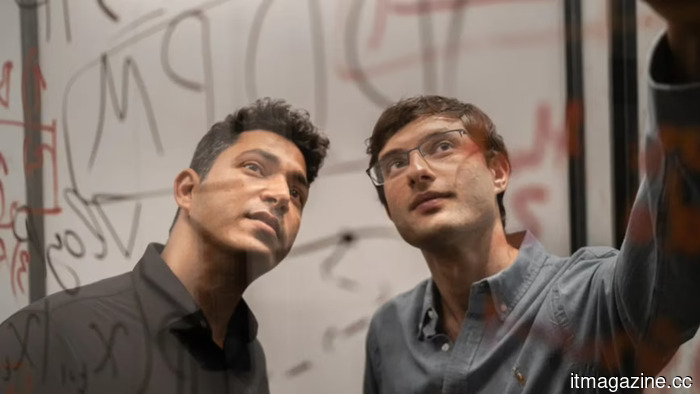 Decart secures $300 million to develop a real-time world model utilizing Amazon’s chips.
Decart has secured $300 million in a funding round led by Radical Ventures, bringing the total funding for the real-time world-model lab to over $450 million. NVIDIA, Adobe, Toyota, and eBay Ventures participated in the round, with Karpathy and Eisner also contributing as angel investors.
Decart secures $300 million to develop a real-time world model utilizing Amazon’s chips.
Decart has secured $300 million in a funding round led by Radical Ventures, bringing the total funding for the real-time world-model lab to over $450 million. NVIDIA, Adobe, Toyota, and eBay Ventures participated in the round, with Karpathy and Eisner also contributing as angel investors.
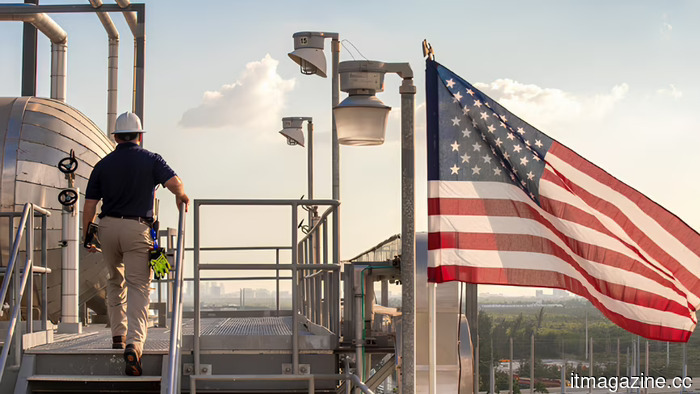 NextEra has reached a $67 billion all-stock agreement to acquire Dominion, marking the largest power acquisition in history.
NextEra Energy has reached an agreement to purchase Dominion Energy for approximately $67 billion in an all-stock transaction, marking the largest acquisition in the power sector to date.
NextEra has reached a $67 billion all-stock agreement to acquire Dominion, marking the largest power acquisition in history.
NextEra Energy has reached an agreement to purchase Dominion Energy for approximately $67 billion in an all-stock transaction, marking the largest acquisition in the power sector to date.
 Perhaps consider using a different option for your AI images instead of Gemini and ChatGPT. I just found an alternative that might interest you.
Ideogram may not replace all AI image generators, but its precision with text, format controls, and remix features make it a worthwhile option for creating posters, thumbnails, social graphics, and other visuals that require strong design elements.
Perhaps consider using a different option for your AI images instead of Gemini and ChatGPT. I just found an alternative that might interest you.
Ideogram may not replace all AI image generators, but its precision with text, format controls, and remix features make it a worthwhile option for creating posters, thumbnails, social graphics, and other visuals that require strong design elements.
XPeng launches its robotaxi service in Guangzhou, three years after the industry leaders and ahead of any other Chinese car manufacturer.
XPeng commenced production of its robotaxi in Guangzhou on Monday, featuring VLA 2.0, four Turing chips, and aiming for a driverless target by 2027.