
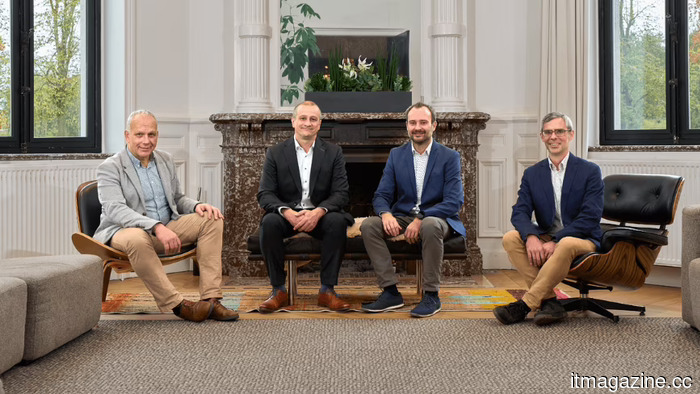
Dutch company Eyeo secures €40 million to commercialize NCOS color-splitting image sensors.
Innovation Industries is leading the Series A funding round, with returning investors including imec.xpand, Invest-NL Deep Tech Fund, QBIC, HTGF, and BOM. The total funding has now reached €55 million. These funds will support in-house chip design and the development of high-volume sensors utilizing the company's NCOS color-splitting technology.
Based in Eindhoven, eyeo has secured €40 million in Series A financing to commercialize a sensor technology that aims to eliminate a limitation that has influenced digital imaging for the past fifty years. This funding round is led by Innovation Industries, with participation from existing backers imec.xpand, Invest-NL Deep Tech Fund, QBIC, High-Tech Gründerfonds, and Brabant Development Agency (BOM). With this funding, eyeo's total raised amount is now €55 million. The financing is also backed by support from the European Union through the InvestEU Fund.
The technical foundation is straightforward. Every standard digital image sensor—whether in smartphones, cars, XR headsets, or security cameras—utilizes a Bayer-pattern color filter that allows red, green, or blue light to pass to each pixel while blocking the other two colors. While effective, this process is costly, as approximately 70% of incoming light does not reach the photodetector. In contrast, eyeo's NCOS platform operates on an inverse principle: instead of filtering, it splits the light, directing each photon to the appropriate pixel. Eyeo claims that its patented design captures three times more light than comparable filter-based sensors, overcoming the resolution limits imposed by sub-micron pixel sizes.
The platform incorporates 26 patents and is compatible with existing CMOS sensor platforms, which is crucial for adoption by leading sensor manufacturers.
Jeroen Hoet, co-founder and CEO of eyeo, highlighted the company's progress from research to commercial scaling. "Every modern device that observes the world, from smartphones to autonomous systems, is constrained by this 50-year-old limitation," Hoet stated. "Eyeo eliminates it right at the source. Our technology is proven, patented, and validated at a commercial foundry, with tier-one customers already involved. This €40 million round provides us with the necessary resources to scale."
Eyeo has worked towards this achievement for seven years, resulting from its spin-out from imec, the Belgian research institute, during which it developed the NCOS approach in collaboration with imec’s nanoelectronics division. The company has completed process integration at a commercial foundry, signed several tier-one agreements, and earlier in 2026 opened a dedicated sensor design center in Antwerp to complement its headquarters in Eindhoven. The team has quadrupled in size over the past year.
The Series A funding will support three key initiatives: expanding the IC and system-architecture design team at the new Antwerp center, developing and launching next-generation color-splitting image sensors using 3D-stacked CMOS technology (a format adopted by leading mobile camera manufacturers in the last five years), and increasing sensor sales and commercial partnerships across smart-city, industrial, XR, and mobile markets. Eyeo identifies a $30 billion total addressable imaging market, with around seven billion image sensors sold annually.
Nard Sintenie, partner at Innovation Industries, described eyeo as delivering a fundamental breakthrough that redefines its category, asserting, “This is a powerful example of deep-tech innovation fostering real structural advancements in semiconductors, with implications that span the larger technology ecosystem.” This perspective aligns with the growing commitment from European deep-tech venture capital firms to chip startups. Innovation Industries has raised a dedicated fund for semiconductors and photonics, while imec.xpand has opened an office in the Netherlands to focus on the Eindhoven area.
Eindhoven's vibrant photonic-chip cluster consists of entities like imec, PhotonDelta, and the High Tech Campus, along with nearby companies such as Photon IP and SMART Photonics, which are engaged in silicon-photonic, integrated, and now nanophotonic technologies. Eyeo extends this cluster into the image sensor market, which has predominantly been controlled by companies like Sony, Samsung, and OmniVision, with few leading European players.
Eyeo's proposal fits within a larger trend of research aimed at reinventing image sensors, a topic of ongoing interest in optical-engineering for two decades. Various academic and corporate teams have investigated alternatives to the Bayer filter, including splitter, plasmonic, and metasurface solutions, often failing between lab demonstrations and manufacturable yields. Eyeo asserts that the NCOS process has successfully bridged this gap, and the credibility of its Series A investors suggests they concur.
The applications named in the press release are traditional yet significant. They include smartphone cameras, where the trade-off between sensor size and image quality has influenced flagship product launches for years; XR headsets, where the quality of pass-through cameras significantly affects perceived immersion; smart-city infrastructure, where low-light dynamic-range performance hinders accurate analytics
Other articles
 GPUaaS is strengthening the perception of AI sovereignty in Europe.
Access does not equate to sovereignty. The risk associated with Europe's €20 billion investment in an AI gigafactory lies in potentially increasing its reliance on Nvidia and US hyperscalers rather than diminishing it.
GPUaaS is strengthening the perception of AI sovereignty in Europe.
Access does not equate to sovereignty. The risk associated with Europe's €20 billion investment in an AI gigafactory lies in potentially increasing its reliance on Nvidia and US hyperscalers rather than diminishing it.
 Anthropic reports that Claude learned the concept of blackmail through stories about malicious AI.
Anthropic has linked Claude's pre-release blackmail actions to online content that depicts AI as malevolent and self-protective.
Anthropic reports that Claude learned the concept of blackmail through stories about malicious AI.
Anthropic has linked Claude's pre-release blackmail actions to online content that depicts AI as malevolent and self-protective.
 Amazon is set to issue its inaugural Swiss franc bond as part of a six-phase initiative focused on artificial intelligence capital expenditures.
Amazon has appointed BNP Paribas, Deutsche Bank, and JPMorgan for its inaugural issuance of bonds in Swiss franc.
Amazon is set to issue its inaugural Swiss franc bond as part of a six-phase initiative focused on artificial intelligence capital expenditures.
Amazon has appointed BNP Paribas, Deutsche Bank, and JPMorgan for its inaugural issuance of bonds in Swiss franc.
 Credit card dimensions: This fully operational computer is also equipped with an e-ink display.
The open-source Muxcard combines a working computer, E Ink display, NFC, and wireless connectivity into a compact, credit card-sized design.
Credit card dimensions: This fully operational computer is also equipped with an e-ink display.
The open-source Muxcard combines a working computer, E Ink display, NFC, and wireless connectivity into a compact, credit card-sized design.
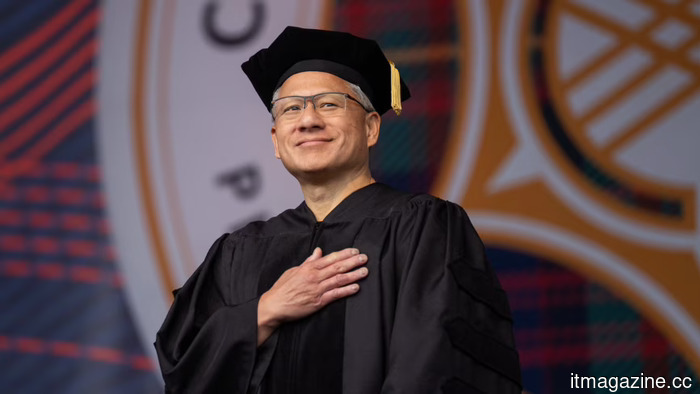 Jensen Huang addressed the class of 2026 at CMU:
Jensen Huang gave the commencement speech at Carnegie Mellon University, presenting AI as a pivotal moment for reindustrialization in the United States.
Jensen Huang addressed the class of 2026 at CMU:
Jensen Huang gave the commencement speech at Carnegie Mellon University, presenting AI as a pivotal moment for reindustrialization in the United States.
 I allowed this Galaxy S26 feature to manage my battery, and it really does work.
The Device Care functionalities of the Galaxy S26 effectively manage battery health, background applications, and system optimization in ways that yield noticeable benefits over time. After the initial setup, it generally operates in the background, allowing you to use your phone without interruption.
I allowed this Galaxy S26 feature to manage my battery, and it really does work.
The Device Care functionalities of the Galaxy S26 effectively manage battery health, background applications, and system optimization in ways that yield noticeable benefits over time. After the initial setup, it generally operates in the background, allowing you to use your phone without interruption.
Dutch company Eyeo secures €40 million to commercialize NCOS color-splitting image sensors.
eyeo has secured €40 million in a Series A funding round led by Innovation Industries to advance its Nanophotonic Color Splitting sensor technology, which was developed by imec.