

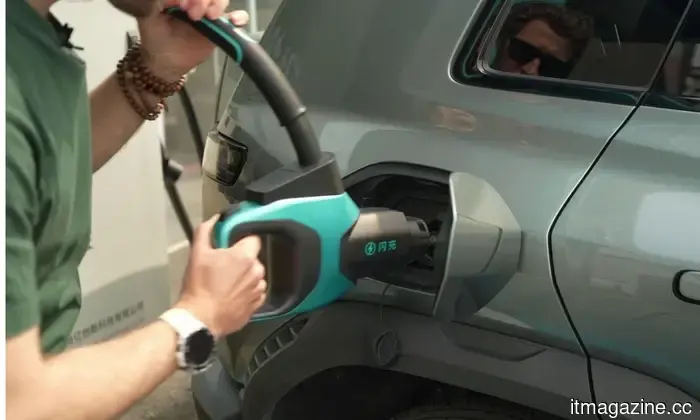
BYD's incredibly rapid Flash charging technology for electric vehicles became so hot that it could roast a turkey.
A real-world evaluation of BYD's Megawatt Flash Charge technology revealed that the battery temperature reached 169.6°F during the charging process. This temperature is sufficiently high enough to cook a turkey and significantly surpasses China's recommended safety threshold of 149°F for lithium iron phosphate battery cells. Conducted by an automotive blogger who livestreamed the event (via ChinaEVHome), the test has raised concerns regarding the potential long-term effects of ultra-fast charging on battery health due to the excessive heat generated.
The significance of the heat
Typically, EV battery cells operate within a temperature range of 68°F to 86°F under standard driving and charging conditions, with most vehicles issuing overheating alerts when temperatures exceed 140°F. The temperatures recorded in this test place significant stress on the Solid Electrolyte Interphase (SEI) layer, which serves as a protective barrier separating the electrolyte from the anode while permitting lithium ion flow.
Experts in battery technology indicate that this SEI layer begins to break down above 158°F. This raises concerns about the possibility of accelerated battery deterioration from repeated exposure to such high temperatures.
BYD reportedly expected this level of scrutiny. When they introduced the second-generation Blade Battery, company executives highlighted a lifetime warranty on the battery cells and stated that the new battery pack improves capacity retention by 2.5% compared to the prior generation. Additionally, BYD showcased the battery's durability by intentionally short-circuiting four cells and maintaining that condition for 24 hours, with no fires or explosions reported.
The larger context
BYD is not the only company venturing into fast charging technologies. Although its advancements surpass those of many automakers, including Tesla, Porsche, Hyundai, and Lucid, Chinese rivals like CATL and Geely have created battery platforms capable of charging rates that go beyond BYD’s current megawatt charging capacities.
As the industry strives for increasingly rapid charging solutions, effectively managing heat without compromising battery longevity is becoming as crucial as the speed itself. CATL has claimed to have solved this challenge with its 5C lithium-ion battery; however, this technology has yet to be introduced to the market.





Other articles
 A $13,500 Unitree robot was 'blessed' at the Jogyesa Temple in Seoul.
A Unitree robot was 'blessed' at the Jogyesa Temple in Seoul. Amid the event, the Jogye Order established five AI ethics guidelines that are worth considering.
Demand for Mac mini is reaching new heights due to Claude AI agents.
The Mac mini from Apple has become the standard hardware for self-hosted Claude and ChatGPT agents that utilize the OpenClaw framework.
A $13,500 Unitree robot was 'blessed' at the Jogyesa Temple in Seoul.
A Unitree robot was 'blessed' at the Jogyesa Temple in Seoul. Amid the event, the Jogye Order established five AI ethics guidelines that are worth considering.
Demand for Mac mini is reaching new heights due to Claude AI agents.
The Mac mini from Apple has become the standard hardware for self-hosted Claude and ChatGPT agents that utilize the OpenClaw framework.
 Novo Nordisk transfers Parkinson's cell therapy to Cellular Intelligence, which is supported by Zuckerberg.
Novo Nordisk has transferred STEM-PD, an unused cell therapy for Parkinson's, to the AI biotechnology company Cellular Intelligence in exchange for equity and certain milestones.
Claude AI agents are spurring unprecedented demand for Mac minis.
Apple's Mac mini has emerged as the standard hardware for self-hosted Claude and ChatGPT agents developed using the OpenClaw framework.
Novo Nordisk transfers Parkinson's cell therapy to Cellular Intelligence, which is supported by Zuckerberg.
Novo Nordisk has transferred STEM-PD, an unused cell therapy for Parkinson's, to the AI biotechnology company Cellular Intelligence in exchange for equity and certain milestones.
Claude AI agents are spurring unprecedented demand for Mac minis.
Apple's Mac mini has emerged as the standard hardware for self-hosted Claude and ChatGPT agents developed using the OpenClaw framework.
 Novo Nordisk transfers Parkinson's cell therapy to Cellular Intelligence, which is backed by Zuckerberg.
Novo Nordisk has transferred its Parkinson's cell therapy, STEM-PD, which was previously on hold, to the AI biotech company Cellular Intelligence in exchange for equity and milestone payments.
Novo Nordisk transfers Parkinson's cell therapy to Cellular Intelligence, which is backed by Zuckerberg.
Novo Nordisk has transferred its Parkinson's cell therapy, STEM-PD, which was previously on hold, to the AI biotech company Cellular Intelligence in exchange for equity and milestone payments.
 Alphabet intends to conduct its inaugural yen bond offering to finance its artificial intelligence development.
Alphabet has appointed Mizuho, Bank of America, and Morgan Stanley to manage its inaugural bond sale denominated in yen.
Alphabet intends to conduct its inaugural yen bond offering to finance its artificial intelligence development.
Alphabet has appointed Mizuho, Bank of America, and Morgan Stanley to manage its inaugural bond sale denominated in yen.
BYD's incredibly rapid Flash charging technology for electric vehicles became so hot that it could roast a turkey.
A practical evaluation of BYD's Megawatt Flash Charge technology showed battery temperatures reaching 169.6°F, significantly exceeding China's advised safety limit for lithium iron phosphate cells, which has sparked worries regarding the long-term health of the batteries.