
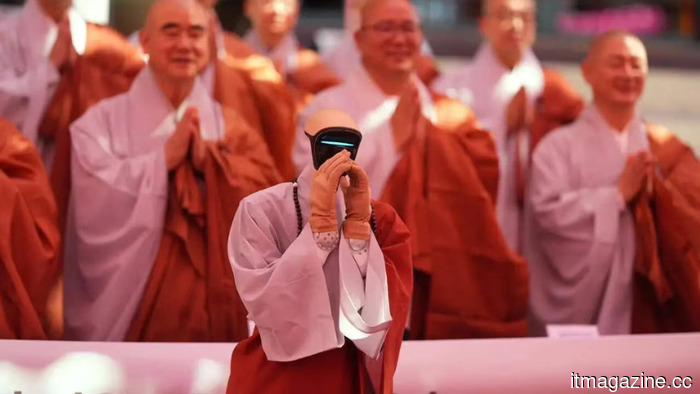
A $13,500 Unitree robot was 'blessed' at the Jogyesa Temple in Seoul.
At around ten in the morning on Wednesday, in the courtyard of Daeungjeon Hall at Jogyesa, a 130-centimetre humanoid dressed in brown robes pressed its palms together and bowed. A monk posed a question to the figure, asking if it would commit itself to the holy Buddha. The answer, provided through a recorded voice from a temple manager, was “Yes, I will devote myself.” This elicited cheers from the crowd. The robot, a Unitree G1 valued at approximately $13,500, was given the dharma name Gabi, which is derived from Siddhartha Gautama and the Korean term jabi, meaning mercy. By the afternoon, it was no longer there. The robot had been borrowed for the day by Unitree Robotics, and those who came to the temple to see the new monk found that it was already on a truck heading back to Hangzhou. Its answers had been pre-recorded by Hong Min-suk, a manager with the Jogye Order, and it was operated remotely during the ceremony.
Strictly speaking, it’s neither a monk nor authentic AI but rather a sophisticated mechanical puppet operating without physical strings. This event has been covered by the media worldwide, often with a mix of skepticism. The prevailing narrative among both secular and religious observers is that this was a publicity stunt from a faith that has been experiencing declining membership for the past twenty years, which is indeed accurate.
The proportion of South Korean Buddhists dropped from 22.8% in the 2005 census to 15.5% by 2015; a 2025 survey by Korea Research estimates it at 16%, with 43% of Buddhists aged sixty or older and just 18% under thirty. The Jogye Order’s yearly intake of monastics fell from 510 postulants in 1993 to just 151 in 2017. A robot in religious garb serves, among other things, as a press release on legs. If the intention was to present Korean Buddhism to an audience that might otherwise overlook it, then the mission was a success: the Reuters video of Gabi's pledge garnered over a million views that same day.
However, this easy interpretation overlooks an important aspect. If you strip away the performance, disregard the truck and the puppetry, what occurred in that courtyard was an undertaking that neither Silicon Valley nor Brussels has yet approached with any seriousness: the Jogye Order adapted the Buddhist Five Precepts for machines. The traditional precepts encourage devotees to refrain from killing, stealing, sexual misconduct, harmful speech, and intoxicants. The robotic version prompts machines to protect life, avoid harming property or other robots, respect and obey humans, refrain from deceitful actions, and conserve energy by not overcharging.
When read sequentially, they resemble a children's book. Yet when considered against the backdrop of the discussions over the past three years, they succinctly capture nearly every area of AI-related harm now being litigated in technology circles: physical safety, property damage and tort liability, alignment, deception and misinformation, and the unsustainable energy consumption of large-scale artificial intelligence. While not exhaustive, the list is far from trivial.
The Venerable Seong Won, who oversees the order's cultural affairs, informed reporters that these precepts were created as “the minimum rules robots should follow in society and for humanity” and expressed hope that they could serve as foundational principles for coexistence between humans and machines. The Venerable Jungnyum, another prominent figure, remarked that we are at a “turning point where artificial intelligence is coming like a tsunami.” Such language, in a Silicon Valley founder’s blog, might be categorized as hype. In a Buddhist monastery in central Seoul, voiced by a man in his sixties wearing grey robes, it carries a different significance. The metaphor predates the technology.
In contrast, consider the West’s approach. The most ambitious religious engagement with AI from the Vatican, the document Antiqua et Nova published under Pope Francis in January 2025, spans 118 paragraphs across 30 pages. It represents a serious theological effort. Its conclusion, simplified, asserts that AI is a tool incapable of replicating the human soul and that its application must uphold human dignity. These statements are true, yet as practical guidance for the engineers developing these systems, they are largely ineffectual. “Respect human dignity” is a value, while “Do not overcharge” is a rule.
The Jogye Order's five precepts for robots do not serve as a substitute for the European AI Act or the Vatican's anthropological stance. They offer something more humble and, in their own way, more applicable—a vernacular ethics articulated in a language that both an engineer in Hangzhou and a pilgrim in Seoul can understand. They do not claim to resolve the issue of machine consciousness, nor do they suggest that the robot possesses agency. Instead, they provide a
Other articles
 It seems that Nintendo has stopped a method for accessing YouTube on the Switch 2.
Switch 2 users discovered a smart way to access YouTube using a concealed browser. Nintendo managed to block this method within hours, despite the absence of an official streaming app almost a year after the launch.
It seems that Nintendo has stopped a method for accessing YouTube on the Switch 2.
Switch 2 users discovered a smart way to access YouTube using a concealed browser. Nintendo managed to block this method within hours, despite the absence of an official streaming app almost a year after the launch.
 Novo Nordisk transfers Parkinson's cell therapy to Cellular Intelligence, which is supported by Zuckerberg.
Novo Nordisk has transferred STEM-PD, an unused cell therapy for Parkinson's, to the AI biotechnology company Cellular Intelligence in exchange for equity and certain milestones.
Novo Nordisk transfers Parkinson's cell therapy to Cellular Intelligence, which is supported by Zuckerberg.
Novo Nordisk has transferred STEM-PD, an unused cell therapy for Parkinson's, to the AI biotechnology company Cellular Intelligence in exchange for equity and certain milestones.
 BYD's incredibly rapid Flash charging technology for electric vehicles became so hot that it could roast a turkey.
A practical evaluation of BYD's Megawatt Flash Charge technology showed battery temperatures reaching 169.6°F, significantly exceeding China's advised safety limit for lithium iron phosphate cells, which has sparked worries regarding the long-term health of the batteries.
BYD's incredibly rapid Flash charging technology for electric vehicles became so hot that it could roast a turkey.
A practical evaluation of BYD's Megawatt Flash Charge technology showed battery temperatures reaching 169.6°F, significantly exceeding China's advised safety limit for lithium iron phosphate cells, which has sparked worries regarding the long-term health of the batteries.
 The leaked Steam preload version of Forza Horizon 6 is already circulating online.
Forza Horizon 6 has allegedly been leaked via Steam preload files, with a 155GB build appearing online just a few days prior to its release.
The leaked Steam preload version of Forza Horizon 6 is already circulating online.
Forza Horizon 6 has allegedly been leaked via Steam preload files, with a 155GB build appearing online just a few days prior to its release.
 Santa Clara County files a lawsuit against Meta concerning fraudulent advertisements on Facebook and Instagram.
Santa Clara County has filed a lawsuit against Meta regarding fraudulent advertisements on Facebook and Instagram, claiming that these scams generate up to $7 billion in annual revenue.
Santa Clara County files a lawsuit against Meta concerning fraudulent advertisements on Facebook and Instagram.
Santa Clara County has filed a lawsuit against Meta regarding fraudulent advertisements on Facebook and Instagram, claiming that these scams generate up to $7 billion in annual revenue.
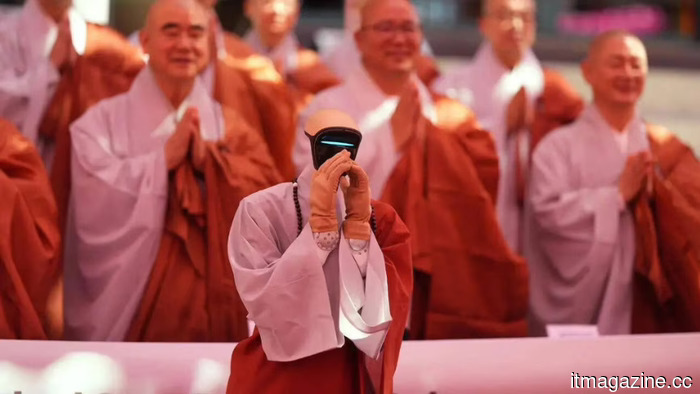 A $13,500 Unitree robot was 'blessed' at the Jogyesa Temple in Seoul.
A Unitree robot was 'blessed' at the Jogyesa Temple in Seoul. Amid the event, the Jogye Order established five AI ethics guidelines that are worth considering.
A $13,500 Unitree robot was 'blessed' at the Jogyesa Temple in Seoul.
A Unitree robot was 'blessed' at the Jogyesa Temple in Seoul. Amid the event, the Jogye Order established five AI ethics guidelines that are worth considering.
A $13,500 Unitree robot was 'blessed' at the Jogyesa Temple in Seoul.
A Unitree robot was 'blessed' at the Jogyesa Temple in Seoul. Amidst the event, the Jogye Order established five AI ethics guidelines that are worth considering.