
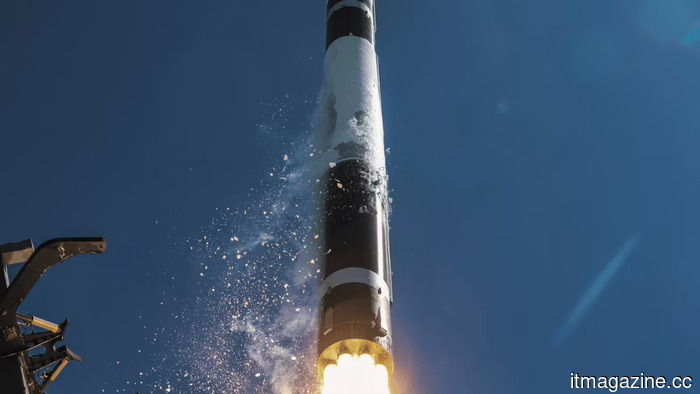
Rocket Lab's revenue for Q1 2026 increases by 64% to a record $200 million, while its backlog reaches $2.2 billion and its stock climbs by 30%.
Rocket Lab’s revenue surged by 64 percent in the first quarter, reaching a record 200 million dollars, while its backlog expanded to 2.2 billion dollars, and its stock achieved an all-time high. However, the Neutron rocket, which is crucial for the company's valuation, has yet to be launched.
In the first quarter of 2026, Rocket Lab sold more launch services than it did in the entire previous year. Revenue reached 200.3 million dollars, up from 122.6 million a year prior, surpassing analyst projections that had been revised upward twice in the last three months. The space systems division, responsible for building satellites and spacecraft parts, earned 136.7 million dollars, while the launch business brought in 63.7 million dollars, both exceeding expectations. Following this news, the stock jumped 30 percent in after-hours trading, giving the company an approximate valuation of 45 billion dollars.
The financial results indicate strong momentum across all business segments. Gross margin improved to 38.2 percent, compared to the low thirties the previous year. The net loss decreased to 45 million dollars from 60.6 million in the first quarter of 2025, and the adjusted EBITDA loss was 11.8 million, suggesting that profitability may be achievable if revenue growth continues.
During the quarter, Rocket Lab secured 31 new contracts for Electron and HASTE launches and five contracts for Neutron, its yet-to-fly medium-lift rocket. The company announced its largest launch agreement to date, involving a bulk order of Neutron and Electron flights from an undisclosed customer.
Additionally, Rocket Lab revealed a 30 million dollar contract with Anduril Industries for three HASTE hypersonic test flights from its Virginia launch facility. The HASTE vehicle, which is a suborbital version of Electron, serves as a platform for testing hypersonic technologies at speeds exceeding Mach 5. Funding for these flights comes from Anduril's own resources, highlighting private-sector interest in hypersonic testing infrastructure that has traditionally been exclusive to government programs.
The backlog of 2.2 billion dollars explains why investors boosted the company’s market capitalization by 10 billion dollars in one night. Rocket Lab's backlog was roughly 1.1 billion dollars a year ago, so it has doubled in twelve months. The most significant component is an 816 million dollar prime contract to create a missile defense constellation for the Space Development Agency, which is part of the Space Force.
The second-quarter revenue guidance of 225 to 240 million dollars surpassed Wall Street's estimate of 205 million dollars, indicating that analysts may not have fully accounted for the growth acceleration. CEO Peter Beck mentioned that the current pipeline supports ongoing growth into the second half of the year and beyond.
Rocket Lab’s clients include both government and commercial sectors. It provides satellite launches for the National Reconnaissance Office, NASA, the Space Force, and allied military forces, and it manufacturers spacecraft components for firms like GlobalStar. It is also developing the SDA’s Tranche 2 Transport Layer satellites. The wide-ranging business model supports the company’s valuation; Rocket Lab is positioned as a vertically integrated space infrastructure provider, rather than just a launch company.
Neutron is the medium-lift launch vehicle that is central to Rocket Lab’s future ambitions. It is designed to transport 13,000 kilograms to low Earth orbit in a reusable setup and 15,000 kilograms in an expendable format. Neutron aims to compete for constellation deployments, national security, and deep space missions currently dominated by SpaceX's Falcon 9.
Neutron has not conducted its inaugural flight yet. Beck stated that the integration of hardware for the first flight is in progress, the Archimedes engine qualification is advancing, and development on the second stage and reusable fairing systems is ongoing. The anticipated debut launch is set for later this year, but Rocket Lab has previously adjusted this timeline. The original target was late 2024, which was shifted to mid-2025, then to 2026. Each delay has come with credible technical explanations, and investors have shown continued patience.
This patience is somewhat warranted due to Electron’s history of success. While Dawn Aerospace, a company from New Zealand, has proven that smaller nations can create reliable launch vehicles, Rocket Lab has outperformed other non-American entities by establishing a commercially successful orbital launch business. Electron has successfully completed over 60 missions with a success rate exceeding 95 percent, making it the most frequently launched small orbital rocket globally. The critical question is whether the engineering precision that ensured Electron’s reliability can be replicated for a vehicle that is ten times its size.
SpaceX dominates the launch market, boasting a launch frequency and cost structure unmatched by competitors. In 2025, Falcon 9 conducted more than 100 launches, compared to Rocket Lab's 21, highlighting a significant gap. However, the disparity in market positioning is not as wide as
Other articles
 Hackers compromised Poland's water treatment facilities by exploiting default passwords, while the US encounters similar threats to its critical infrastructure.
Poland's ABW revealed that five water treatment facilities experienced ICS breaches due to the use of default passwords. The US EPA identified that 70% of American water utilities do not meet fundamental cybersecurity standards.
Hackers compromised Poland's water treatment facilities by exploiting default passwords, while the US encounters similar threats to its critical infrastructure.
Poland's ABW revealed that five water treatment facilities experienced ICS breaches due to the use of default passwords. The US EPA identified that 70% of American water utilities do not meet fundamental cybersecurity standards.
 An Apple leak predicts the arrival of a Spatial iPhone featuring a holographic 3D display. It's high time!
A leak indicates that Apple and Samsung are collaborating on a Spatial iPhone featuring a holographic display capable of creating depth effects without the need for glasses, with a target release around 2030.
An Apple leak predicts the arrival of a Spatial iPhone featuring a holographic 3D display. It's high time!
A leak indicates that Apple and Samsung are collaborating on a Spatial iPhone featuring a holographic display capable of creating depth effects without the need for glasses, with a target release around 2030.
 How Google Workspace aids small businesses in scaling with the assistance of an AI co-founder.
Google Workspace with Gemini supports small teams in working more efficiently by serving as a digital co-founder, automating tasks, and enhancing productivity in daily workflows.
How Google Workspace aids small businesses in scaling with the assistance of an AI co-founder.
Google Workspace with Gemini supports small teams in working more efficiently by serving as a digital co-founder, automating tasks, and enhancing productivity in daily workflows.
 The Pentagon has introduced war.gov/ufo, featuring 162 declassified UFO files as part of Trump's PURSUE initiative.
The Pentagon has made available 162 UFO documents on war.gov/ufo, which include mysterious Apollo 17 images and footage of military sightings. Among these files, 108 contain partial redactions.
The Pentagon has introduced war.gov/ufo, featuring 162 declassified UFO files as part of Trump's PURSUE initiative.
The Pentagon has made available 162 UFO documents on war.gov/ufo, which include mysterious Apollo 17 images and footage of military sightings. Among these files, 108 contain partial redactions.
 I abandoned physical books, and my reading experience has improved immensely.
Reading at night, integrated dictionaries, more affordable books, and notes that you'll find useful in the future. This is why you should consider abandoning physical books and never returning to them.
I abandoned physical books, and my reading experience has improved immensely.
Reading at night, integrated dictionaries, more affordable books, and notes that you'll find useful in the future. This is why you should consider abandoning physical books and never returning to them.
 How Google Workspace supports small businesses in scaling with the assistance of an AI co-founder.
Google Workspace with Gemini assists small teams in working more efficiently by serving as a digital co-founder, automating tasks and enhancing productivity throughout daily workflows.
How Google Workspace supports small businesses in scaling with the assistance of an AI co-founder.
Google Workspace with Gemini assists small teams in working more efficiently by serving as a digital co-founder, automating tasks and enhancing productivity throughout daily workflows.
Rocket Lab's revenue for Q1 2026 increases by 64% to a record $200 million, while its backlog reaches $2.2 billion and its stock climbs by 30%.
Rocket Lab announced a record Q1 revenue of $200 million, a backlog amounting to $2.2 billion, and a $30 million hypersonics deal with Anduril. The stock rose by 30%, although the Neutron rocket has yet to fly.