
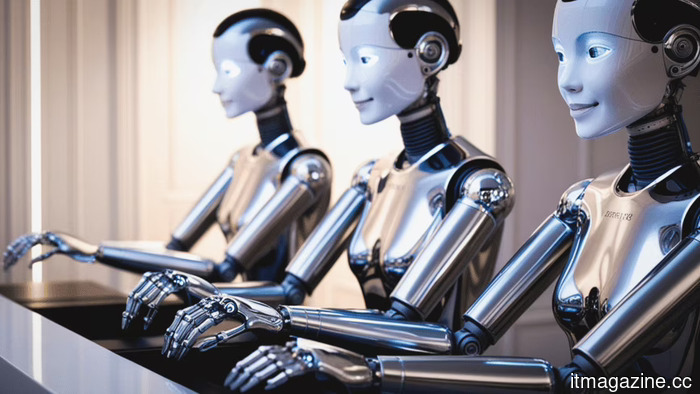
The surge of humanoid robots in China is encountering a reality check, as 150 companies pursue a market where merely 23% of customers express satisfaction.
In 2025, China accounted for 90% of global humanoid robot shipments and boasts over 150 companies in this field. However, a survey revealed that only 23% of enterprises were satisfied with the available products. Morgan Stanley warns of an impending market correction, as billion-dollar IPOs clash with issues like two-hour battery life and a market that only sold 14,000 units last year.
China's humanoid robot sector includes more than 150 companies, and the country shipped about 90% of the world's humanoid robots in 2025. Leading manufacturers Unitree and AgiBot are preparing for initial public offerings valuing them at a total of $13 billion. Morgan Stanley has revised its delivery predictions for the Chinese market to forecast 28,000 units this year, a 133% increase from 2025. Yet, a survey showed only 23% of companies expressed satisfaction with existing products. Most robots have battery life limited to two to three hours, and deployments mainly occur at exhibitions and special events rather than in industry. While technology has advanced, the market demand has not. The humanoid robot industry in China is the most invested, productive, and saturated robotics sector globally and faces imminent challenges, as flagged by the government.
In late 2025, the National Development and Reform Commission (NDRC) of China issued a rare public statement regarding the humanoid robot industry. Spokesperson Li Chao noted that the number of firms surpassed 150 and continues to grow, with many being startups or from different industries. The NDRC cautioned about redundant products, duplicated investments, and diminished genuine R&D opportunities. Although the warning was subtle, it indicated that a bubble might be forming in this prioritized sector supported by a one-trillion-yuan state fund within the 15th Five-Year Plan.
China's smartphone supply chain has started transitioning towards humanoid robot production, with companies like Lingyi iTech—an iPhone assembler—aiming to produce 500,000 humanoid units by 2030. The country has the necessary manufacturing infrastructure and component ecosystem in place. However, the revenue generated from the produced robots has not met the implied valuations. Unitree, which has submitted a $608 million IPO request on Shanghai's STAR Market, saw its humanoid robot revenue exceed that of its quadruped robots for the first time in 2025, but still falls short of its seven billion dollar valuation target. Similarly, AgiBot is pursuing a six billion dollar listing in Hong Kong but faces the same challenge: strong technological capabilities and government support without a corresponding commercial market scale.
According to Morgan Stanley's survey led by industrial analyst Sheng Zhong, 62% of Chinese companies indicated they are likely to adopt humanoid robots within the next three years. This enthusiasm is tempered by practical constraints that the sector has yet to address. The low satisfaction rate of 23% highlights issues in dexterity, functionality, and pricing. Ninety-two percent of companies stated that robots need to be priced below 200,000 renminbi (around $28,000) for mass adoption to be feasible. Currently, only about 10% of surveyed firms are evaluating or conducting pilot projects. While the theoretical demand exists, the reality is that the existing robots are too costly, limited in capability, and have inadequate battery life to warrant investment in most industrial contexts.
UBTech, one of the leading players in the industry, has offered $18 million to hire a chief AI scientist, illustrating the intense competition for talent and the substantial engineering challenges that remain. The company's latest humanoid robot, the Walker S2, began mass production in early 2026 with orders exceeding 800 million yuan, and UBTech is establishing a factory in Beijing aiming to produce 10,000 units annually by the end of 2026. However, production capacity does not equate to commercial demand. Zhong described 2026 as a pivotal year for humanoid robotics integrators aiming for commercialization and ecosystem development, warning of an impending market shake-out. He noted that production likely outpaces sales since major manufacturers are creating robots for training and testing rather than for customers.
In April, a humanoid robot named Lightning, created by Chinese smartphone manufacturer Honor, completed the Beijing E-Town Half-Marathon in 50 minutes and 26 seconds, surpassing the human world record by nearly seven minutes, with over a hundred robots participating. Media coverage was extensive, and an engineer from the winning team noted that this achievement could lead to advancements in structural reliability and cooling for industrial use. However, experts in robotics express skepticism, arguing that the skills demonstrated in a half-marathon—sustained bipedal movement on a flat surface—do not translate to the manual dexterity, real-world adaptation, and problem-solving necessary for factory work and logistics, which are crucial to the industry's business models.
The discrepancy between spectacle and practical application characterizes China's humanoid robot landscape
Other articles
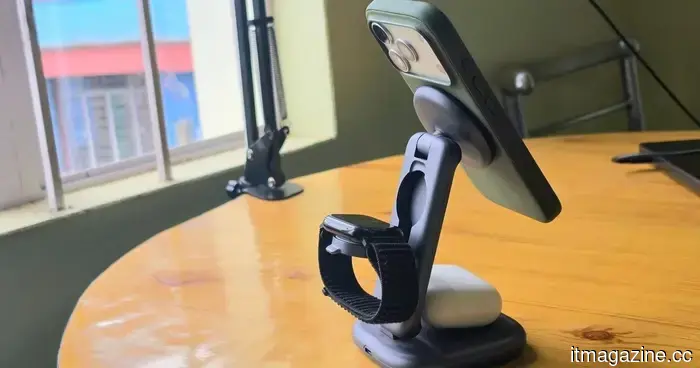 Satechi 3-in-1 Foldable Wireless Charging Stand Qi2 Review: Quick, compact, and my new go-to device
Satechi's 3-in-1 charging stand combines the practicality of a foldable design with top-notch wireless charging speeds available in any device of its type. Tired of tangled wires? This one is a standout solution.
Satechi 3-in-1 Foldable Wireless Charging Stand Qi2 Review: Quick, compact, and my new go-to device
Satechi's 3-in-1 charging stand combines the practicality of a foldable design with top-notch wireless charging speeds available in any device of its type. Tired of tangled wires? This one is a standout solution.
 RingConn's Gen 3 smart ring is now available, featuring haptic notifications and a battery life of 14 days.
The Gen 3 smart ring from RingConn is now open for pre-orders, with a starting price of $314. It features haptic alerts, a battery life of 14 days, and blood pressure monitoring that will be available through a future update.
RingConn's Gen 3 smart ring is now available, featuring haptic notifications and a battery life of 14 days.
The Gen 3 smart ring from RingConn is now open for pre-orders, with a starting price of $314. It features haptic alerts, a battery life of 14 days, and blood pressure monitoring that will be available through a future update.
 Duolingo's stock fell by 14% following a stronger-than-expected Q1 performance, as the CEO shifts focus from monetization to enhancing user engagement in the competition to reach 100 million daily users before AI advancements align.
Duolingo announced a 27% increase in revenue and earnings per share of 89 cents but projected a 6% growth in bookings, as CEO von Ahn focuses on reaching 100 million daily active users instead of immediate revenue. The stock dropped 14%.
Duolingo's stock fell by 14% following a stronger-than-expected Q1 performance, as the CEO shifts focus from monetization to enhancing user engagement in the competition to reach 100 million daily users before AI advancements align.
Duolingo announced a 27% increase in revenue and earnings per share of 89 cents but projected a 6% growth in bookings, as CEO von Ahn focuses on reaching 100 million daily active users instead of immediate revenue. The stock dropped 14%.
 The upcoming foldable devices from Samsung might have been revealed through its own software.
Samsung's intentions for foldable devices might have been revealed inadvertently through its One UI 9 software, and the broader foldable appears to be the exciting option.
The upcoming foldable devices from Samsung might have been revealed through its own software.
Samsung's intentions for foldable devices might have been revealed inadvertently through its One UI 9 software, and the broader foldable appears to be the exciting option.
 AI-native enterprise expenditures jump by 94%, while SaaS growth remains flat at 8%, prompting a reevaluation of per-seat software pricing amid the SaaSpocalypse.
Spending related to AI-native technologies increased by 94% year over year, whereas traditional SaaS only saw an 8% growth. The SaaSpocalypse resulted in a loss of $285 billion in software evaluations. Each enterprise vendor is shifting towards agents.
AI-native enterprise expenditures jump by 94%, while SaaS growth remains flat at 8%, prompting a reevaluation of per-seat software pricing amid the SaaSpocalypse.
Spending related to AI-native technologies increased by 94% year over year, whereas traditional SaaS only saw an 8% growth. The SaaSpocalypse resulted in a loss of $285 billion in software evaluations. Each enterprise vendor is shifting towards agents.
 Intel showcases its Computex 2026 lineup that includes handheld devices, desktops, and servers, with the 18A process emerging as a hallmark of its foundry services.
At Computex 2026, Intel will showcase Panther Lake Arc G3 handheld devices, a 52-core Nova Lake desktop, and a 288-core Clearwater Forest Xeon. All of these products are manufactured using the 18A process node.
Intel showcases its Computex 2026 lineup that includes handheld devices, desktops, and servers, with the 18A process emerging as a hallmark of its foundry services.
At Computex 2026, Intel will showcase Panther Lake Arc G3 handheld devices, a 52-core Nova Lake desktop, and a 288-core Clearwater Forest Xeon. All of these products are manufactured using the 18A process node.
The surge of humanoid robots in China is encountering a reality check, as 150 companies pursue a market where merely 23% of customers express satisfaction.
China is home to over 150 humanoid robot companies, holding a 90% share of the global market; however, buyer satisfaction stands at just 23%. Morgan Stanley cautions that a shake-out may occur as the number of IPOs surpasses demand.