

Expenditure in AI-native enterprises has jumped by 94%, while spending on SaaS has remained stagnant at 8%, leading to a recalibration of prices for per-seat software in what is being termed the SaaSpocalypse.
TL;DRAI-native enterprise expenditures skyrocketed by 94 percent year-on-year as traditional SaaS growth slowed to just eight percent. The SaaSpocalypse wiped out $285 billion in software valuations in February 2026, and enterprise platforms, from Salesforce to a Hong Kong messaging startup called Omnichat, are hurrying to shift from per-seat pricing to an agent-based delivery model before the market labels them as outdated.
For two decades, the enterprise software industry focused on selling individual licenses. Companies purchased a license for each employee needing access, multiplying it by their workforce, creating predictable revenue streams reflected in quarterly earnings reports. However, with the arrival of AI agents, this model faced disruption. In the first quarter of 2026, spending on AI-native solutions surged by 94 percent year-on-year, based on market data from enterprise platforms adjusting to this change. Meanwhile, traditional SaaS only grew by eight percent—a gap that continues to widen. This disparity highlights a division between businesses selling tools and those offering outcomes, with firms on the wrong side running out of time to adapt.
The reckoning
On February 3, 2026, dubbed the SaaSpocalypse by financial media, software-as-a-service companies lost around $285 billion in market capitalisation in a mere 48 hours. This was triggered not by a single event but by a series of factors: the release of open-source enterprise agent plugins by Anthropic, a wave of AI product launches from Salesforce, ServiceNow, and Google, and growing evidence showing that AI agents could drastically reduce the number of human users needed for operational software. This led Wall Street to reassess the per-seat pricing model that most enterprise SaaS companies relied on, deeming many structurally overvalued. If a single AI agent could accomplish the work of ten employees, why would a business continue to pay for the extra licenses?
Market numbers have remained bleak. Public SaaS growth rates have dropped every quarter since their peak in 2021. For the first time in the modern era, software stocks are trading at a discount compared to the S&P 500. Gartner forecasts that by 2030, at least 40 percent of enterprise SaaS spending will transition from per-seat to usage-based, agent-based, or outcome-based pricing models. Within the past year, the share of seat-based revenue in enterprise software contracts has decreased from 21 percent to 15 percent. While the model that established companies like Salesforce, ServiceNow, and Workday isn’t defunct, it is no longer the standard. Those firms that have yet to start this transition are witnessing their valuations dwindle in real time.
The pivot
In response to this shifting landscape, Hong Kong-based Omnichat has rebranded itself as an AI-native agent-based customer experience platform, now named Omni AI. Serving more than 5,000 enterprises across the Asia-Pacific, UK, and UAE, it is phasing out its rule-based automation tools in favor of "AI Employees," autonomous agents equipped with brand-specific knowledge, capable of managing customer interactions on platforms like WhatsApp, LINE, Facebook Messenger, Instagram, WeChat, TikTok, and KakaoTalk, and running complete marketing campaigns using natural language instructions instead of manual config. The company reports two consecutive years of 130 percent year-on-year growth in Southeast Asia, having processed over three billion messages and generated more than $100 million in revenue for its clients in the last twelve months.
Omnichat's transformation is not an isolated incident; it is representative of a broader trend. Companies that have thrived on workflow automation, customer relationship management, and marketing technology are urgently repositioning themselves as AI-native platforms to avoid being deemed obsolete by the market. The success of the companies that successfully navigate this transition will depend not on the sophistication of their AI technologies, which are becoming increasingly standardized, but rather on the extent of their integration into customer workflows and the associated switching costs.
The new architecture
Wonderful, an enterprise AI agent platform founded in Amsterdam, raised $150 million in a Series B funding round in March 2026, achieving a valuation of $1.7 billion just eight months after launching. The company has rolled out production-grade agents in over 30 countries across telecom, financial services, manufacturing, and healthcare. Nexus, a startup from Brussels backed by Y Combinator and General Catalyst, secured $4.3 million to enable non-technical enterprise teams to deploy AI agents within weeks using natural language descriptions instead of coding. French telecom Orange successfully deployed a customer onboarding agent through Nexus in four weeks, reporting a 50 percent rise in conversion rates, generating over $6 million in annual lifetime value from a single agent.
Tencent introduced ClawPro, an enterprise AI agent management platform built on OpenClaw, enabling businesses to deploy agents in as little as ten minutes with features for template selection, model switching, and compliance. Over 200 organizations adopted the platform during its internal beta
Other articles
 A man charged with attempted murder for throwing a Molotov cocktail at Sam Altman's residence and possessing a kill list targeting the AI CEO has pleaded not guilty.
Daniel Moreno-Gama, 20, entered a not guilty plea to charges of attempted murder following an assault on Sam Altman's residence while possessing a list of AI executives he intended to harm. He could face a sentence of up to life in prison.
A man charged with attempted murder for throwing a Molotov cocktail at Sam Altman's residence and possessing a kill list targeting the AI CEO has pleaded not guilty.
Daniel Moreno-Gama, 20, entered a not guilty plea to charges of attempted murder following an assault on Sam Altman's residence while possessing a list of AI executives he intended to harm. He could face a sentence of up to life in prison.
 The updated default model of ChatGPT is now 50% less likely to provide misleading information regarding medical and financial inquiries.
OpenAI has updated the default model for ChatGPT from GPT-5.3 Instant to GPT-5.5 Instant, which claims to reduce hallucinated responses on medical, legal, and financial inquiries by 52.5%.
The updated default model of ChatGPT is now 50% less likely to provide misleading information regarding medical and financial inquiries.
OpenAI has updated the default model for ChatGPT from GPT-5.3 Instant to GPT-5.5 Instant, which claims to reduce hallucinated responses on medical, legal, and financial inquiries by 52.5%.
 Meta's AI analyzes images for bone structure to identify underage users on Instagram and Facebook.
Meta is employing AI visual analysis to examine photos and videos for physical traits such as height and bone structure in order to identify and eliminate users under the age of 13 from Instagram and Facebook.
Meta's AI analyzes images for bone structure to identify underage users on Instagram and Facebook.
Meta is employing AI visual analysis to examine photos and videos for physical traits such as height and bone structure in order to identify and eliminate users under the age of 13 from Instagram and Facebook.
 Amazon's Alexa+ has now integrated into your Bose speaker, provided you're ready to cover the cost.
The AI-driven assistant has partnered with Bose, enabling both new and current Bose speaker users to utilize natural-language music discovery.
Amazon's Alexa+ has now integrated into your Bose speaker, provided you're ready to cover the cost.
The AI-driven assistant has partnered with Bose, enabling both new and current Bose speaker users to utilize natural-language music discovery.
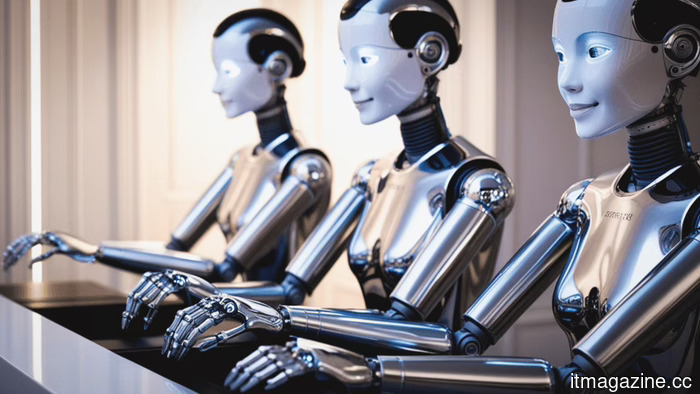 China's surge in humanoid robots encounters a reality check, as 150 firms pursue a market where just 23% of customers are content.
China boasts over 150 humanoid robot companies and holds a 90% share of the global market, yet only 23% of buyers are satisfied. Morgan Stanley cautions that there may be a consolidation in the industry as the number of IPOs exceeds market demand.
China's surge in humanoid robots encounters a reality check, as 150 firms pursue a market where just 23% of customers are content.
China boasts over 150 humanoid robot companies and holds a 90% share of the global market, yet only 23% of buyers are satisfied. Morgan Stanley cautions that there may be a consolidation in the industry as the number of IPOs exceeds market demand.
 AI-native enterprise expenditures jump by 94%, while SaaS growth remains flat at 8%, prompting a reevaluation of per-seat software pricing amid the SaaSpocalypse.
Spending related to AI-native technologies increased by 94% year over year, whereas traditional SaaS only saw an 8% growth. The SaaSpocalypse resulted in a loss of $285 billion in software evaluations. Each enterprise vendor is shifting towards agents.
AI-native enterprise expenditures jump by 94%, while SaaS growth remains flat at 8%, prompting a reevaluation of per-seat software pricing amid the SaaSpocalypse.
Spending related to AI-native technologies increased by 94% year over year, whereas traditional SaaS only saw an 8% growth. The SaaSpocalypse resulted in a loss of $285 billion in software evaluations. Each enterprise vendor is shifting towards agents.
Expenditure in AI-native enterprises has jumped by 94%, while spending on SaaS has remained stagnant at 8%, leading to a recalibration of prices for per-seat software in what is being termed the SaaSpocalypse.
AI-native spending increased by 94% year-over-year, whereas traditional SaaS growth reached 8%. The SaaSpocalypse resulted in a loss of $285 billion in software valuations. Every enterprise vendor is shifting towards agents.