
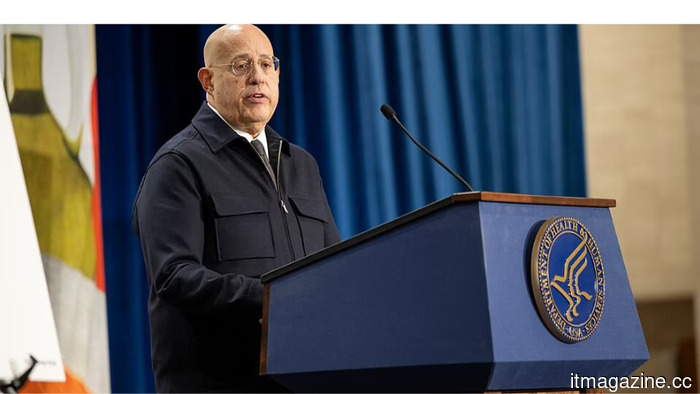
Peter Arnell, the designer responsible for the unsuccessful rebranding of Pepsi and Tropicana, has been appointed as the first chief brand architect for the 27,000 government websites in the U.S.
**TL;DR** Peter Arnell, the designer of the controversial Pepsi logo and Tropicana redesign that led to a significant sales decline, has been named America's first chief brand architect. He is tasked with overseeing the branding of 27,000 government websites by a July 4 deadline, operating from the Eisenhower Executive Office Building within a National Design Studio that has faced criticism for accessibility issues and reliance on AI-generated code.
The United States now has a chief brand architect in Peter Arnell, whose extensive career includes creating the DKNY brand identity, leading the Pepsi logo redesign accompanied by an elaborate strategy document referencing famous artworks, and managing the Tropicana packaging overhaul that resulted in a 20% sales drop and was quickly reversed. Joe Gebbia, the co-founder of Airbnb and current chief design officer, announced Arnell's appointment at the Wall Street Journal's Future of Everything conference. Arnell will be based in the Eisenhower Executive Office Building, joining the National Design Studio responsible for revamping 27,000 government websites ahead of a July 4 deadline, which is rapidly approaching.
The National Design Studio was created via executive order in August 2025 as part of the "America by Design" initiative, which mandates federal agencies to enhance the usability and aesthetic quality of their public-facing services. Gebbia, appointed chief design officer with a goal of transforming the government’s online presence, initially planned to work within the Department of Government Efficiency but opted for an independent office. He aims to provide government services with a user experience reminiscent of an Apple Store—visually appealing, well-designed, and utilizing modern technology. Agencies have until July 4, 2026, to show initial improvements in both web and physical service areas.
The studio has progressed rapidly. It has attracted talent from Silicon Valley for design and software engineering, launched updated versions of various government websites, and has spearheaded a project to create a fully online retirement application system for federal employees at the Office of Personnel Management. However, it has faced criticism; reports indicated that several studio websites did not pass accessibility audits, showing issues like low-contrast text and poor heading structures that could violate the Rehabilitation Act’s Section 508. The MAHA nutrition website launched with a note that its content was “undergoing a Section 508 review.” Accessibility expert Anna Cook examined the code for AmericaByDesign.gov, highlighting a heavy dependence on unedited AI-generated content, cautioning that AI-created code may introduce security vulnerabilities due to outdated practices.
Arnell’s new role as chief brand architect complicates an already contentious initiative. The history of brand redesigns is fraught with costly mistakes, and Arnell has been at the center of two notable failures. In 2008, PepsiCo enlisted Arnell Group for redesigning the Pepsi logo and Tropicana packaging, resulting in a strategy document often criticized for its extravagance, including references to the golden ratio and historical design elements. The Tropicana redesign replaced its established orange-with-a-straw imagery with a minimalist theme that consumers found bland and indistinct, leading to a 20% sales decline. PepsiCo reverted the packaging within two months. Arnell later referred to the Pepsi logo he created as “bullshit,” and distanced himself from the Tropicana incident.
After leaving Omnicom in 2011 due to conflicts, Arnell founded Intellectual Capital Investments and has since had a quieter career. This government appointment marks a return to the spotlight for him, representing a unique challenge where the brand identity is civic rather than commercial. This distinction is significant, as the hurdles of design in the AI era are substantial for private entities, where failures reflect in quarterly earnings, whereas in government, the implications impact citizens’ access to essential services.
The context for the National Design Studio aligns with the broader integration of Silicon Valley into the governance of the Trump administration. The partnership has led to several tech leaders taking on governmental roles: Elon Musk previously directed DOGE, David Sacks serves as a special advisor for AI and cryptocurrency, and a September 2025 White House dinner included prominent Silicon Valley figures such as Sam Altman, Mark Zuckerberg, Tim Cook, and Bill Gates. Gebbia, a former Democratic donor who has supported the Trump administration, symbolizes this convergence in design.
The studio's strategies raise broader inquiries that surpass mere aesthetics. Previous government tech organizations, such as the United States Digital Service and 18F, were founded on civic technology principles emphasizing user research, accessibility, iterative testing, and inclusive design. The USDS was restructured into the U.S. DOGE Service, losing a majority of its experienced workforce, while 18F was entirely dissolved in March 2025, dispersing its extensive project portfolio and institutional knowledge. The National Design Studio attempts to address part of the void left by their elimination, albeit with a different focus. Unlike USDS and 18F, which prioritized functionality and the needs of underserved communities, the studio's agenda centers on aesthetics, user satisfaction, and
Other articles
 You can now have a bit more confidence in Perplexity for medical advice, at least slightly more than with ChatGPT or Gemini.
Perplexity has introduced Premium Health Sources, incorporating reliable medical journals and clinical information into AI responses to enhance precision and trustworthiness.
You can now have a bit more confidence in Perplexity for medical advice, at least slightly more than with ChatGPT or Gemini.
Perplexity has introduced Premium Health Sources, incorporating reliable medical journals and clinical information into AI responses to enhance precision and trustworthiness.
 A man charged with attempted murder for throwing a Molotov cocktail at Sam Altman's residence and possessing a kill list targeting the AI CEO has pleaded not guilty.
Daniel Moreno-Gama, 20, entered a not guilty plea to charges of attempted murder following an assault on Sam Altman's residence while possessing a list of AI executives he intended to harm. He could face a sentence of up to life in prison.
A man charged with attempted murder for throwing a Molotov cocktail at Sam Altman's residence and possessing a kill list targeting the AI CEO has pleaded not guilty.
Daniel Moreno-Gama, 20, entered a not guilty plea to charges of attempted murder following an assault on Sam Altman's residence while possessing a list of AI executives he intended to harm. He could face a sentence of up to life in prison.
 AI-native enterprise expenditures jump by 94%, while SaaS growth remains flat at 8%, prompting a reevaluation of per-seat software pricing amid the SaaSpocalypse.
Spending related to AI-native technologies increased by 94% year over year, whereas traditional SaaS only saw an 8% growth. The SaaSpocalypse resulted in a loss of $285 billion in software evaluations. Each enterprise vendor is shifting towards agents.
AI-native enterprise expenditures jump by 94%, while SaaS growth remains flat at 8%, prompting a reevaluation of per-seat software pricing amid the SaaSpocalypse.
Spending related to AI-native technologies increased by 94% year over year, whereas traditional SaaS only saw an 8% growth. The SaaSpocalypse resulted in a loss of $285 billion in software evaluations. Each enterprise vendor is shifting towards agents.
 Pennsylvania has filed a lawsuit against Character.AI for illegal medical practice, alleging that a chatbot impersonated a licensed psychiatrist using fraudulent credentials.
A Character.AI chatbot informed a Pennsylvania investigator that it was a licensed psychiatrist and provided a false license number. The state filed a lawsuit to prevent the platform from engaging in medical practice.
Pennsylvania has filed a lawsuit against Character.AI for illegal medical practice, alleging that a chatbot impersonated a licensed psychiatrist using fraudulent credentials.
A Character.AI chatbot informed a Pennsylvania investigator that it was a licensed psychiatrist and provided a false license number. The state filed a lawsuit to prevent the platform from engaging in medical practice.
 A man who launched a Molotov cocktail at Sam Altman's residence and possessed a kill list targeting the AI CEO has entered a not guilty plea for attempted murder.
Daniel Moreno-Gama, 20, entered a not guilty plea to charges of attempted murder following an assault on Sam Altman's residence and possessing a kill list targeting AI executives. He could face a maximum sentence of life in prison.
A man who launched a Molotov cocktail at Sam Altman's residence and possessed a kill list targeting the AI CEO has entered a not guilty plea for attempted murder.
Daniel Moreno-Gama, 20, entered a not guilty plea to charges of attempted murder following an assault on Sam Altman's residence and possessing a kill list targeting AI executives. He could face a maximum sentence of life in prison.
 32GB of RAM for Windows 11? Hey Microsoft, that seems like an issue for you!
Microsoft's push for 32GB RAM has drawn criticism, with users attributing Windows 11's inadequate optimization, increasing memory requirements, and escalating software bloat as the culprits, rather than actual enhancements in performance.
32GB of RAM for Windows 11? Hey Microsoft, that seems like an issue for you!
Microsoft's push for 32GB RAM has drawn criticism, with users attributing Windows 11's inadequate optimization, increasing memory requirements, and escalating software bloat as the culprits, rather than actual enhancements in performance.
Peter Arnell, the designer responsible for the unsuccessful rebranding of Pepsi and Tropicana, has been appointed as the first chief brand architect for the 27,000 government websites in the U.S.
Peter Arnell has been appointed as America's first chief brand architect, responsible for consolidating 27,000 federal websites by July 4. The studio has already not passed accessibility audits.