
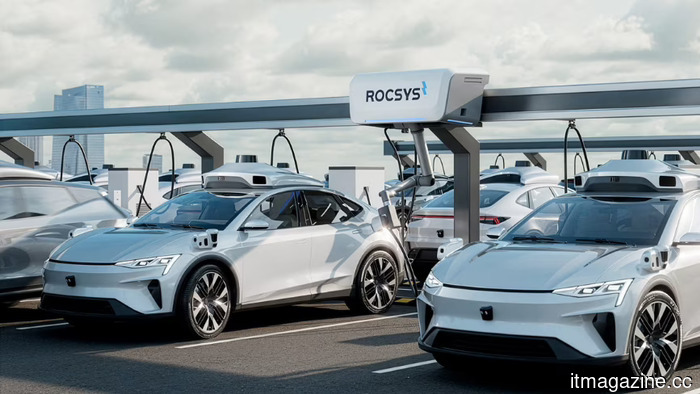
Rocsys secures $13 million in funding for hands-free robotaxi charging solutions.
The M1, an overhead rail-mounted robot capable of autonomously charging up to 10 vehicles per unit without human involvement, is now entering pilot deployment and is set for a larger rollout in 2027, with support from Scania Invest and Capricorn Partners.
There's a notable irony in the robotaxi sector. While these vehicles can drive themselves to collect passengers, they still require a human to plug them in at the depot. Since 2019, Crijn Bouman has been working to address this issue. On Wednesday, his company Rocsys made significant progress.
The Dutch startup revealed the Rocsys M1, which it claims is the world’s first hands-free charging system designed for multiple bays in robotaxi depot operations, along with a $13 million Series A extension to finance its implementation. This funding round was led by Capricorn Partners, with contributions from Scania Invest, Forward.One, SEB Greentech Venture Capital, and Graduate Ventures. The total capital raised since the company's inception now amounts to $56 million.
The M1 operates using an overhead rail-mounted robotic arm that utilizes AI-based computer vision and Rocsys’s proprietary soft robotics technology to locate parked vehicles, navigate to the charging port, and connect the plug without human assistance. Each M1 unit can serve up to 10 charging bays by moving along the overhead rail and is compatible with any electric vehicle model, charger brand, and connector type, allowing fleet operators to avoid vehicle modifications or dependence on a single charging supplier. The system has ground- and roof-mounted configurations to accommodate various depot layouts.
Rocsys reports that the system has a plug-in success rate exceeding 99.9% based on live deployment data, having been trained with over six years of operational data from previous port and logistics projects. In a depot with 50 bays, Rocsys estimates that the M1 could enhance operational efficiency by up to 75% with existing staff, enabling employees to oversee the charging process rather than perform it, resulting in potential annual savings of up to $1.7 million.
Rocsys is tackling a challenge that intensifies with each additional robotaxi introduced onto the streets. Waymo, the leading commercial robotaxi operator, currently provides around 500,000 paid rides per week in 10 US cities with a fleet of 3,000 vehicles, each requiring multiple charges daily at depot facilities. The manual charging process, involving workers plugging and unplugging cables repeatedly during shifts, proves labor-intensive and becomes a significant operational bottleneck at scale.
Uber has recognized this challenge by committing over $100 million specifically towards charging infrastructure as part of its autonomous vehicle strategy.
In Europe, the rollout of robotaxi services is gaining momentum. Verne initiated what it claims is Europe’s first commercial robotaxi service in Zagreb in April 2026, collaborating with Pony.ai and Uber. Motional re-entered the Las Vegas market with Uber's support, while Waymo intends to offer a fully driverless service in London by Q4 2026. As these fleets grow from dozens to hundreds and thousands of vehicles, the issue of depot infrastructure—historically overlooked compared to the technology behind autonomous driving—shifts from a logistical challenge to a significant barrier to growth.
“Autonomous vehicles are expanding rapidly, and infrastructure needs to keep up,” Bouman stated. “If operations aren't hands-free, autonomy ends at the depot. This is the crucial link for robotaxi operators transitioning from pilot programs to widespread deployment.”
The company has confirmed the M1 with what it terms ‘a major robotaxi deal,’ though the operator has not been disclosed. The system is currently in pilot deployment, with plans for a large-scale rollout across thousands of bays in North America and Europe by 2027.
The architectural and market considerations
The multi-bay design is a key characteristic of the M1. Most robotic charging solutions either assign a single robot to each parking bay, which is costly and requires significant space, or necessitate that vehicles stop at fixed charging points.
Rocsys’s overhead rail architecture allows a single unit to serve multiple bays in succession, conserving depot floor space and permitting simultaneous operations such as interior cleaning and inspections while vehicles are charging.
This design choice directly influences depot economics, considering the scale at which robotaxi operators are planning to operate. The M1 represents the first offering in what Rocsys envisages as a more comprehensive depot autonomy platform that will eventually include automated interior cleaning and inspections, extending the hands-free concept beyond just charging to all operational tasks that currently require human interaction with the vehicle between rides.
The global robotaxi market is anticipated to reach $45.7 billion by 2030, according to MarketsandMarkets. Whether Rocsys can position the M1 as the standard charging infrastructure for this market, ahead of similar systems in development by VW, Hyundai, and other companies, will hinge on the 2027 rollout and the customer partnerships it can announce at that time.
Other articles
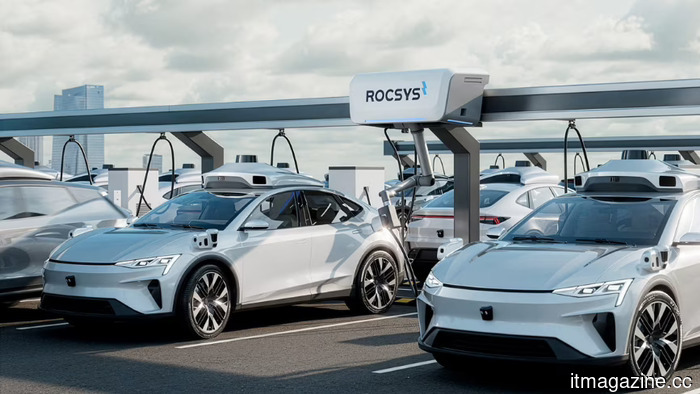 Rocsys secures $13 million in funding for hands-free robotaxi charging.
Rocsys secures $13 million in funding and introduces the M1, a multi-bay overhead charging system for robotaxis, capable of accommodating up to 10 bays per unit.
Rocsys secures $13 million in funding for hands-free robotaxi charging.
Rocsys secures $13 million in funding and introduces the M1, a multi-bay overhead charging system for robotaxis, capable of accommodating up to 10 bays per unit.
 Anthropic aims for a $900 billion valuation in a possible $50 billion funding round.
Anthropic is considering a funding round of $50 billion at a valuation exceeding $900 billion, which could potentially surpass OpenAI's value.
Anthropic aims for a $900 billion valuation in a possible $50 billion funding round.
Anthropic is considering a funding round of $50 billion at a valuation exceeding $900 billion, which could potentially surpass OpenAI's value.
 Eight banks are currently supporting SoftBank's unprecedented $40 billion loan to OpenAI.
HSBC, BNP Paribas, and Intesa Sanpaolo are part of a group of eight banks participating in SoftBank's $40 billion bridge loan for OpenAI.
Eight banks are currently supporting SoftBank's unprecedented $40 billion loan to OpenAI.
HSBC, BNP Paribas, and Intesa Sanpaolo are part of a group of eight banks participating in SoftBank's $40 billion bridge loan for OpenAI.
 Anthropic is targeting a $900 billion valuation in a possible $50 billion funding round.
Anthropic is considering a funding round of $50 billion, which would value the company at over $900 billion, potentially making it more valuable than OpenAI.
Anthropic is targeting a $900 billion valuation in a possible $50 billion funding round.
Anthropic is considering a funding round of $50 billion, which would value the company at over $900 billion, potentially making it more valuable than OpenAI.
 Eight banks are currently supporting SoftBank's unprecedented $40 billion loan to OpenAI.
HSBC, BNP Paribas, and Intesa Sanpaolo are part of a group of eight banks participating in SoftBank's $40 billion bridge loan for OpenAI.
Eight banks are currently supporting SoftBank's unprecedented $40 billion loan to OpenAI.
HSBC, BNP Paribas, and Intesa Sanpaolo are part of a group of eight banks participating in SoftBank's $40 billion bridge loan for OpenAI.
 Q1 2026 earnings for Big Tech: $650 billion in AI capital expenditures and limitations on computing resources.
In the first quarter of 2026, Google Cloud, a part of Alphabet, experienced a 63% growth, whereas AWS reported a 28% increase. Meanwhile, Meta adjusted its capital expenditure guidance to $145 billion, resulting in a 6% drop in its share prices.
Q1 2026 earnings for Big Tech: $650 billion in AI capital expenditures and limitations on computing resources.
In the first quarter of 2026, Google Cloud, a part of Alphabet, experienced a 63% growth, whereas AWS reported a 28% increase. Meanwhile, Meta adjusted its capital expenditure guidance to $145 billion, resulting in a 6% drop in its share prices.
Rocsys secures $13 million in funding for hands-free robotaxi charging solutions.
Rocsys has secured $13 million in funding and introduced the M1, a charging system for robotaxis that features multiple bays and can accommodate up to 10 bays per unit.