
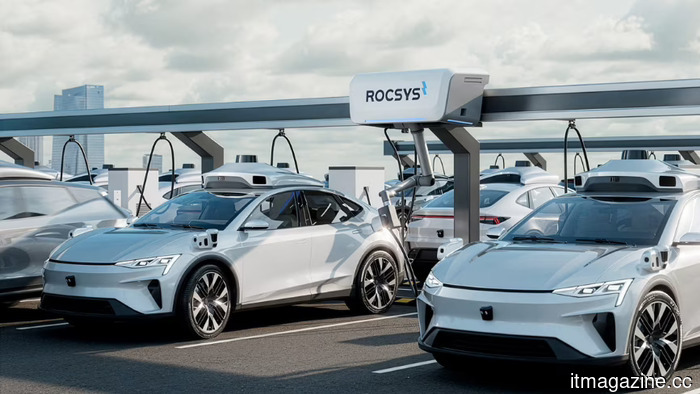
Rocsys secures $13 million in funding for hands-free robotaxi charging.
The M1, an overhead rail-mounted robot that autonomously charges up to 10 vehicles per unit without human involvement, is now entering pilot deployment and is set to be launched at scale in 2027, with support from Scania Invest and Capricorn Partners.
There’s a subtle irony in the robotaxi industry: while the vehicles can drive themselves to pick up passengers, they still require a human to plug them in at the depot. Since 2019, Crijn Bouman has been working to resolve this issue. On Wednesday, his company Rocsys made a significant advancement.
The Dutch startup announced the Rocsys M1, touted as the world’s first hands-free charging system capable of servicing multiple bays within robotaxi depot operations, alongside a $13 million extension to its Series A round to facilitate its rollout.
This funding round was led by Capricorn Partners, with contributions from Scania Invest, Forward.One, SEB Greentech Venture Capital, and Graduate Ventures. The total amount raised since the company’s inception now reaches $56 million.
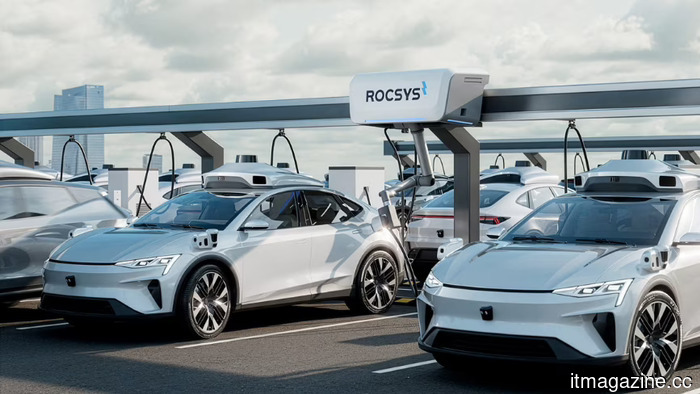
The M1 utilizes an overhead rail-mounted robotic arm, which is guided by AI-based computer vision and Rocsys’s proprietary soft robotics technology. It identifies parked vehicles, navigates to the charging port, and connects the plug autonomously.
A single M1 unit can service up to 10 bays by moving along the overhead rail. The system is compatible with any electric vehicle model, any charger brand, and any connector type, meaning fleet operators are not required to retrofit vehicles or rely on a specific charging supplier. Options for ground- and roof-mounted configurations are available to fit various depot layouts.
According to the company, the system achieves a plug-in success rate of over 99.9% in real deployments, trained on more than six years of operational data from previous port and logistics applications.
In a 50-bay depot, Rocsys estimates that the M1 can increase operational efficiency by up to 75% through existing staff, enabling them to oversee the charging process instead of performing it, which could result in annual savings of up to $1.7 million.
Rocsys is addressing a growing issue that intensifies with each additional robotaxi added to the fleet. Waymo, the most advanced commercial robotaxi operator, currently manages around 500,000 paid rides weekly across 10 U.S. cities with a fleet of 3,000 vehicles. Each vehicle requires charging multiple times a day at depot facilities, and the process, which relies on human workers plugging and unplugging cables dozens of times per shift, is labor-intensive and poses a significant operational bottleneck when scaled.
Uber has recognized this challenge, investing more than $100 million specifically for charging infrastructure as part of its autonomous vehicle strategy.
In Europe, the commercialization of robotaxi operations is picking up speed. Verne launched what it claims is Europe’s first commercial robotaxi service in Zagreb in April 2026, in partnership with Pony.ai and Uber. Motional re-entered the market in Las Vegas with Uber’s support. Waymo plans a fully driverless service in London by Q4 2026. As these fleets expand from dozens to hundreds and then thousands of vehicles, the depot infrastructure issue—historically less prioritized than the autonomous driving technology—transitions from a logistical challenge to a significant barrier to growth.
“Autonomous vehicles are developing rapidly, and infrastructure must evolve accordingly,” Bouman stated. “Without hands-free operations, autonomy is limited to the depot. This is the essential link for robotaxi operators to advance from pilot programs to global deployment.”
The company has validated the M1 with what it describes as ‘a major robotaxi deal,’ though the specific operator remains unnamed. The system is currently in pilot deployment, with plans for large-scale rollout across thousands of bays in North America and Europe set for 2027.
**The architecture and the market**
The defining architectural feature of the M1 is its multi-bay approach. Most robotic charging solutions either assign one robot per parking bay, which is costly and takes up space, or require vehicles to arrive at a fixed charging point.
Rocsys's overhead rail architecture allows a single unit to sequentially serve a row of bays, freeing up depot floor space and permitting simultaneous operations, such as interior cleaning and inspection, while vehicles are charging.
This is not merely a design preference; it directly influences the depot economics that robotaxi operators are planning for.
The M1 is the first product in what Rocsys envisions as a wider depot autonomy platform, which will eventually include automated interior cleaning and inspection, extending the hands-free concept beyond just connecting charging cables to all operational tasks currently requiring human interaction with the vehicle between rides.
The global robotaxi market is expected to reach $45.7 billion by 2030, according to MarketsandMarkets. Whether Rocsys can establish the M1 as the standard charging infrastructure
Other articles
 Eight banks are currently supporting SoftBank's unprecedented $40 billion loan to OpenAI.
HSBC, BNP Paribas, and Intesa Sanpaolo are part of a group of eight banks participating in SoftBank's $40 billion bridge loan for OpenAI.
Eight banks are currently supporting SoftBank's unprecedented $40 billion loan to OpenAI.
HSBC, BNP Paribas, and Intesa Sanpaolo are part of a group of eight banks participating in SoftBank's $40 billion bridge loan for OpenAI.
 Google Photos will allow you to virtually try on clothing that you already own or have simply captured by taking a screenshot.
Google Photos is introducing a new wardrobe feature that utilizes AI to organize your outfits from previous photos, assist you in combining different styles, and allow you to virtually try them on.
Google Photos will allow you to virtually try on clothing that you already own or have simply captured by taking a screenshot.
Google Photos is introducing a new wardrobe feature that utilizes AI to organize your outfits from previous photos, assist you in combining different styles, and allow you to virtually try them on.
 Nvidia B300 servers are priced at $1 million in China, almost twice the cost in the United States.
In China, Nvidia B300 servers are now priced at $1 million, almost twice the cost in the US, following the arrest related to Supermicro smuggling that shut down the grey market.
Nvidia B300 servers are priced at $1 million in China, almost twice the cost in the United States.
In China, Nvidia B300 servers are now priced at $1 million, almost twice the cost in the US, following the arrest related to Supermicro smuggling that shut down the grey market.
 Eight banks are currently supporting SoftBank's unprecedented $40 billion loan to OpenAI.
HSBC, BNP Paribas, and Intesa Sanpaolo are part of a group of eight banks participating in SoftBank's $40 billion bridge loan for OpenAI.
Eight banks are currently supporting SoftBank's unprecedented $40 billion loan to OpenAI.
HSBC, BNP Paribas, and Intesa Sanpaolo are part of a group of eight banks participating in SoftBank's $40 billion bridge loan for OpenAI.
 Rocsys secures $13 million in funding for hands-free robotaxi charging solutions.
Rocsys has secured $13 million in funding and introduced the M1, a charging system for robotaxis that features multiple bays and can accommodate up to 10 bays per unit.
Rocsys secures $13 million in funding for hands-free robotaxi charging solutions.
Rocsys has secured $13 million in funding and introduced the M1, a charging system for robotaxis that features multiple bays and can accommodate up to 10 bays per unit.
 The Trump administration halts the rollout of Anthropic’s Mythos.
The White House has informed Anthropic that it is against the expansion of Mythos access to an additional 70 organizations, citing concerns regarding security and computing resources.
The Trump administration halts the rollout of Anthropic’s Mythos.
The White House has informed Anthropic that it is against the expansion of Mythos access to an additional 70 organizations, citing concerns regarding security and computing resources.
Rocsys secures $13 million in funding for hands-free robotaxi charging.
Rocsys secures $13 million in funding and introduces the M1, a multi-bay overhead charging system for robotaxis, capable of accommodating up to 10 bays per unit.