
Foundation Future Industries secures $24 million contracts from the Pentagon for humanoid robot soldiers, with support from Eric Trump and trialed in Ukraine.
TL;DRFoundation Future Industries, a startup based in San Francisco whose CEO previously led a failed fintech company, has obtained $24 million in research contracts from the Pentagon to evaluate humanoid robots for infiltrating enemy positions. Two Phantom MK-1 units were dispatched to Ukraine in February for testing in logistics and reconnaissance. The company's chief strategy adviser is Eric Trump, which has led Senator Warren to label the contracts as "corruption in plain sight." Foundation aims to raise $500 million at a valuation exceeding $3 billion, but it faces a daunting production goal of 50,000 units by 2027, a significant increase from its base of 40 units, necessitating a 250-fold scaling up from approximately $21 million in current funding.
Foundation Future Industries was established in April 2024 and has secured $24 million in research contracts with the US Army, Navy, and Air Force to test humanoid robots intended for breaching enemy positions. The Phantom MK-1 stands 5 feet 9 inches tall, weighs 176 pounds, features 19 degrees of freedom in its upper body, has five-fingered hands, utilizes a camera-first vision system, and employs an LLM-powered autonomy stack that balances independent and supervised operations. Two units were sent to Ukraine in February for logistics and reconnaissance tests, marking the first instance of humanoid robots being deployed in a combat setting. The company is seeking $500 million in new funds, aiming for a valuation of over $3 billion. Its chief strategy adviser, Eric Trump, the son of the current president, has prompted Senator Elizabeth Warren to raise concerns about the Pentagon contracts, describing them as “corruption in plain sight.” The CEO previously managed a fintech startup that went bankrupt, leaving millions in consumer deposits unaccounted for.
The Phantom MK-1 operates at a speed of 1.7 meters per second, can carry a payload of 44 pounds, functions with eight cameras without the need for bulky LiDAR, and is powered by proprietary cycloidal actuators providing up to 160 newton-metres of torque. Its AI stack converts high-level task directives into actions through an LLM pipeline, while operators maintain final decision-making power over lethal actions. Each unit costs around $150,000, with a lease option available for $100,000 annually. The anticipated MK-2, arriving this month, streamlines electronics to minimize short-circuit risks, adds waterproofing and larger batteries, boosts payload capacity to 175 pounds, and employs cast-molded bodywork to expedite manufacturing and reduce expenses. Foundation aims to produce 40 units in 2025, 10,000 in 2026, and 50,000 by the end of 2027, with a steady production target of 30,000 units annually. Achieving these targets necessitates scaling production by 250 times over the next two years based on approximately $21 million in funding.
The company was founded by Sankaet Pathak, who was previously CEO of Synapse, a banking-as-a-service platform that went bankrupt in 2024; Arjun Sethi, CEO of Tribe Capital, which participated in Foundation’s $11 million pre-seed funding round; and Mike LeBlanc, a 14-year Marine Corps veteran and co-founder of Cobalt Robotics. LeBlanc, who lends military credibility to the firm, has stated there is "a moral imperative to deploy these robots in war instead of soldiers." In June 2024, CNBC reported Foundation had been fundraising with inflated claims regarding connections to General Motors, including assertions that GM had committed to investing and had placed a $300 million purchase order. GM rejected all these claims, and LeBlanc acknowledged the denial, expressing embarrassment over the misleading marketing materials. For a company asking the Pentagon to rely on its robots in combat, this credibility issue is significant.
The Pentagon contracts totaling $24 million include an SBIR Phase 3 designation, confirming Foundation as an approved military vendor, along with specific research agreements for testing humanoid robots in breach scenarios. Some contracts were inherited through the acquisition of Boardwalk, including a U.S. Air Force SBIR award valued at around $1.8 million. Eric Trump appeared on Fox Business to promote these contracts, prompting an immediate response from Warren: “Is the Pentagon a cash machine for Trump’s kids?” This political involvement raises governance issues, given that a sitting president’s son serves as chief strategy adviser to a company receiving Defense Department contracts. Although the contracts are tangible, they are diminutive compared to larger funding within the defense sector. For instance, Shield AI recently secured $2 billion to enhance its autonomous combat pilot system, Hivemind, while Anduril landed a landmark $20 billion, ten-year contract with the U.S. Army for its AI-driven Lattice platform. Foundation's $24 million is merely a research agreement, not a production contract, and the chasm between a research initiative and a
Other articles
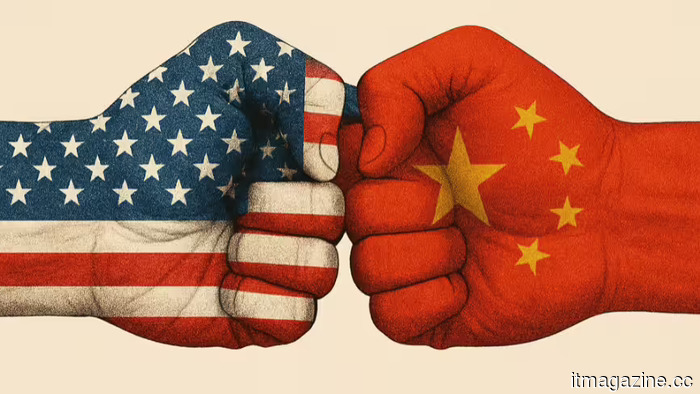 The United States aims to restrict China's access to chip manufacturing equipment. In response, China claims that this move will disrupt the supply chain for all parties involved.
China cautions that the MATCH Act could disturb global chip supply chains as the U.S. Congress moves forward with the most extensive export control markup in history.
Sequoia distributes 200 engraved Mac Minis at an AI event as OpenClaw emerges as the infrastructure layer that VCs cannot possess.
Alfred Lin distributed 200 engraved Mac Minis that operate on OpenClaw, the open-source AI agent framework that has surpassed Apple's stock in sales and outperformed React on GitHub. Sequoia is unable to invest in it. That's the approach.
The United States aims to restrict China's access to chip manufacturing equipment. In response, China claims that this move will disrupt the supply chain for all parties involved.
China cautions that the MATCH Act could disturb global chip supply chains as the U.S. Congress moves forward with the most extensive export control markup in history.
Sequoia distributes 200 engraved Mac Minis at an AI event as OpenClaw emerges as the infrastructure layer that VCs cannot possess.
Alfred Lin distributed 200 engraved Mac Minis that operate on OpenClaw, the open-source AI agent framework that has surpassed Apple's stock in sales and outperformed React on GitHub. Sequoia is unable to invest in it. That's the approach.
 AI stocks compared to the dot-com bubble: CAPE ratio at 38, concentration exceeds levels seen in 2000, but these companies are genuinely profitable.
The Shiller CAPE stands between 38 and 40, only surpassed by the dot-com peak of 44.19. The concentration in the top 10 exceeds levels seen in 2000. However, Nvidia generated $120 billion, and tech stocks are trading at 30 times earnings, not 50 times. Both perspectives hold validity.
AI stocks compared to the dot-com bubble: CAPE ratio at 38, concentration exceeds levels seen in 2000, but these companies are genuinely profitable.
The Shiller CAPE stands between 38 and 40, only surpassed by the dot-com peak of 44.19. The concentration in the top 10 exceeds levels seen in 2000. However, Nvidia generated $120 billion, and tech stocks are trading at 30 times earnings, not 50 times. Both perspectives hold validity.
 I'm still using the original Switch in 2026. It simply works since everything else has become too complicated.
The original Switch from Nintendo may be less powerful than current handheld devices, but by 2026, its straightforwardness seems less of a drawback and more like a key feature.
I'm still using the original Switch in 2026. It simply works since everything else has become too complicated.
The original Switch from Nintendo may be less powerful than current handheld devices, but by 2026, its straightforwardness seems less of a drawback and more like a key feature.
 NotebookLM now has the ability to automatically arrange your research sources.
Google has introduced automatic source labeling and categorization for NotebookLM. This feature activates automatically when you have five or more sources in a notebook.
NotebookLM now has the ability to automatically arrange your research sources.
Google has introduced automatic source labeling and categorization for NotebookLM. This feature activates automatically when you have five or more sources in a notebook.
Foundation Future Industries secures $24 million contracts from the Pentagon for humanoid robot soldiers, with support from Eric Trump and trialed in Ukraine.
Foundation Future Industries has obtained $24 million in Pentagon contracts for humanoid robots that were tested in Ukraine. The company's CEO previously led a bankrupt fintech, an adviser to the firm is Eric Trump, and it is seeking $500 million at a valuation exceeding $3 billion.