
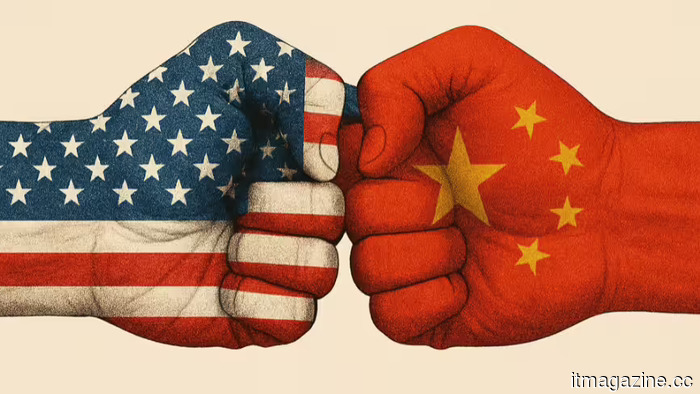
The United States aims to restrict China's access to chip manufacturing equipment. In response, China claims that this move will disrupt the supply chain for all parties involved.
**TL;DR** China's Ministry of Commerce cautioned that US chip export legislation could "severely disrupt" global semiconductor supply chains in response to the House Foreign Affairs Committee's April 22 markup of over 20 export control bills, marking the largest such action in congressional history. The main focus is the MATCH Act, which would obligate the Netherlands and Japan to synchronize DUV lithography export limitations with US regulations within 150 days or face unilateral measures, potentially halting ASML's remaining sales to China and prohibiting maintenance on existing machines. China has already implemented wide-ranging supply chain security regulations and rare earth restrictions, while the US simultaneously builds domestic capacity through investments from the CHIPS Act and the $25 billion Terafab project.
On Friday, China's Ministry of Commerce stated that the US legislation progressing in Congress would "severely disrupt the international economic and trade order and significantly undermine the stability of the global semiconductor industry chain and supply chain." The legislation at issue is the MATCH Act, which passed the House Foreign Affairs Committee on April 22, described by lawmakers as the largest markup on semiconductor export controls in congressional history. This bill requires the Netherlands and Japan to align their chip equipment export restrictions with US rules within 150 days or face unilateral enforcement, including an expanded Foreign Direct Product Rule that would give the US jurisdiction over equipment containing American technology, regardless of its production location. If passed, the MATCH Act would restrict China’s access to DUV immersion lithography machines provided by ASML and would prohibit servicing existing machines, impacting every advanced and near-advanced fabrication facility in China.
The Markup
The House Foreign Affairs Committee advanced over 20 export control bills on April 22, led by Representative Brian Mast. The MATCH Act, introduced by Representative Michael Baumgartner on April 2, has garnered bipartisan backing in both chambers. Senators Jim Risch, Pete Ricketts, Andy Kim, and Chuck Schumer introduced a Senate counterpart on April 8. This bill designates SMIC, Huawei, Hua Hong, CXMT, and YMTC as "covered facilities," encompassing all subsidiaries and affiliates, and would bar the export of DUV immersion lithography machines to these entities. It would also prevent allied companies from offering engineering services to maintain or upgrade machines already functioning in Chinese fabs, which would degrade existing capacity over time as these machines need regular upkeep for optimal yield.
The committee also advanced the Chip Security Act, mandating that advanced chips incorporate location verification systems before export, enabling exporters to alert the government if a chip reaches an unauthorized destination. The Semiconductor Industry Association opposes this aspect, cautioning against "untested and potentially unfeasible on-chip mechanisms" that could damage global trust in American semiconductors. The ECRA Penalty Increase Act would increase civil penalties for export violations fourfold, raising the maximum penalty per violation from $300,000 to $1.2 million. The ECRA Statute of Limitations Extension Act would extend the prosecutorial timeframe from five to ten years. The Deterring American AI Model Theft Act would empower sanctions against Chinese AI companies accused of misusing US-developed models. An instance of smuggling $2.5 billion worth of Nvidia servers to China, allegedly by Super Micro Computer’s co-founder through a diversion route via Southeast Asia, underscores the demand for restricted chips and highlights the limitations of an enforcement system reliant on declared end-use and corporate compliance.
The Escalation
The MATCH Act represents a major escalation in US semiconductor export controls since initial limitations imposed in October 2022. Those rules banned the export of advanced computing chips and chipmaking equipment to China, were updated in October 2023 to fix loopholes, expanded in December 2024 to include high-bandwidth memory and further equipment, and supplemented in January 2026 when the Trump administration enforced a 25% Section 232 tariff on advanced semiconductor imports while shifting Nvidia’s H200 and AMD’s MI325X from a default denial to case-by-case evaluations. Blackwell-class chips remain under default denial. The January 2026 adjustments were partly in response to Nvidia's CEO Jensen Huang, who argued that excessively stringent controls could drive Chinese AI labs to develop domestic alternatives. Huang has stated that switching to DeepSeek’s AI models designed for Huawei chips instead of Nvidia hardware would be "a horrible outcome" for the United States, as it would sever the software dependency on Nvidia’s CUDA ecosystem, which currently provides a competitive edge to American chips.
The MATCH Act departs from the relaxation of restrictions seen in January. While the executive branch eased limitations on finished chips, Congress is tightening controls on the machinery used to fabricate them. The reasoning is that regulating equipment is more effective than controlling chips, given that a lithography machine is a $200 million tool requiring years of maintenance from the manufacturer, whereas a chip is a commodity easily rerouted through intermediaries. Since the bill's introduction, ASML, the exclusive producer of both EUV and advanced D
Other articles
 Beijing issues a warning to the EU following the inclusion of 27 Chinese companies in the 20th sanctions package against Russia and responds by taking action against European defense firms.
China criticized the European Union's 20th sanctions package, which affects 27 Chinese entities, and responded within a day by targeting seven EU defense companies. Europe's rearmament relies on the rare earth materials that Beijing possesses.
Beijing issues a warning to the EU following the inclusion of 27 Chinese companies in the 20th sanctions package against Russia and responds by taking action against European defense firms.
China criticized the European Union's 20th sanctions package, which affects 27 Chinese entities, and responded within a day by targeting seven EU defense companies. Europe's rearmament relies on the rare earth materials that Beijing possesses.
 Sam Altman has issued an apology following OpenAI's decision not to report a ChatGPT user involved in the Tumbler Ridge school shooting.
Eight months prior to the attack, OpenAI marked the ChatGPT account of the Tumbler Ridge shooter as a concern. Staff suggested notifying law enforcement, but their recommendations were dismissed by management. Altman's apology cannot bridge this gap.
Sequoia hands out 200 engraved Mac Minis at an AI event as OpenClaw establishes itself as the infrastructure layer that VCs cannot possess.
Alfred Lin distributed 200 engraved Mac Minis equipped with OpenClaw, the open-source AI agent framework that has outperformed Apple's inventory and exceeded React's popularity on GitHub. Sequoia is unable to invest in it. That’s the approach.
Sam Altman has issued an apology following OpenAI's decision not to report a ChatGPT user involved in the Tumbler Ridge school shooting.
Eight months prior to the attack, OpenAI marked the ChatGPT account of the Tumbler Ridge shooter as a concern. Staff suggested notifying law enforcement, but their recommendations were dismissed by management. Altman's apology cannot bridge this gap.
Sequoia hands out 200 engraved Mac Minis at an AI event as OpenClaw establishes itself as the infrastructure layer that VCs cannot possess.
Alfred Lin distributed 200 engraved Mac Minis equipped with OpenClaw, the open-source AI agent framework that has outperformed Apple's inventory and exceeded React's popularity on GitHub. Sequoia is unable to invest in it. That’s the approach.
 Oracle's $16.3 billion financing for data centers needed PIMCO to step in and provide $10 billion after U.S. banks withdrew.
PIMCO acquired $10 billion of Oracle's unprecedented $16.3 billion data center bond offering after U.S. banks stepped back. The Michigan campus is included in the $72 billion Stargate infrastructure debt, which has a maturity of 19.5 years.
Oracle's $16.3 billion financing for data centers needed PIMCO to step in and provide $10 billion after U.S. banks withdrew.
PIMCO acquired $10 billion of Oracle's unprecedented $16.3 billion data center bond offering after U.S. banks stepped back. The Michigan campus is included in the $72 billion Stargate infrastructure debt, which has a maturity of 19.5 years.
 China establishes protections for gig workers, covering 200 million platform employees, with a focus on algorithm transparency and a deadline set for 2027.
China's top governing authorities have established regulations for over 200 million gig workers, including minimum wage, maximum working hours, and the need for algorithm transparency. Delivery apps are required to halt order assignments once drivers reach their time limits. Full compliance is expected by 2027.
China establishes protections for gig workers, covering 200 million platform employees, with a focus on algorithm transparency and a deadline set for 2027.
China's top governing authorities have established regulations for over 200 million gig workers, including minimum wage, maximum working hours, and the need for algorithm transparency. Delivery apps are required to halt order assignments once drivers reach their time limits. Full compliance is expected by 2027.
The United States aims to restrict China's access to chip manufacturing equipment. In response, China claims that this move will disrupt the supply chain for all parties involved.
China cautions that the MATCH Act could disturb global chip supply chains as the U.S. Congress moves forward with the most extensive export control markup in history.