
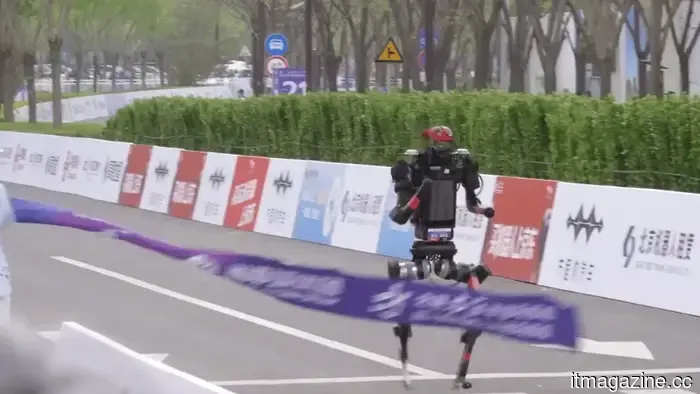
A humanoid robot surpassed the human half-marathon world record by 7 minutes during a race in Beijing that featured 112 teams.
A humanoid robot called Lightning finished the Beijing E-Town Half-Marathon today in 50 minutes and 26 seconds, surpassing the human world record by nearly seven minutes. Developed by Shenzhen Honor Smart Technology Development Co., the robot autonomously covered the 21-kilometre route without remote control, utilizing multi-sensor fusion and real-time decision-making algorithms. A second Lightning unit, which was remotely controlled, completed the race even more quickly in 48 minutes and 19 seconds. The human half-marathon world record, set by Uganda's Jacob Kiplimo in Lisbon on March 8, stands at 57 minutes and 20 seconds.
Both robots and approximately 12,000 human runners followed the same path but competed in different lanes. The human race was won by Zhao Haijie of China, who completed it in 1 hour, 7 minutes, and 47 seconds. The robot race was led by a machine that is 169 centimetres tall and has a leg length of 95 centimetres, designed to emulate elite human runners. It generates a peak torque of 400 newton-metres and features a proprietary liquid cooling system with a heat exchange flow rate exceeding four litres per minute, technology derived from Honor’s smartphone division.
The scale of the event has evolved significantly. This was the second edition of the Robot World Humanoid Robot Games Half-Marathon, co-organized by the Beijing Municipal People’s Government and China Media Group. The inaugural event last year was fraught with issues, with only six out of 21 robotic runners finishing. Many stumbled, lost control, or failed to start. The winning robot, Tiangong Ultra, finished in 2 hours, 40 minutes, and 42 seconds.
The 2026 edition was markedly different, featuring 112 teams from 26 brands and over 300 individual robots, including five international teams from Germany, France, and Brazil. About 40% of the teams participated in the autonomous navigation category, where robots had to navigate the course without human intervention. Remote-controlled teams had their net times adjusted with a coefficient of 1.2, a 20% penalty designed to promote autonomous capabilities. All three top finishers in the autonomous category were Honor robots, and their times all exceeded the human world record.
The progress from 2025 to 2026 is notable, improving from six finishers out of 21 to over 100 teams with autonomous navigation capabilities. This reflects a year-over-year advancement that enhances the event's significance beyond mere spectacle. Lightning did experience a collision with a barrier near the finish line and fell, needing assistance to get back up before completing the race. Another robot fell at the start line, yet such failures were exceptions rather than the rule, marking a shift from the previous year.
Honor, the smartphone company that separated from Huawei in 2020, is the first major mobile phone brand to venture into humanoid robotics. They introduced their humanoid robot program at the Mobile World Congress on March 1 and pledged $10 billion over five years for AI development. The company claims that Lightning's speed of four metres per second is 14% quicker than Boston Dynamics’ Atlas. The entire journey from development to marathon participation took just one year.
Engineer Du Xiaodi, part of Honor's winning team, highlighted the competition's importance for technology transfer: “In the future, some of these technologies may be adapted for other sectors. For instance, advancements in structural reliability and liquid cooling could be utilized in upcoming industrial environments.” The race serves as a catalyst for improving locomotion, balance, navigation, and endurance—qualities that are also needed in factories, construction sites, and possibly domestic settings.
The marathon serves as a platform for showcasing an industry that China is developing through the same coordinated state investment strategies it previously applied to electric vehicles and solar energy. The 15th Five-Year Plan, which spans 2026 to 2030, designates robotics and “embodied intelligence” among the country's top ten “new industry tracks.” The government has committed a one-trillion-yuan ($138 billion) state-backed fund to support humanoid robots, industrial automation, and embodied AI. In February, the Ministry of Industry and Information Technology released the “Humanoid Robot and Embodied Intelligence Standard System,” created by over 120 research institutions and manufacturers, with plans to align Chinese standards with ISO and IEC international benchmarks by 2028.
The MIIT characterizes humanoid robots as “the next groundbreaking innovation following computers, smartphones, and new-energy vehicles.” The industry is expected to surpass 20 billion yuan ($2.8 billion) in scale by the end of the year. Chinese firms currently dominate production, with AGIBOT shipping over 5,000 units in 2025, Unitree Robotics delivering 5,500, and UBTech dispatching more than 1,000 with plans to reach 5,000 this year and 10,000
Other articles
 Steam is essentially a monopoly in the PC gaming market, so why isn't there any outrage?
Open any gaming PC, and you're likely to find the blue Steam icon prominently displayed on the desktop. It's not tucked away, nor is it merely an option; it's almost a given. Over time, Steam has evolved from being simply another launcher to becoming the primary storefront for PC gaming, effectively integrated into the overall experience. The Monopoly Nobody [...]
Steam is essentially a monopoly in the PC gaming market, so why isn't there any outrage?
Open any gaming PC, and you're likely to find the blue Steam icon prominently displayed on the desktop. It's not tucked away, nor is it merely an option; it's almost a given. Over time, Steam has evolved from being simply another launcher to becoming the primary storefront for PC gaming, effectively integrated into the overall experience. The Monopoly Nobody [...]
 As if the situation wasn't challenging enough, AI is set to exacerbate the global e-waste problem.
The expansion of AI may result in an additional 5 million metric tons of electronic waste by 2030, due to swift hardware upgrades and the growth of data centers elevating environmental effects.
As if the situation wasn't challenging enough, AI is set to exacerbate the global e-waste problem.
The expansion of AI may result in an additional 5 million metric tons of electronic waste by 2030, due to swift hardware upgrades and the growth of data centers elevating environmental effects.
 As if the situation wasn't already dire, AI is set to exacerbate the global e-waste crisis.
The expansion of AI may result in up to 5 million metric tons of electronic waste by 2030, as swift hardware enhancements and the growth of data centers elevate environmental consequences.
As if the situation wasn't already dire, AI is set to exacerbate the global e-waste crisis.
The expansion of AI may result in up to 5 million metric tons of electronic waste by 2030, as swift hardware enhancements and the growth of data centers elevate environmental consequences.
 Steam essentially operates as a monopoly in the PC gaming market, so why isn't there any outrage?
Open any gaming PC, and it's likely that the blue Steam icon is prominently displayed on the desktop. It's not concealed, nor is it a choice—it's nearly a given. Over the years, Steam has evolved from merely another launcher to the primary marketplace for PC gaming, functioning almost as an integral aspect of the experience. The Monopoly Nobody […]
Steam essentially operates as a monopoly in the PC gaming market, so why isn't there any outrage?
Open any gaming PC, and it's likely that the blue Steam icon is prominently displayed on the desktop. It's not concealed, nor is it a choice—it's nearly a given. Over the years, Steam has evolved from merely another launcher to the primary marketplace for PC gaming, functioning almost as an integral aspect of the experience. The Monopoly Nobody […]
 A Google Pixel laptop could be in development, but is there really a demand for it?
A new Google Pixel laptop may be under development, but historical trends, increasing hardware expenses, and the $599 MacBook Neo indicate that it could face an unpromising launch.
A Google Pixel laptop could be in development, but is there really a demand for it?
A new Google Pixel laptop may be under development, but historical trends, increasing hardware expenses, and the $599 MacBook Neo indicate that it could face an unpromising launch.
 Trump's efforts to prevent state regulation of AI are encountering opposition from both states and Congress.
The White House rejected an AI safety bill proposed by a Republican from Utah and established a DOJ task force to contest state regulations, yet Congress voted 99-1 in favor of opposing AI preemption.
Trump's efforts to prevent state regulation of AI are encountering opposition from both states and Congress.
The White House rejected an AI safety bill proposed by a Republican from Utah and established a DOJ task force to contest state regulations, yet Congress voted 99-1 in favor of opposing AI preemption.
A humanoid robot surpassed the human half-marathon world record by 7 minutes during a race in Beijing that featured 112 teams.
Honor's Lightning robot finished the Beijing half-marathon in a time of 50:26, surpassing the human record of 57:20, while 112 teams and over 300 robots highlighted China's $138 billion humanoid industry.